
Digital transformation and big data: Optimizing the digital journey in the pharmaceutical industry
Optimizing the digital journey in the pharmaceutical industry has become a priority for companies seeking to stand out in an increasingly digitalized market.
21 de março de 2023
Optimizing the digital journey in the pharmaceutical industry has become a priority for companies seeking to stand out in an increasingly digitalized market.
The global increase in consumer digital interaction with health services and medications is causing a significant transformation in the pharmaceutical industry.
Easy and quick access to health information and pharmaceutical companies at the palm of one’s hand has changed how consumers research medications and interact with the sector.
To keep up with these changes, it is essential that pharmaceutical companies are digitally prepared and understand the steps necessary to achieve their goals in the digital world.
In this context, digital transformation and the use of big data are essential tools for optimizing consumers’ digital journey in the pharmaceutical industry.
In this article, we will explore how digital transformation and big data impact the optimization of the digital journey in the pharmaceutical industry. Additionally, we will highlight how companies can leverage these technologies to overcome challenges and achieve significant results in an increasingly competitive market.
Follow along and discover how the digital journey can be a differentiator for your pharmaceutical company.
The importance of digital transformation and big data in the pharmaceutical industry
A company with digital maturity has more competitive advantage in the market and most often presents better business results.
But how many companies are truly creating an efficient digital journey process?
It is a reality that the pharmaceutical sector still faces significant challenges in terms of time, resources and costs related to its processes, from research and development of new drugs to distribution, sales and customer loyalty.
One of the main problems currently faced is how to optimize the digital journey in pharmaceutical companies, in order to increase efficiency and reduce costs. In these conditions, digital transformation and big data can play a crucial role in optimizing the digital journey. On the other hand, many companies have not yet fully explored their potential.
Companies that choose not to invest in these two areas may miss opportunities to:
- Improve efficiency;
- Accelerate the drug approval process;
- Increase treatment effectiveness and
- Improve patient experience.
According to Deloitte, many pharmaceutical companies are still stuck with legacy systems and manual processes that are slow and inefficient.
Manual techniques and analog systems can lead to delays in drug development, increased costs and, ultimately, loss of business opportunities.
In addition, the lack of adoption of digital technologies can result in a negative patient experience, leading to loss of customer loyalty and trust.
Forbes also highlights that companies not taking advantage of digital technologies risk missing the opportunity to improve efficiency and reduce costs.
Digital transformation can help pharmaceutical companies improve productivity and increase product quality, and still generate a significant improvement in patient experience, which can increase customer loyalty and consequently become a competitive advantage.
Companies that have difficulty starting or making digital transformation functional usually make the following mistakes:
- They see digital transformation and IT companies, digital service providers as a secondary investment.
- They work with several business partners, each with a part of the overall process, with no communication between teams.
- The areas that need to be involved in digital transformation are not integrated, and each takes care of its own “process”.
It is important that the CEO, CTO, Heads of technology and leaders of the digital transformation process are aligned and mature to follow this journey.
How to generate competitive advantages with the correct use of data and integration of emerging technologies
Emerging technologies and the use of data are fundamental to optimizing the digital journey of the pharmaceutical industry.
One of the main reasons for the lack of adoption of these technologies is the lack of knowledge and resources needed to implement them. We can witness in the pharma sector:
- Companies stuck with legacy systems and manual processes that are slow and inefficient;
- Lack of integration between systems and data sources, which hinder obtaining valuable insights and decision-making.
These organizations are increasingly moving away from the essential technological trends needed to compete in today’s market.

Emerging technology trends for the pharmaceutical sector and how to use them
There are several types of emerging technologies that can be used in the pharmaceutical industry to improve the efficiency and effectiveness of sector processes. The most appropriate choice will depend on the specific needs of each company, as well as its budget and available resources.
Some trends are at the center of discussions:
IT as a business driver
Nowadays, IT is increasingly being seen as a cross-functional area to businesses, integrated into all areas of the company.
The role of IT in pharmaceutical companies is changing from an infrastructure approach to a product-oriented and stakeholder-needs-oriented approach.
This change in perspective can be seen as a market trend, with a focus on more product-oriented approaches.
Integration of Platforms and Legacy Systems
The integration of platforms and legacy systems is necessary for all data to communicate with each other.
This integration can generate value for the industry, as it allows greater connectivity, development of different applications and new synergies between areas that were not previously possible.
The integration of manufacturing with logistics and sales can generate a range of powerful insights for the sector. There is also a preparation of the sector for the challenges of open data, where data tends to be shared in real time.
Data and Artificial Intelligence at the center of strategic decisions
The trend is to have a growing conjunction of data available in the industry, with specific applications that support better direction of the sales force and decision-making in various areas, including research, development, manufacturing and logistics.
The use of artificial intelligence helps accelerate the analysis of large volumes of data and offers valuable insights for decision-making.
Internet of Things (IoT) in the supply chain
The use of IoT devices in the supply chain has been shown as a growing trend in the pharmaceutical industry.
This technology allows monitoring and tracking of medications from their production to final consumption by the patient, ensuring product quality and safety.
With IoT, the pharmaceutical industry can have a complete and real-time view of the entire supply chain, enabling better resource management and cost reduction.
Telemedicine and Digital Health
The pandemic accelerated the adoption of telemedicine technologies, and this trend should continue in 2023 in the pharmaceutical industry.
With telemedicine, patients can receive medical care remotely, reducing travel time and cost to patients and hospitals.
Telemedicine can be applied in prevention and monitoring programs for chronic diseases, for example, through mobile applications that allow symptom tracking and information exchange with healthcare professionals.
These technologies can bring benefits to both patients and pharmaceutical companies, which can develop more personalized products and services for their customers.
Superapps at the center of digital sales
The term “superapp” refers to an application that offers multiple functions and services, usually integrated, in a single location.
These applications tend to be popular in Asian countries, such as China, Singapore and Indonesia, and are becoming increasingly common in other parts of the world, such as Brazil
In the pharmaceutical industry, superapps can be used in several ways, including:
1. Medication delivery: some health superapps offer medication delivery services, allowing patients to request and receive their medications without leaving home. This is especially useful for elderly patients or those with reduced mobility.
2. Health monitoring: some super apps allow patients to monitor their health, for example, measuring their blood sugar levels or blood pressure, and sharing this information with their doctors in real time.
3. Appointment scheduling: superapps can also be used to schedule doctor appointments or book exams, allowing patients to avoid queues and waiting time.
4. Patient education: many health super apps provide information and resources to help patients better manage their health, including tips on healthy eating and physical exercise
These integrated applications can include medication prescription services, medication delivery, online medical consultations, loyalty programs and other health-related functionalities.
Superapps have the potential to improve the efficiency of health services, allowing patients to better manage their health conditions and simplifying the process of distributing medications and treatments.
In addition, offering a more personalized experience for users, providing information about specific medications and treatments, based on their medical and personal history.
Decentralized innovation to optimize the digital journey
Decentralized innovation is a business model that allows companies to adapt quickly to market changes and respond more agilely to challenges.
Digital transformation is a process that involves the integration of emerging technologies in all areas of the company, from product development to service delivery.
This integration allows the collection and analysis of large volumes of data, enabling better decision-making and the development of more efficient strategies.
Some of the solutions indicated in this process are:
Integration Development
Systems integration is a growing need for companies undergoing digital transformation. Connectivity between legacy systems, suppliers, partners and customers is fundamental to business success, and lack of integration can lead to communication errors and loss of efficiency.
By designing and applying strategies for legacy systems integration with API & Middleware concepts, it is possible to ensure system connectivity in a secure and efficient way.
By working with a company specialized in integration development, like ours, clients can benefit from a personalized and tailored approach to their needs.
Having a technology partner that helps understand your company’s demands and workflows and designs integration solutions that meet these needs is crucial for positive business results.
API & Middleware enable the creation of a flexible and scalable infrastructure that guarantees security and optimized governance of integrations. This means that clients can focus on their core businesses, while the technology partner takes care of their systems integration.
With a successful integration approach, the company can benefit from:
- greater operational efficiency,
- better communication between systems and
- better customer service.
Automation & Improvement
Achieving business goals becomes easier through the development and improvement of processes based on opportunity mapping and task and activity automation.
By analyzing business processes, it is possible to identify areas where automation can be applied to reduce labor usage, reduce process times and increase reliability.
With task and activity automation, your company can save time and resources, allowing it to focus on higher value-added activities.
We can also highlight that automation can also help reduce human errors and increase process reliability.
By opting for this Zappts solution, pharmaceutical companies can expect a collaborative and personalized approach to improving their business processes.
Digital channels
Companies need to be present on multiple digital channels to communicate with their customers and other stakeholders in the production chain. However, simply being present on multiple channels is not enough. It is necessary to develop, optimize and integrate these channels to strengthen relationships with stakeholders and provide memorable digital experiences.
By using omnichannel applications, it becomes possible to create consistent and personalized experiences across all digital channels, from the website to social media and mobile applications.
Industry Data & BI
With the growing amount of data available to companies, it is essential to have data architecture and Business Intelligence (BI) solutions to obtain valuable insights and make informed decisions.
Today there is a variety of data and BI services to help companies make the most of their data, such as:
- Data Lake Architecture,
- Parallel Data Processing (Hadoop),
- Pipeline development,
- Business Intelligence and Analytics,
- Indicator Modeling and dashboard management, Data storytelling (data driven decisions)
In the pharmaceutical sector, data architecture and BI allow information to be captured, transformed and loaded into BI systems for analysis. This model allows indicator modeling and dashboard management.

How to optimize the relationship with doctors and patients in the pharmaceutical sector?
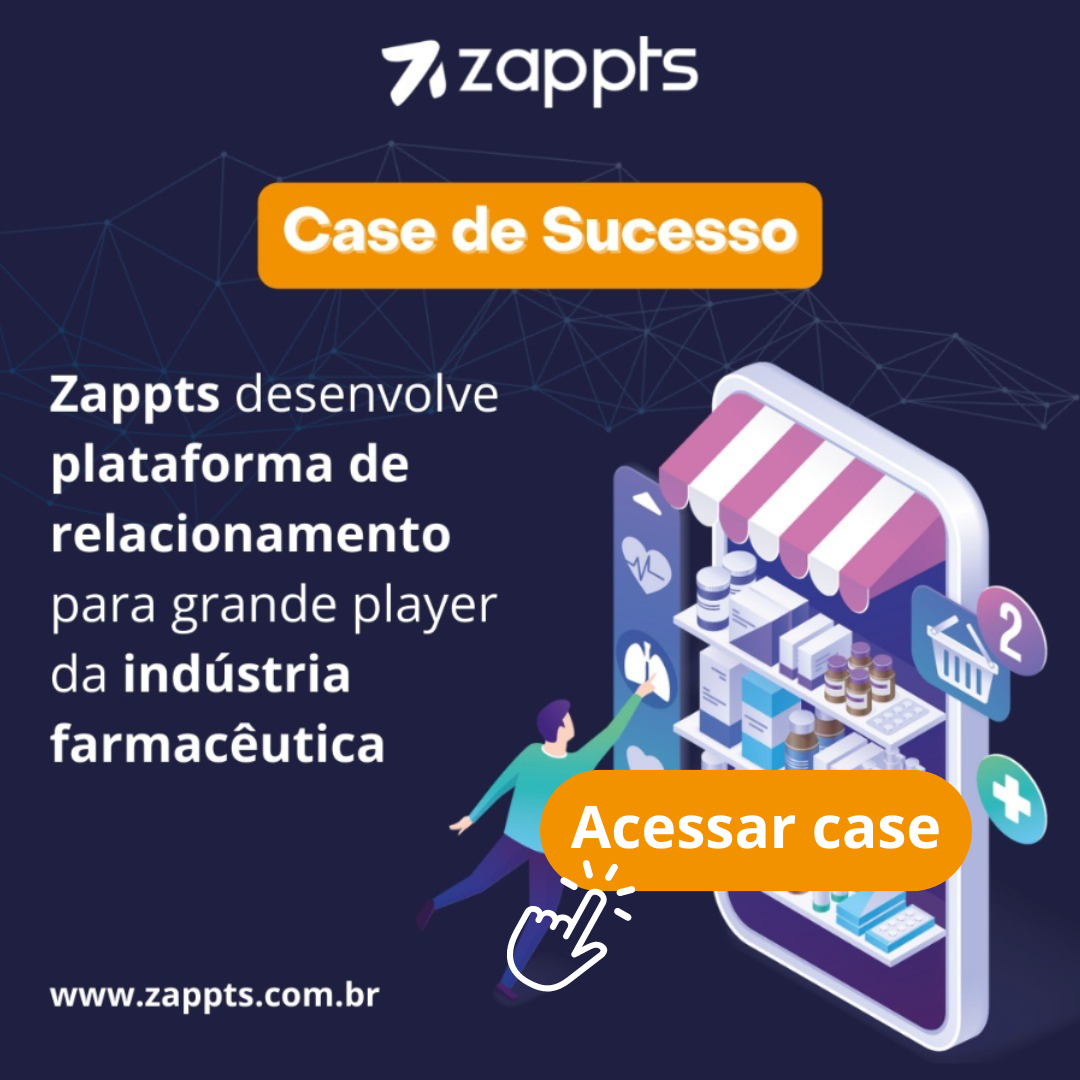
A major pharmaceutical company sought Zappts to solve this challenge. Through a digital platform, doctors can access exclusive content about the brand’s products and their training specialty or others of interest, all categorized according to the medical area. Zappts was responsible for the entire process, from technology validation to final delivery in the development environment. In just two weeks, it was possible to identify customer pain points and expectations in a Design Sprint. Next, the prototyping phase was adapted to the client’s reality, bringing the best solution and experience to users. The MVP was delivered in just over two months, at the end of 2022, and is currently being tested by the brand’s end users. The client praised the excellent relationship and the speed of solution delivery.
To learn more about this success story, click here.
Conclusion
In summary, digital transformation is a reality in the pharmaceutical industry and lack of adaptation can result in loss of competitiveness.
The adoption of digital transformation combined with Big Data is an effective strategy to accelerate the digital transformation process in companies.
The situations and solutions discussed here, such as artificial intelligence and Big Data, can transform how the pharmaceutical industry operates. An information technology company will undoubtedly be your best partner on this journey with personalized and innovative solutions.
Digital transformation will bring significant changes to the way products are developed, marketed and delivered, improving patient experience and driving the success of pharmaceutical companies.
Zappts is a company that accelerates the digital transformation of major market brands, enhancing assertive decision-making through the use of data and integration of emerging technologies efficiently and effectively.
Through a personalized approach and a wide range of technology consulting and implementation services, we help your company optimize its processes, improve its efficiency and obtain more consistent results.
About Zappts
Since 2014 in the market, Zappts supports leading brands in their markets, such as Porto, Getnet, BTG Pactual, Cateno, Ambev, Multilaser, Ultragaz, C&A and Burger King, among others. Focused on software development, especially in Front-end, UX Design, Quality Assurance and Cloud Environment Management, it operates in the planning, management and operation of corporate digital solution development services, environment management and knowledge transfer through information technology.
We are a reference company in creating digital experiences for users, in addition to developing innovative and fast solutions, we operate in a 100% remote model, with teams distributed across more than 18 states in Brazil.
To learn more about how Zappts can help your company, click here, and get a free assessment with our pharma sector tech consultants.
Share this article
Related articles

16 set 2026
The End of Passive SaaS: Why You’ll Pay for Outcomes, Not Seats
The traditional software pricing model based on per-user licenses (seat-based SaaS) faces an inevitable decline in 2026.

09 set 2026
The Timid Autonomy Dilemma: Why Keeping AI in a Suggestion-Only Role Is Killing Your Margins
This article analyzes the financial impact of this "timid autonomy" and advocates for an urgent shift to the "Human-on-the-loop" (HOTL) model.

02 set 2026
The "SaaSocalypse" is actually an architecture and identity crisis.
This article reverse-engineers a real-world success story (anonymized) from the financial sector, dissecting the layers of...