
The New Normal and the New IT Professional
Digital Transformation, challenges and opportunities: understand the new reality for technology professionals By Roque Sales, CX & UX Manager at Zappts The new landscape for IT professionals presents challenges and opportunities, both for those already working and those who wish to enter the field. All due to the accelerated advances…
6 de julho de 2020
Digital Transformation, challenges and opportunities: understand the new reality for technology professionals
By Roque Sales, CX & UX Manager at Zappts

The new landscape for IT professionals presents challenges and opportunities, both for those already working and those who wish to enter the field.
All due to the accelerated advances in Digital Transformation, which drives the creation of interactive business solutions, optimizing the user experience with practical and secure applications.
In this context, the “new normal” is directly related to what IT companies expect from professionals and how they are directing their activities toward excellence, something that will consequently require specific and multidisciplinary competencies.
The New Normal and the New IT Professional
This article addresses the following topics:
- The new job market being shaped by Digital Transformation;
- The challenges of continuous learning;
- Theory U and Bloom’s Taxonomy;
- Changes in the IT field and opportunities.
Sharing knowledge, experiences, and perspectives. Amid so many developments in the digital universe, it is essential to stay updated and ready to work in an increasingly technological and multifaceted landscape.
The New Normal
Several events have accelerated Digital Transformation in companies, such as the advancement of technology itself, the development of applications, and the growth of e-commerce — these are just a few factors that make up what many are calling “the new normal”.
But this concept gained strength in the first half of 2020, due to the impacts of the COVID-19 pandemic on all sectors of society. With social isolation as a measure to prevent the spread of the coronavirus, companies had to apply digital strategies for business continuity and employee safety.

The ways and means of work, business, and human interactions are being continuously modified, but it is through technology that these changes are accentuated, and therefore, the new normal presents itself as increasingly digital, interactive, and intuitive.
Before the COVID-19 pandemic, Home Office was already working for many companies, but studies indicate that remote work should grow up to 30% after the social isolation period and resumption of activities.
Thus, 100% Home Office companies are expected to emerge in the coming years or migrate to the remote model, as is the case with Twitter.
The social network’s CEO, Jack Dorsey, announced through an internal communication that the possibility of working from home will be permanent, even after the end of the COVID-19 pandemic.
And what is the importance of technology in all of this?
Technology is essential in this “new normal” that is taking shape, especially for companies, which need to keep their systems secure, reliable, and interactive to generate productivity and business.
During the COVID-19 pandemic, closed restaurants continued serving their customers through ordering and delivery apps. Schools had to adapt in-person classes to online, and offices started operating remotely — all through the use of digital channels, tools, and solutions.
The lessons learned from the Covid-19 crisis stem from practices resulting from Digital Transformation, “a business model used by organizations to adapt to digital, and in the implementation process, the organization becomes shaped by digital”.
According to a study led by Dell Technologies (2019), it is estimated that 85% of jobs that will exist in 2030 will be new, many professions will disappear, and according to interviewed business leaders, 84% expect their employees to be digital specialists, and 50% cannot imagine what the next 15 years of their segment will look like.
The report, published in 2017, indicates that society should enter a new phase of relationship with machines in the coming decades, and from this relationship, the main changes will be:
- Technology will function as an extension of people and will help manage everyday activities;
- Companies will use data-based technologies to seek talent with the right competencies around the world;
- People will have to learn in real time. Changes will be so rapid that new industries will be created, and thus, new competencies will be required.
Talking about the new normal also requires an approach to the professional who will work in the digital landscape, the challenges and opportunities that arise with the development of disruptive technologies and new ways of producing innovative and intuitive solutions.
The Challenges of Continuous Learning
The internet promotes access to knowledge by creating an environment that allows sharing knowledge through websites, social media, and digital channels.
On one hand, we have more conditions to learn by accessing content available on the Web; on the other, we need to filter the volume of information presented daily on the network.
Continuous learning is a culture focused on lifelong employability rather than lifelong employment.
In other words: with continuous learning, the professional invests in the training necessary to work in different positions and companies, developing personal and technical competencies throughout their career.
Therefore, continuous learning does not become a challenge due to a scarcity of content, but because of the need to identify new tools and practices aligned with the multidisciplinary and technological professional landscape.
To understand this reality, let’s look at an example: the new and old learning models.
In the old model, the teacher was the “holder of knowledge”, that is, a kind of channel for understanding theories, concepts, and consequently, the development of competencies.
With the advent of new technologies, communication media, and easy access to digital content, the teacher went from holder to mediator of the learning process, facilitating the connection of students to the learning network through innovative practices and experiences that bring practice closer to theory.
Theory U
Speaking of theory, you have certainly had contact with some study on learning and productivity, and as we are talking about the “new normal”, it is pertinent to share Theory U here, which comes directly in line with the subject of this article.
It was created by Otto Scharmer, an American economist and MIT professor. Otto developed a theory that provides paths to design and conduct deep collective learning processes in the face of uncertain scenarios, applicable to any type of organization, including at an individual level.
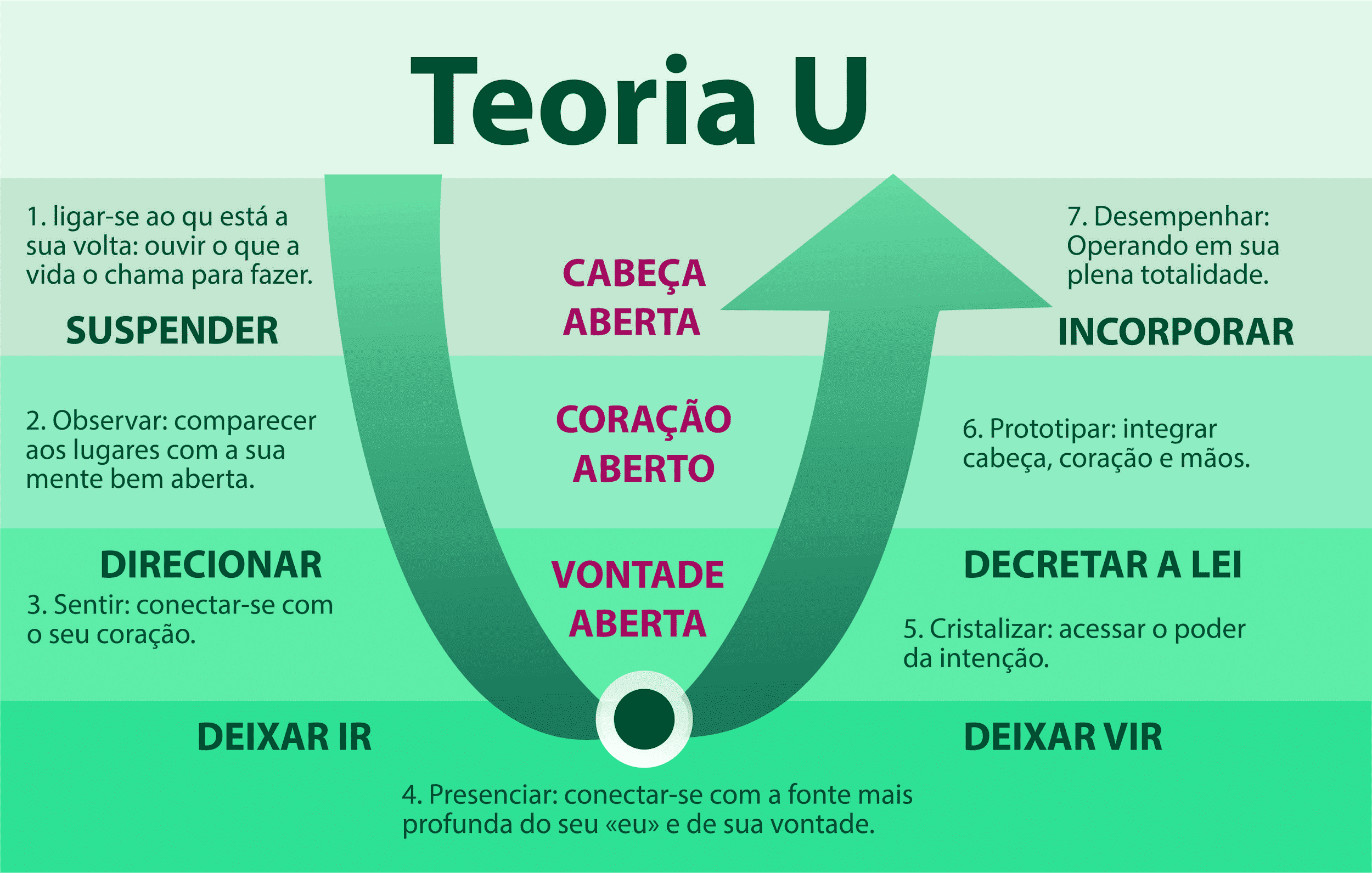
Essence of Theory U: “presence” + “sensing” = “the ability to sense and bring forth one’s best potential future”.
In the image below, we can see the seven steps of Theory U:
Source: Blueprint
Theory U is about a journey. In it, we move toward the external world to then connect with the internal world and develop the creation of a new world, based on clarity of purpose, productivity, and cooperation.
Bloom’s Taxonomy
Theory U is an excellent tool for connecting us with who we are through understanding our past, while simultaneously connecting with the future.
At a more “microscopic” level of understanding, Bloom’s Taxonomy of Knowledge can be an excellent tool for self-awareness.
It consists of a structure that hierarchically organizes educational objectives according to three main domains:
- Cognitive domain: knowledge, comprehension, and thinking about a problem or fact (application, analysis, synthesis, evaluation);
- Affective domain: deals with affective and empathy reactions (reception, response, valuation, organization, internalization of values);
- Psychomotor domain: deals with skills related to manipulating tools or objects (perception, guided response, complex responses, adaptation and organization).
In summary, Theory U and Bloom’s Taxonomy are related to defining purposes for learning and how the process of continuous knowledge acquisition can occur productively, connecting the individual to a path that “makes sense” so that transformation (in the best sense of the word) actually occurs.
Changes in the IT Field and Opportunities
The technology sector is in constant change, with the emergence of new work tools, agile processes, and innovative services.
This reality has increasingly demanded more from professionals: more knowledge, more skills, and more creativity — all linked to a landscape of challenges and many opportunities.
The boundaries between business and technology areas are becoming increasingly blurred, with Artificial Intelligence, Data Science, and IoT on the rise.
In addition to all these factors, we cannot fail to mention the constant evolution of Software Development, systems integration, and security, in more dynamic processes.
Speaking of changes and opportunities in the IT sector, we arrive at a fundamental point of discussion: the profile of the “most sought-after” professional. So, let’s start talking about soft skills.
Every profession requires specific technical competencies, which are acquired through study, project development, research, training, and many other processes.
However, it is very important that beyond this type of preparation, the professional also seeks to learn soft skills, which are skills and competencies related to human behavior.
Want an example of an extremely important soft skill for any field: emotional intelligence. Yes, knowing how to deal with your own emotions and use that energy productively are great differentiators for achieving goals, collaboration in teamwork, and stimulating creativity.
I just mentioned two more soft skills highly sought after in IT professionals (collaboration and creativity), so here are a few more that deserve attention and investment:
- Analytical thinking: the ability to suggest innovative solutions and ideas, in addition to solving complex problems through reasoning and logic.
- Leadership: related to the power to inspire and help others become better professionals, taking responsibility and discovering potential in teamwork.
- Diversity and cultural intelligence: respect and understanding of each individual’s uniqueness, seeking proximity to new cultures and worldviews.
Growth mindset, decision-making, communication, and adaptation are other soft skills highly valued in sectors characterized by teamwork and constant evolution. (IT fits perfectly in this scenario, doesn’t it?).
Another very significant change in the new landscape for IT professionals is working with Remote Squads, a way to expand production possibilities with teams made up of professionals from different cities, states, and countries, all working on the same projects.
An interesting fact is that companies increasingly have retention and attraction actions beyond salary and career plans, and therefore, they value employees who demonstrate a willingness to grow.
Thus, many benefits and conditions are offered, such as remote work, decompression environments, and experience-sharing events, which are enriching opportunities for those who are starting out and also for those who have know-how to share.
Finally, some tips for those preparing to enter the IT field or seeking new professional challenges, in the face of this new normal:
- Invest as much as possible in knowledge: be a multidisciplinary professional and be willing to keep learning;
- Organizational culture: understand differences in customs as something enriching and add to the team by bringing some of your academic background and other experiences in the professional environment;
- Develop creativity: the search for creative professionals is increasingly intense. All companies have problems, and solutions come from innovative ideas, born from the desire to make a difference combined with the purpose of adding value to the product or service developed.
Conclusion
As you can see, the new normal will demand more commitment and pursuit from the professional for qualification, preparation, and adaptation to the constant changes in the market, and the question I have to ask now is: Are you ready for this?
I hope you enjoyed this content and can use it as a guide in your professional journey, which will certainly have many challenges and great opportunities.
Check out the video on the topic discussed here “The New Normal and the New IT Professional”, and see you in the next article!
Share this article
Related articles
16 set 2026
The End of Passive SaaS: Why You’ll Pay for Outcomes, Not Seats
The traditional software pricing model based on per-user licenses (seat-based SaaS) faces an inevitable decline in 2026.
09 set 2026
The Timid Autonomy Dilemma: Why Keeping AI in a Suggestion-Only Role Is Killing Your Margins
This article analyzes the financial impact of this "timid autonomy" and advocates for an urgent shift to the "Human-on-the-loop" (HOTL) model.

02 set 2026
The "SaaSocalypse" is actually an architecture and identity crisis.
This article reverse-engineers a real-world success story (anonymized) from the financial sector, dissecting the layers of...