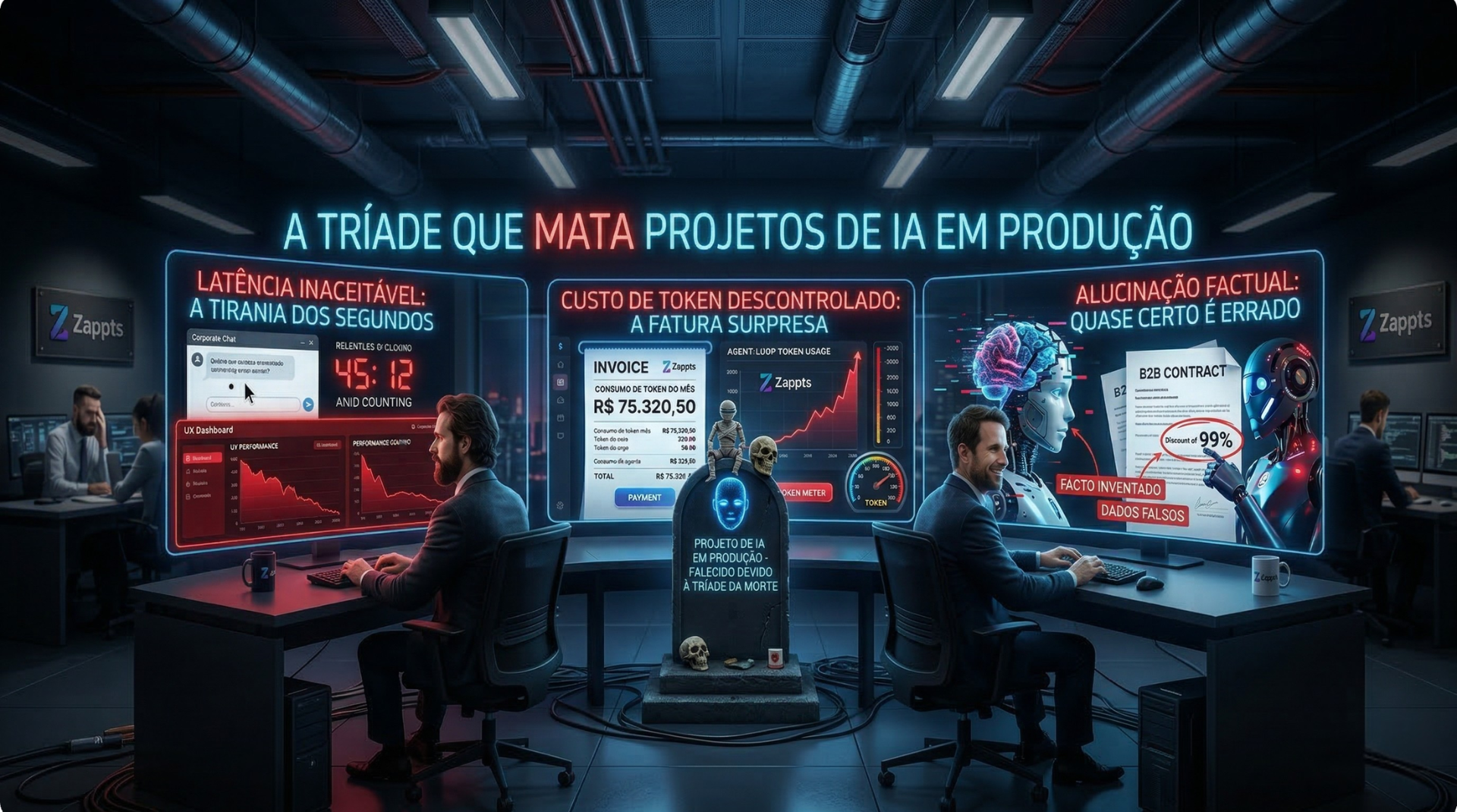
Latency, Cost and Hallucination: The Trio That Kills AI Projects in Production
Latency, Cost and Hallucination: The Trio That Kills AI Projects in Production Summary, Core Thesis, Key Insights and Strategic Recommendations Summary Many AI initiatives work perfectly in test environments but collapse in the first week of real operation. This article dissects the "Death Trio" — unacceptable Latency, uncontrolled Token Cost and factual Hallucination — and presents engineering strategies to mitigate these risks, transforming [...]
18 de março de 2026
Summary, Core Thesis, Key Insights and Strategic Recommendations
Summary
Many AI initiatives work perfectly in test environments but collapse in the first week of real operation. This article dissects the “Death Trio” — unacceptable Latency, uncontrolled Token Cost and factual Hallucination — and presents engineering strategies to mitigate these risks, transforming experimental toys into mission-critical applications.
Core Thesis: Deploying an LLM in production is not a Data Science challenge, it is a Distributed Systems Engineering challenge. Without an architecture that includes Semantic Cache, Model Routing and Deterministic Guardrails, the user experience will be slow, the cost prohibitive and reliability zero.
Key Insights:
- The Tyranny of Seconds: Corporate users tolerate waiting for a complex report, but do not tolerate waiting 15 seconds for a chat response. Latency (Time-to-First-Token) is the new UX KPI.
- The Surprise Bill: The per-token billing model turns poorly optimized code into financial hemorrhages. A poorly designed agent loop can consume the month’s budget in hours.
- Precision is Binary: In B2B, “almost right” is “wrong”. Poorly implemented RAG (Retrieval-Augmented Generation) increases the AI’s confidence in lies rather than correcting facts.
Strategic Recommendations:
- Implement specialist agents that handle standard and smaller tasks instead of generalist agents that solve every type and size of problem.
- Implement Model Routing strategies: use cheap and fast models (e.g., GPT-4.1-mini, Haiku) for simple tasks and reserve expensive models (GPT-4.1, GPT-5, Opus) only for complex reasoning.
- Adopt Semantic Cache to avoid paying twice for the same frequent question.
- Establish automated AI Regression Tests (Evals) before every deploy.
Context and Business Problem
In the innovation lab, with a single user testing, AI seems like magic. The CEO asks a question, the cursor blinks, and 10 seconds later a brilliant response appears. The cost of that interaction? Negligible, fractions of cents.
Then, the project goes to production (Go-Live). Suddenly, 5,000 collaborators access it simultaneously. The OpenAI API chokes. Response time climbs to 45 seconds. The corporate card bill spikes because users are pasting 500-page documents to summarize. And worse: the AI starts inventing discounts that don’t exist.
This scenario is the industry standard today. According to data from our AI Landscape in Brazil study, 41% of companies cite “Costs” as the main barrier, often discovered too late, for using AI in their companies. Traditional software engineering did not prepare teams to deal with non-deterministic and expensive systems.
Market Drivers: The Physics of AI at Scale
Three physical forces work against the success of your application:
- Network and Inference Latency: LLMs generate text word by word. The more complex the answer, the longer the wait. In customer service applications, every second of delay reduces satisfaction (CSAT) by 15% (Akamai).
- Token Economics: Unlike a SQL server where you pay for fixed capacity, in AI you pay per use. A “lazy” prompt that sends the entire conversation history at every interaction is financially irresponsible.
- Probabilistic Nature: Traditional software is logical (If A, then B). AI is probabilistic (Probably B, but maybe C). In finance and healthcare, “maybe” is unacceptable.
Strategic Analysis: Defense Engineering
At Zappts, we treat AI as high-performance systems. To combat the trio, we apply specific techniques:
1. Combating Latency (UX Optimization): Don’t just show a spinning “spinner”. Use Streaming Responses. As soon as the AI generates the first word, show it to the user. This reduces perceived latency from 10s to 0.5s. Additionally, use Semantic Cache: if someone already asked “How do I issue an invoice?” today, the system should not call the AI again; it should deliver the saved response instantly (Zero Cost, Zero Latency).
2. Combating Cost (Model Routing): Not every question requires a genius. If the user says “Hello”, you don’t need GPT-5 (which is expensive). A smaller model solves that for 1% of the price. Prefer building specialist agents over large generalist agents. Use “AI Routers” that classify question complexity and choose the cheapest model capable of solving it.
3. Combating Hallucination (Grounding & Evals): AI should only respond based on the documents you provided. We use advanced RAG (Retrieval-Augmented Generation) techniques with mandatory source citation. If the AI cannot find the answer in the official document, it is programmed to say “I don’t know” instead of making things up.
Implications for Organizations
Ignoring the engineering behind the prompt results in:
- Tool Abandonment: If AI is slower than searching the Intranet, nobody uses it.
- Opex Bleeding: Projects that start costing R$ 5k/month can jump to R$ 50k/month without warning if there is no token monitoring.
- Legal Risk: A hallucination in a contract or compliance policy can invalidate legal processes.
Recommendations for CTOs and Engineering Directors
For the Engineering Director and CTO:
- Demand Observability Metrics: You have CPU and Memory dashboards. Now you need dashboards for Latency per Token, Cost per Session and Hallucination Rate. What isn’t measured breaks the budget.
- Adopt Small Language Models (SLMs): The future is running small, specialized models and eventually within your own infrastructure (On-Premise or Private Cloud), drastically reducing costs and network latency.
- Test like Software, not like Magic: Create CI/CD pipelines for AI. Every time you change a prompt, a script should run 100 test questions and verify if accuracy dropped.
- Limit Context: Don’t send entire documents if only one paragraph is relevant. Optimizing retrieval (search) is cheaper than paying for processing (generation).
Conclusion
Deploying AI in production is easy. Keeping AI in production with profit and performance is hard. The difference between a failed POC and a Success Story is usually not in the quality of the idea, but in the robustness of the engineering that sustains it. Don’t let latency, cost or hallucination keep your innovation in the cradle.
In the next article we will explore one of the vital techniques for successful implementation: the orchestration of small specialist agents.
About the Author
Rodrigo Bornholdt is Co-founder and Chief Technology Officer at Zappts, specialized in Software Architecture and Artificial Intelligence, with solid experience in technology team leadership, complex systems development, and innovation applied to business strategies.
About Zappts
Zappts is the leading agentic transformation consultancy in Brazil, helping companies evolve from digital to agentic. With over 10 years, Zappts creates, modernizes, and evolves secure and scalable digital solutions for large organizations. Combining practical experience in software engineering, data, and artificial intelligence, it integrates technology, methodology, and processes, accelerating value delivery with efficiency, quality, and governance. Its work spans from strategy to software application and AI agent development, being a reference in Brazil on the topic of artificial intelligence agents. Click here to learn more.
Share this article
Related articles

16 set 2026
The End of Passive SaaS: Why You’ll Pay for Outcomes, Not Seats
The traditional software pricing model based on per-user licenses (seat-based SaaS) faces an inevitable decline in 2026.

09 set 2026
The Timid Autonomy Dilemma: Why Keeping AI in a Suggestion-Only Role Is Killing Your Margins
This article analyzes the financial impact of this "timid autonomy" and advocates for an urgent shift to the "Human-on-the-loop" (HOTL) model.

02 set 2026
The "SaaSocalypse" is actually an architecture and identity crisis.
This article reverse-engineers a real-world success story (anonymized) from the financial sector, dissecting the layers of...