
Strategies to reduce 'time to market' of digital products in large corporations
With Rafael Tiba, our CEO.
6 de dezembro de 2021
In November 2021, Zappts held Digital Products Month, with several free online lectures and training sessions. To kick off the month, we had a lecture with our CEO, Rafael Tiba, talking about strategies to reduce the Time To Market of digital products in large corporations.
We developed this text based on the lecture given by Tiba, as a summary of everything that happened at the event. It was a real class, and the recording is available below.
Let’s start by talking a little bit about strategies! And when we talk about them, we have to ask the right questions. So, throughout this content, we will present what questions we should ask to accelerate the time between the development of a digital product and its launch in the market.
The longer it takes us to launch a product, the less market share and less revenue we will have, becoming less competitive in the market. This is because, with digital acceleration, all companies are rushing to renew their products and services, and that’s why this timing is so important.
When we talk about creating digital products and time to market, we are talking about digital transformation, open innovation and heating up the tech sector. As a consequence of these movements, strategic reorganization happens within companies, when large corporations dictate an increasingly accelerated pace of their processes, not only in product development, but also in the incorporation of new products.
So, what factors impact an organization’s time to market?
First, let’s conceptualize time to market.
Time to Market is the moment from when you start the development process, whether it’s an insight or an approved project, until the moment the product is launched, when people can use it. Everything that happens in this time interval, we call Time To Market.
Companies have different processes from each other, but, in the vast majority, these processes are divided into several stages, usually sequential, and that take a certain time to be completed.
When we think about how to reduce time to market, the first thing that comes to mind is reducing the execution time of these stages. But, by doing this, we don’t always see the total project time decrease. This is because, when we take this targeted approach, points of loss and complexity arise within the process.
Losses are predictable and deterministic. They are things that don’t work well within the process, such as time waste and rework. Complexities, on the other hand, are unpredictable and probabilistic. Sometimes they happen, but it’s very difficult for us to anticipate them.
In theory, development is linear, but in practice, rework exists. If your process is slow, rework requires you to do the same step several times, and this impacts time. The big problem is not having this development mapped out, and then ending up thinking that the stages are what cause this impact.
And how do we solve this problem? Where – really – do we spend time?
When we talk about mapping where we spend this time, we always have several ready answers, but, in reality, they are just the tip of the iceberg, the apparent causes. Of course they are important and need to be solved, but, normally, they hide a series of other causes that are happening at the same time, and these are the ones that really take our time. We call them “deep dive”.
So, how do we learn to see where we need to improve to have more agile processes?
If you identify with this question, it is very important to be aware of what the organization, as a whole, can and cannot do. When we are clear about this, we avoid a series of traps.
To start seeing these inefficiencies, we need a “lens”. Something a little different from “Learn to see”, which is looking at the company as every executive looks.
For this, we need to work with a simple model. This pyramid was inspired by the book “The Innovator’s Dilemma” by Clayton Christessen, and, basically, every organization has these three pillars:
Profit Formula: which is basically how the company makes money;
Resources (money, time, technical knowledge, infrastructure, team availability): is what the company invests to reach the profit formula;
Processes: direct how these things are done.
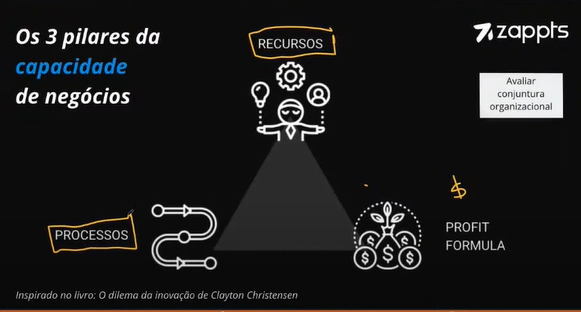
It is important for us to have this basic model to evaluate the organizational context, because when we talk about them, we want to say that:
The ‘profit formula’ directly affects how the company makes a decision, from the lowest to the highest hierarchical level. It is what determines how quickly this decision will be made, which direction it goes and what the priorities are;
With the ‘resources’ point, we discover why things go fast or slow. It is the speed. The more resources, the faster, and vice versa;
‘Processes’ determine efficiency, because, in the end, it is what determines how the resource will be consumed.
What do these three pillars have in common? They all consume time.
And, if you are on the journey to reduce the time to market of your digital product, you need to make sure that these are aligned.
From now on we will break down these three points, to ask the right questions and create a reflection of what you can apply in your process.
Talking a little about Profit Formula
As mentioned earlier, profit formula means understanding how your company makes money. Simple as that.
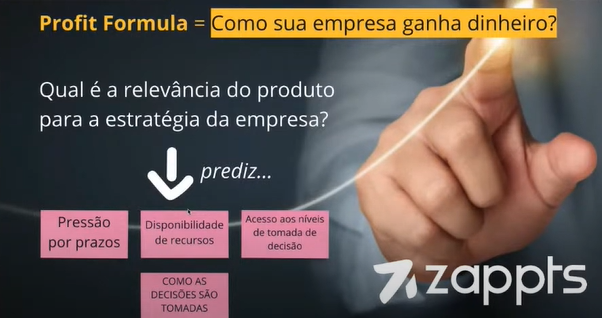
The key question that needs to be asked to start this reflection is: what is the relevance of the product to the company’s strategy?
By understanding this, you can predict:
How great the pressure for deadlines will be;
What the availability of resources is;
How easy it will be to access decision-making levels;
In other words, understanding well the strategy of the product you are developing helps you understand what decisions will be made. Much of the processes, sometimes, becomes paralyzed by the difficulty of making decisions.
Talking a little about Resources
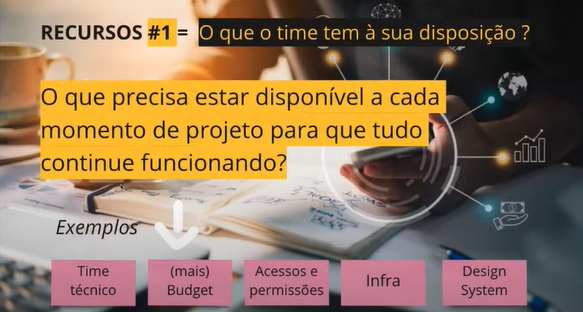
Explaining simply, resources means what the team has at its disposal. It is linked to a key question: what needs to be available at each project moment for everything to continue working?
It’s no use things arriving in reverse order. It’s hard to orchestrate this within a project, and it’s very important to always stop and think: if you have an inefficiency happening, do we have everything that’s needed for the process to continue working?
The answer to this question is that, usually, some resource is missing. Whether it’s the technical team, money, access, permissions or even infrastructure.
And how do we know that resources are being well utilized?
This question is super important because, the better a resource is utilized, the more attention, more focus and more resources you receive.
Understanding that you are doing a good job helps in the pyramid we talked about above!
If you spend resources well and have efficient processes, this helps the profit formula. And, if you don’t use these resources well, it’s very likely that you will suffer a shortage down the road.
What determines how and how well resources are being utilized? Processes.
Talking a little about Processes
Process is how we do activities. And, basically, it is what determines which tasks must be carried out and with which resources.
Examples:
- Planning rituals, onboarding and reporting;
- Homologation and controls;
- Political approvals and compliance;
- Production and storage of documentation;
- Technical decision-making;
- Product decision-making;
- Metric determination.
If this is not well determined, the company, as a whole, wastes resources, and this goes against the profit formula, creating a bad cycle for the entire product development.
As important as thinking about how tasks should be carried out, it is also important to think about what to do when things don’t go as planned. And here we are talking about contingencies, knowledge management, member substitution, rejections and errors, continuity plans.
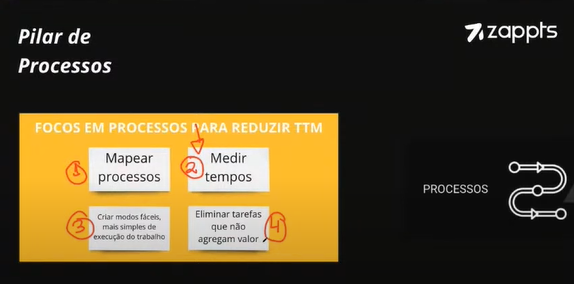
To help with these processes and reduce flow time, there are four steps we should highlight:
- Map Processes;
- Measure times;
- Create easy and simple ways to execute work;
- Eliminate tasks that don’t add value.
When processes are done simply, they usually don’t need to be done again, eliminating rework.
How to map processes?
We usually say that every process has three versions: What you think it is, how it really is, and how it should be.
Taking into account the steps we talked about above, which of the three process versions is the one we should work with? Which of these versions really makes us take decisions?
The correct answer would be: how it really is!
This means that process mapping has a lot to do with understanding how things are being done, at the time they are being done. And this is only possible by working as a team.
The version of how we think it is, is biased. It is from this version that those questions on the surface of the iceberg come out.
The version of how it should be, doesn’t help at all until we understand how it really is. We cannot plan a change without knowing how things really work.
How to measure times?
There are two types of time, TRA (Activity Realization Time) and TP (Persistence Time).
The first refers to how long you spend dedicating yourself to an activity. The second is equal to how long you wait to be able to do something, or how long after, it goes to the next stage to be processed.
TRA is usually less than TP. Most of the time, we spend more time waiting for someone’s approval than doing the task itself.
It is important to have this awareness because, when we map TRA and leave TP aside, we lose the bulk of time to market reduction opportunities.
So, which of the two times determines TTM?
Yes, persistence time. It is the sum of the TP of all process stages that determines how long a company takes to launch a product in the market.
Understanding why something you execute relatively quickly takes so long to be used by the next stage is fundamental to reducing TTM.

And how do we simplify tasks?
The two most important questions in this task simplification process are:
What takes more time / requires more effort than it could?
This has to do with creating easier and simpler ways to execute work.
How does this activity impact the value delivered to the customer?
Thinking that “value to the customer” is delivering what the market really needs, everything that doesn’t impact, by definition, doesn’t add value. This doesn’t mean we can cut this task, but rather that we can work to reduce it in terms of time or frequency.
Always remember that we work to simplify and reduce, but we have to think a lot about losses and complexities to reduce time to market. By reducing once, we apply better next time and enrich know-how in the team and propagate this knowledge to the rest of the organization.
To finish, we have the decisive criterion: VALUE. A small word, but that gives us a lot of work to understand, define and defend on a daily basis.
It is the decisive criterion, because everything that doesn’t add value and can be worked on to be simplified or eliminated, helps to reduce TTM.
Check out our new job openings, click here.
Share this article
Related articles

16 set 2026
The End of Passive SaaS: Why You’ll Pay for Outcomes, Not Seats
The traditional software pricing model based on per-user licenses (seat-based SaaS) faces an inevitable decline in 2026.

09 set 2026
The Timid Autonomy Dilemma: Why Keeping AI in a Suggestion-Only Role Is Killing Your Margins
This article analyzes the financial impact of this "timid autonomy" and advocates for an urgent shift to the "Human-on-the-loop" (HOTL) model.

02 set 2026
The "SaaSocalypse" is actually an architecture and identity crisis.
This article reverse-engineers a real-world success story (anonymized) from the financial sector, dissecting the layers of...