
High IT Operations Cost in the Insurance Sector: Discover the Impacts
In the first half of 2022, the Brazilian insurance market reached R$13.1 billion in revenue. This represents a growth of approximately 19.6% compared to the same period in 2021.
4 de janeiro de 2023
In the first half of 2022, the Brazilian insurance market reached R$13.1 billion in revenue. This represents a growth of approximately 19.6% compared to the same period in 2021.
The information was released by the 22nd edition of the IRB+Market Bulletin based on data collected by Susep (Superintendence of Private Insurance). In the midst of a constantly expanding niche, insurance sector leaders want to know, what has been causing this growth?
Experts claim that the market’s evolution has been driven by numerous factors, among them the post-pandemic economic recovery. After all, it has been a moment when we Brazilians are discovering that insurance goes far beyond protecting vehicles, homes and our lives, and can be acquired on demand, ensuring security for the future.
Insurance companies have been following the behavior of this new consumer profile, creating increasingly customizable and accessible products. From there, another pillar of this market growth emerges: investment in technology, software and other aspects of IT operations.
But how can IT boost business results in the insurance sector? Is the investment worth it?
Digital transformation in insurance company projects
First of all, it is necessary to understand how IT operations can contribute to a digital transformation and what effects this has in terms of market authority. Furthermore, understanding how poor or lack of investment in technology can harm the insurance company.
The base concept of digital transformation consists of making better use of data collected from relevant market/customer bases, transforming business models and creating value propositions. Besides, of course, accelerating the growth and expansion process, a fundamental point in the insurance market.
7 ways to achieve digital transformation through IT in insurance companies

1 – Ensure system integration
System integration is a way to optimize work, especially when we talk about insurance companies. Using a tool aimed at integration, it is possible to create a workflow that works jointly and effectively in day-to-day demands.
This positively impacts the productivity and deliveries of all employees, regardless of the department they work in. Furthermore, it facilitates the process of clarifying doubts, execution guidance and more.
But it is worth remembering that each insurance company has a focus and a delivery routine, an integration-focused software needs to be adaptable and efficient for these varied ecosystems. After all, it is no use being a tool that works only for one side of the corporate network.
Before implementing any integration system, seek to understand the reality of each sector in the insurance market. Identify the pain points and positive aspects of the current routine and try to find a platform that positively encompasses all the points raised.
2 – Use and abuse APIs & Middleware
Another way to transform processes in insurance companies is to use middleware, which is nothing more than a solution that unifies different applications with the objective of establishing universal communication. Thus, it offers an efficient and intelligent connection aimed at accelerating processes.
In other words, it can be defined as a bridge that intermediates between different data sources. For example: a Windows application that receives and sends data through a Linux server without any problem or interference.
Therefore, it is fundamental for managing data in distributed systems, supporting the development of other applications and simplifying some processes. Using middleware for fast and secure data transmission is being many steps ahead in the market.
3 – Invest in cybersecurity
Speaking of security, we cannot overlook the importance of having the support of programs specialized in cybersecurity for insurance companies. Within this, countless points that deserve attention can be listed:
- Network security, seeking software and measures that protect a computer network against unauthorized access;
- Safe cloud, developing encryption systems to protect cloud data storage and transmission, in addition to contributing to the privacy of potential customers;
- LGPD (General Data Protection Law) and information security, protection to prevent sensitive data from being exposed on public networks and without access control.
These are just some of the points that require specific protections to maintain a company’s data health in full balance. Deepen your company’s routine and find loose ends that need to be properly protected.
4 – Ensure real-time Business Intelligence
Basically, it is a way to combine business analysis with data filtering, visualization and mining, and ideal tools to help your company make decisions.
This way, it is easier for insurance companies to execute planning focused on results, after all, they will be decisions supported by truly efficient data-driven actions. In practice, a modern BI is one that allows having a comprehensive view of all your company’s data. With this, use them to positively transform deliveries, reduce inefficiency and boost growth.
5 – Promote a unique experience on your Digital Channels
Thousands of Brazilian companies are increasingly investing in multiple technologies, as shown by the ‘Agenda 2022’ research conducted by Deloitte. At least 96% of organizations allocated capital to the creation of applications, systems and management platforms. Of these, 95% focused on data management and digital security platforms.
And when it comes to technology investment, artificial intelligence stands out, as 39% of companies underwent process digitization. Of these, 34% relied on drones and virtual or augmented reality.
However, the use of digital channels or tools, in isolation, does not necessarily guarantee business results from the digital transformation standpoint.
The focus here ends up being not only on optimizing processes with the help of digital channels, but also on optimizing human resources by creating a strongly digital culture within the organization.
6 – Experience 5G and the Internet of Things
One of the most important technologies of the 21st century, the Internet of Things (IoT) consists of the possibility of connecting numerous devices to a single network. Thus, it is possible to create universal communication, issue commands and more, using a single channel.
Cars, appliances, electronics and other devices interconnected creating a more practical and facilitated routine. In day-to-day life, it is a technology that facilitates the delivery process of employees who will have greater control resulting in a faster and simultaneous volume of execution.
7 – DevOps
DevOps (Development and Operations) is an agile development model that facilitates and improves software delivery in general, thinking about all areas involved.
Therefore, it consists of a set of techniques and tools aimed at improving process organization and offering applications, products and services that prioritize agility.
Insurance companies that need to speed up their deliveries while ensuring the quality of their solutions need to be aware of DevOps methodologies. With it, it is possible to reduce the development time and launch of digital solutions and automate operations using the best practices and professionals in the market.

What prevents digital transformation in insurance companies?
Well, as you can see, digital transformation is no longer optional, or a differentiator, in the insurance sector. After all, innovating and always seeking new technologies is the passport for growth and prospecting for increasingly higher results.
But what can prevent an insurance company from undergoing a digital transformation? The answer to this question may be linked to economic issues, market competition or also more particular reasons of each insurance company, among them:
- Lack of technical knowledge about technologies, as well as a lack of interest in the subject;
- Low productivity and initiative on the part of employees and management, complacency that stagnates and hinders innovation;
- Bureaucracies and difficulty in finding reliable and quality suppliers with experience in IT operations.
How to reduce IT operations costs in the insurance sector?

However, although fundamental, IT operations have a high investment cost, involving everything from tool implementation to employee training, data monitoring, among other factors. But how to ensure evolution and still reduce these costs?
5 solutions to reduce IT costs in insurance companies
1 – Insurance Digital Channels
A solution for insurance companies that want to optimize and integrate their digital channels, in addition to further improving and developing the relationship with their customers. All this by providing satisfactory and memorable digital experiences through omnichannel applications.
Given the digitalization of the market, effective and advanced digital channels are fundamental for building a company’s image in front of the public, as well as providing a good experience to consumers, boosting business results.
From platforms for relationship with resellers, investors and suppliers, to training portals for employees. In addition to onboarding platforms and identity verification systems, to name a few possibilities.
2 – Insurance Experience Design
Entering your company’s portal must be, above all, a unique and positive experience! More than just buying a product or service, customers look for a brand with streamlined processes that collaborate to optimize their routine. For this, solutions like Insurance Experience Design are fundamental.
Through the Solution Design and UX Analysis process, it is possible to develop new digital solutions with the involvement of specialists in the subject. From there, trace strategies for better user usability in order to improve and optimize their experience.
3 – Insurance QA Automation
Every change goes through a first step of understanding what the main points of improvement are. It is to help leaders in the insurance sector that Insurance QA Automation exists. A solution that performs a complete diagnosis of the quality of insurance company products and services, ensuring the effectiveness of their development processes.
The assessment takes into account the entire development cycle, from product validation, tools used, development process, documentation, tests, automation of them and more.
4 – Insurance Integration Tools
The ideal solution for insurance companies that want to design and apply API and Middleware strategies with security and optimized governance. Guarantee of integration with insurtechs, partner ecosystems, B2B clients and more.
The focus is always on the result achieved by the insurance company. Processes centralized from various sectors in one place facilitate business success. Furthermore, they bring dynamism and automate flows that were previously performed manually.
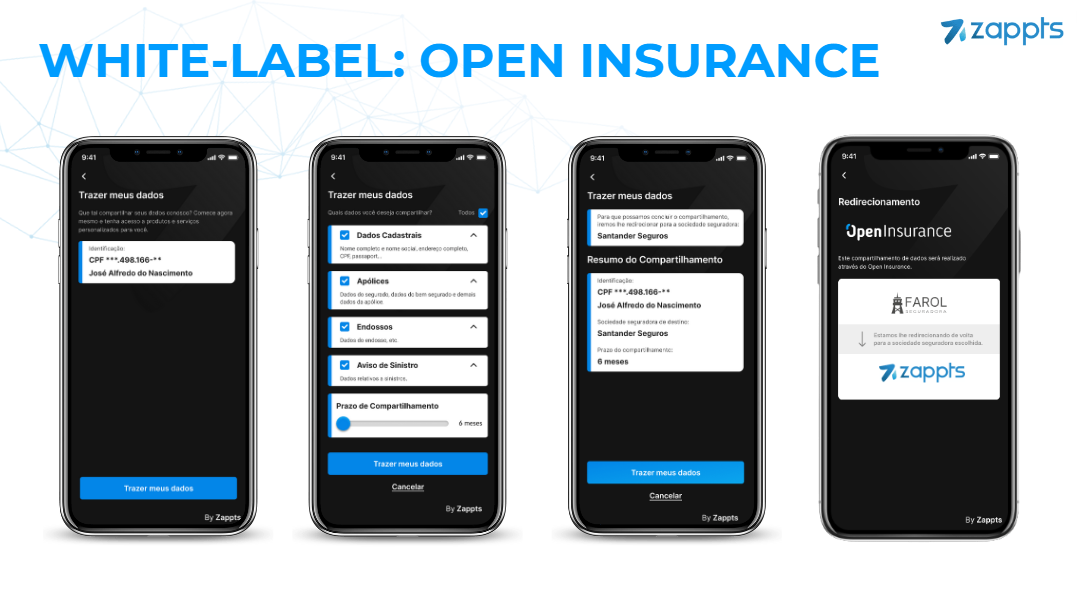
5 – Whitelabel Open Insurance
Through solutions such as Whitelabel Open Insurance from Zappts, we help insurance companies shorten the customer consent journey within the open insurance system. This by immediately adapting to phase 2 of the Open Insurance roadmap through our 100% customizable and responsive web and mobile solution. All of this 100% aligned with the SUSEP user experience guide.
Conclusion
To remain competitive in the insurance market, it is necessary to always be a few steps ahead of the competition. It is important to have technological innovations that guarantee business results without burdening IT operations costs.
Zappts can help your company reduce IT operations costs and boost the return on technological investments. Since 2014, Zappts has guaranteed business results through technology. Always delivering high-relevance cases using agile processes, best development and software quality practices, and an unparalleled ability to understand and solve the day-to-day pains of technology development projects. Companies like Porto, BTG, Santander, Getnet, PagoNxt and Auttar trust their consulting and technology development processes with Zappts.
We contemplate solutions for all phases of digital solution development, from discovery processes to solution sustainment. With defined processes and agile management, our deliveries are always based on expectation alignment, quality and technical robustness.
To learn more about these solutions and guarantee a 1-hour free assessment with our consultants, get in touch by clicking here.
Share this article
Related articles

16 set 2026
The End of Passive SaaS: Why You’ll Pay for Outcomes, Not Seats
The traditional software pricing model based on per-user licenses (seat-based SaaS) faces an inevitable decline in 2026.

09 set 2026
The Timid Autonomy Dilemma: Why Keeping AI in a Suggestion-Only Role Is Killing Your Margins
This article analyzes the financial impact of this "timid autonomy" and advocates for an urgent shift to the "Human-on-the-loop" (HOTL) model.

02 set 2026
The "SaaSocalypse" is actually an architecture and identity crisis.
This article reverse-engineers a real-world success story (anonymized) from the financial sector, dissecting the layers of...