Accessibility and Blockchain
Where accessibility and blockchain technology meet?
3 de setembro de 2021
This publication was developed based on the webinar given by Sérgio Faria on August 5, 2021, available for viewing on the Zappts YouTube channel.
Sérgio Faria has been blind since the age of 2. He used a cane for 29 years, but since 2010 he has used a guide dog. He is 56 years old and has been in the world of information technology for 37 years.
For 16 years he worked in foreign trade, and was a programmer, analyst, and project leader. He was still a boy when the first computers started to appear.
Since childhood he wanted to be an engineer and had a colleague who studied at POLI, but when he started working with computers he liked it a lot and it was love at first sight.
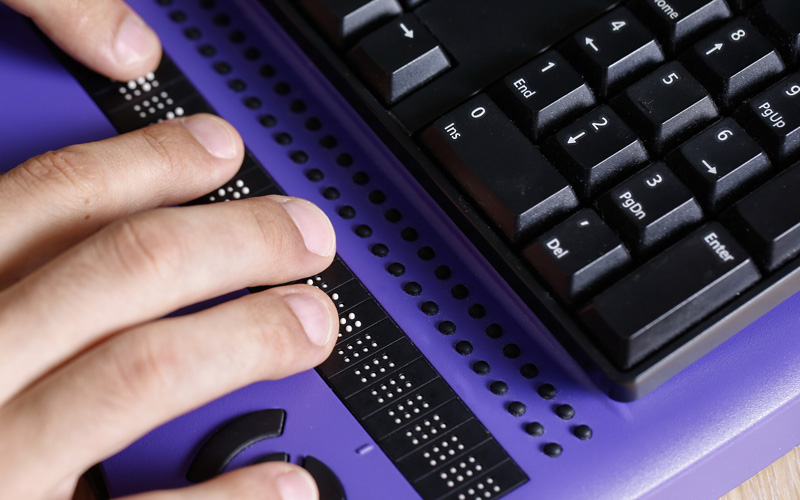
One day he met a blind man who had been working with computing since 1969. At the time, all codes were written on paper, in Braille.
It took 2 years of looking for job opportunities until he got a job at Sadia. There was no accessibility at all at that time.
“We programmed on giant terminals and went by the ‘beeps’. I typed the application I wanted and counted the beeps to know if it crashed or worked.”
In 1988, even without the internet, he discovered IBM equipment in the US and managed to get the director to bring one called OPTACOM, which was a camera and showed on his finger what was on the computer.
“Then we got two talking terminals from IBM, but that’s when application decentralization began.”
“We went to program on a microcomputer and then I went after equipment, learning to use Windows.”
“We didn’t know what it was, and explaining what those windows were to a blind person was very difficult. There weren’t many courses on the subject and the courses that existed weren’t for blind people.”
Sérgio already programmed, but wanted to be a systems analyst. He got a degree in Administration, and three postgraduate degrees, one in systems analysis, another in project management, and then in foreign trade.
“I used to ask myself: if I wrote programs, why wasn’t I an analyst?
Sérgio learned quickly, left Sadia and ended up at Accenture where he aspired to the opportunity to become a project manager. Today it’s been 23 years that Sérgio has been at Accenture and told us that he is the only survivor from the dial-up internet era.
“I was a leader on a telecom company project. By that time there were already software that programmed on windows and several emulators.”
“Today what I see is that we, as developers, have complicated behaviors.”
“There are accessible libraries in Python, Java, and guides like WCAG and so many others, and we keep designing products without labels on buttons, that don’t open menus, that don’t open with voice software.”
“There is a semi-illiteracy in accessibility in the IT field.”
In the IT field, there is usually no real care for accessibility.
Even with UN statistics showing that when accessibility is considered, it is possible to reach one disabled person and four more people, there is still the notion that a blind person doesn’t have a bank account, or doesn’t shop.
“I don’t have difficulty with special characters and different words, but with images and graphs, yes, because the voice software cannot interpret them.”
Sérgio told us that the hashtags #ParaCegoVer help, but when people do audio description, they put what’s in their heads.
“I need them to put only what people actually see. Ex: ‘Luciano is angry’. Angry is my concept, I need them to describe his expressions, like ‘Luciano has a scrunched face’.”
“We have to say what we see, not deductions. But self-description helps, it’s better to have something than nothing.”
On websites with captcha, for example, when you activate the sound, 90% of the time it’s a voice that cannot define whether the object is a letter or a number.
Some things are usable and some things are accessible. If there is an “open” or “print” button, that is accessible.
“When there’s something without a label, I find out by pressing tab 3 times and it just says ‘button’ and when I press enter it works, that’s usable. It’s a deduction, I can use it because I learned from making so many mistakes.”
How to bring more accessibility to the internet?
“There would need to be a awareness process, but with a different focus. Society still has the mindset of ‘I have to make an accessible website to help the blind’, when the focus has to be different, because disability is a state.”
“At this moment I AM a person with a disability, but tomorrow all of this could change, through technological or medical evolution, I could see again.”
“So people need to understand that when something is made accessible, it’s not just for 5% of Brazilians who have disabilities, it’s for everyone. The difference is that some need it now, others will need it in the future.”
“The second important point is: if you can’t do everything you want, do everything you can.”
“Even being an activist, I don’t know all the needs of people with disabilities. There are tools that test accessibility, and you start developing in an accessible way.”
“It’s much cheaper than converting later. It’s much easier to do, than to have to redo something already designed.”
“For us blind people, everything is information, even complete silence. When I already know the person, I can know about them just by the change in behavior. ‘A human polygraph’.”
“We don’t develop our other senses more than normal, that’s a myth. We just use everything we have at our disposal, the other 4 senses that remain.”
“I recognize people by their smell, by the way they move, by their breathing. And the lack of information is also information.”
What is blockchain?
“After I had cancer in my thigh, I came back to active life and wanted to learn, wanted to manage projects. I was unassigned and they put me on a team that told me ‘do what you want to do’, and there was an area where a person was leaving, and it was the blockchain area.”
“I started thinking about people with disabilities, started thinking ahead, because every time I have to prove I’m blind. Then I thought: ‘what if they started making a personal registration with something like this?’. I started thinking about medical records, and dove in headfirst.”
“I have difficulties due to lack of accessibility, so I became a business specialist.”
“I’m not the guy who goes and makes the token, even though I sometimes try. I’m the guy who has the ideas and knows the business, to pass on to the young people who do 20x faster than me.”
“I started reading everything I could about the subject, taking courses, watching webinars, seeing examples, and gradually I started to understand.”
“If today someone asks: ‘are you the one who creates the configurations?’. No, but I’m the guy who says: ‘I want you to do it this way’. I’m the guy who designs the business, along with the architecture. I don’t get my hands dirty, but I’m the one who says ‘create’. I’m ecumenical, I dive into everything whenever necessary.”
The concept of Blockchain
“Blockchain is the seller’s notebook. Imagine you sell Natura at home. You bought a kit that came with 10 deodorants, spent 1000 reais, and wrote it down in your notebook. Then you sold a deodorant, you record it there. Sold another, write it down there.”
“Why is it a notebook? Because it doesn’t change. It’s no use scribbling in the notebook.”
“The difference is that so that no one scribbles, steals, or the notebook doesn’t get lost, it is digital and is registered on your computer and on the buyer’s computer. We call it a ledger, because it never changes. It’s like an accounting book.”
“But what if I bought 10 deodorants, and only 9 came?”. In case of error, you make a justification for why it was wrong. The facts are recorded in a timeline and it never changes. Until there it’s a DLT, because it’s a book and it’s distributed on people’s computers.”
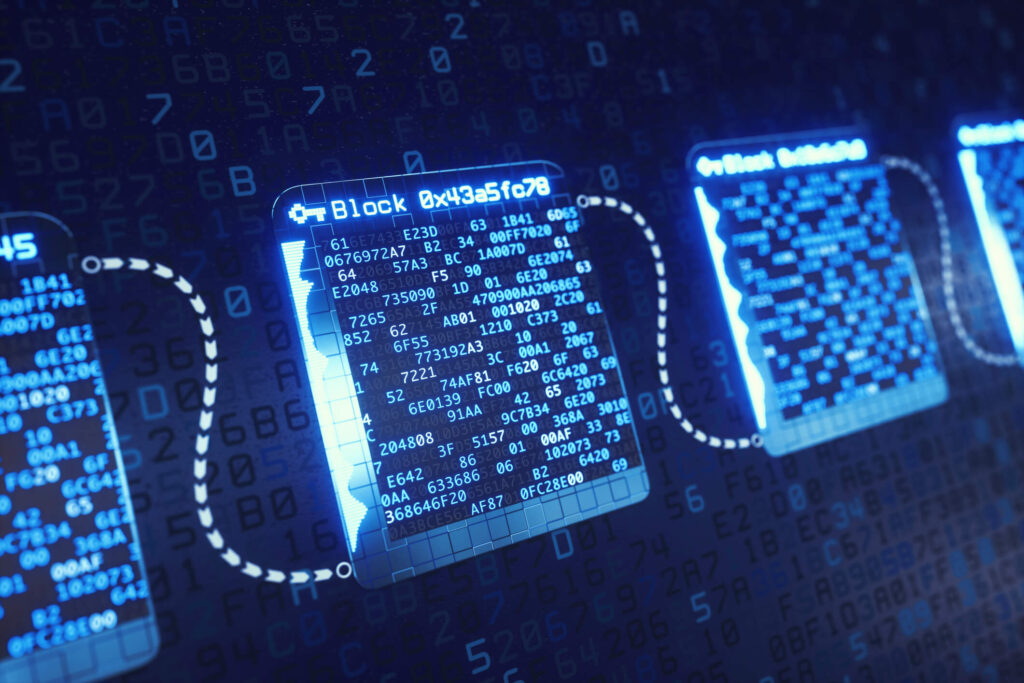
“And why does it become blockchain? Because they are blocks of transactions and the records of these blocks.”
The ‘chain’ is because we tie these blocks to each other. A hash is created in each block and it becomes encrypted to one another. In the end, this is secure because to change a block, I have to redo the chain.”
“And for that I need computational power to decrypt and redo the same.”
“And isn’t it bitcoin? It’s not. Bitcoin has blockchain, but it isn’t blockchain.”
“It was the first to use blockchain to provide transparency and security, because you can track it and it’s trustworthy. It’s impossible to redo the chain and it became trustworthy.”
“Blockchain isn’t new. Hash is old, immutable and sequenced database is old. They just put everything together in one thing, which became something new. It’s a new way of putting old things together.”
“Blockchain is great, but remember: it’s a team sport and you need to ask others if they want to play.”
“If everyone does, think that you need to rent the court and everyone has to want to pay. Will it be cheaper? Yes.”
“If you track a production chain, send documents faster and streamline the process, you show the client it’s worth it. The court is the blockchain infrastructure.”
“To use blockchain, you don’t need all the prerequisites, but you need some. It has to have reliability, traceability, and transparency problems. If people have that and can afford the court, then use blockchain.”
“In Brazil, people get discouraged if they have to ‘coordinate the game with everyone’.”
“When I worked in foreign trade and started getting in touch with blockchain, I said: ‘this needs to exist in foreign trade’. Until IBM created that tool.”
“Remember I was talking about medical records and blockchain? Today there’s the RNDS, where each state is a node in the chain.”
“And, in the future, every Brazilian will have a record in it. With the pandemic, all tests and vaccines done and applied in Brazil are already registered there. And this serves to facilitate the diagnosis and history of each patient.”
To conclude, Sérgio finished with a phrase that should be reflected upon deeply and that proves his good character, humility, and willingness to help.
“I want to learn and pass it on, and help so that people can do better than I did.”
Want to know about our next online events? Click here and secure your spot.
Share this article
Related articles
16 set 2026
The End of Passive SaaS: Why You’ll Pay for Outcomes, Not Seats
The traditional software pricing model based on per-user licenses (seat-based SaaS) faces an inevitable decline in 2026.
09 set 2026
The Timid Autonomy Dilemma: Why Keeping AI in a Suggestion-Only Role Is Killing Your Margins
This article analyzes the financial impact of this "timid autonomy" and advocates for an urgent shift to the "Human-on-the-loop" (HOTL) model.

02 set 2026
The "SaaSocalypse" is actually an architecture and identity crisis.
This article reverse-engineers a real-world success story (anonymized) from the financial sector, dissecting the layers of...