
Technological trends to apply in your company in the second semester of 2023
In recent years, the rapid evolution of technology has driven significant transformations in various sectors, mainly in the financial, insurance, industry and retail segments. New technology trends are emerging and shaping the way these sectors operate, interact with customers and remain competitive in the market.
30 de junho de 2023
In recent years, the rapid evolution of technology has driven significant transformations in various sectors, mainly in the financial, insurance, industry and retail segments. New technology trends are emerging and shaping the way these sectors operate, interact with customers and remain competitive in the market.
In this article, we will explore some of the main technology trends that promise to revolutionize these sectors in the coming months. We will analyze how these trends are impacting companies, providing operational improvements, driving innovation and enabling the creation of personalized experiences for consumers.
Technology Trends in the Financial Sector

Open Banking and Digital Currency
Open Banking is an initiative that aims to open traditional banking systems to allow data sharing with authorized third parties. This promotes innovation and creates opportunities for the development of new financial services. With Open Banking, customers have greater control over their data and can access personalized financial products from different institutions. Furthermore, data sharing allows for a more comprehensive analysis of customer profiles, resulting in more efficient services tailored to their needs.
Furthermore, with the advancement of discussions about Central Bank Digital Currencies (CBDCs), an important question arises: how can Open Banking integrate with this new form of digital currency? CBDCs, such as the Digital Real, have the potential to transform financial transactions, providing greater security and efficiency.
With data sharing facilitated by Open Banking, CBDCs can offer a simplified and accessible payment experience, allowing customers to make instant and interoperable transactions across different financial platforms. The combination of Open Banking with CBDCs could revolutionize the way we handle money, offering benefits for both customers and financial institutions. How this integration will happen and what the challenges and opportunities involved are questions that should be considered by financial sectors and regulators as we advance into the era of CBDCs.
Digital Payments and NFC
The adoption of digital payments continues to gain prominence. Digital wallets, such as Apple Pay, Google Pay and Samsung Pay, allow consumers to make payments easily using their mobile devices. Furthermore, proximity payment technology, such as NFC (Near Field Communication), is becoming more common on mobile devices and credit cards, allowing customers to make transactions without the need to insert a card or type passwords. Another emerging trend is the use of cryptocurrencies, such as Bitcoin, as a decentralized and secure form of digital payment.
Artificial Intelligence (AI) and Machine Learning (ML)
AI and ML are playing an increasingly important role in the financial sector. These technologies are used to detect fraudulent activities, analyze large volumes of data quickly and accurately, automate manual tasks and offer personalized services to customers. For example, AI-based chatbots are used to provide customer support, answer common questions and assist in financial decision-making. Furthermore, machine learning algorithms are employed in credit risk analysis, allowing a more accurate assessment of customers’ payment capacity.
Technology Trends in the Insurance Sector

Data-driven Insurance and IoT
The Internet of Things (IoT) plays a fundamental role in the insurance sector. Connected devices, such as sensors in vehicles, residences and wearables, collect a huge amount of data in real time. This data can be used by insurers to price risks more precisely and personalize insurance policies according to the individual behavior of policyholders. For example, in auto insurance, data collected by sensors can be used to determine premiums based on the driver’s driving patterns.
More Efficient Insurtechs
Insurtechs are startups that apply innovative technologies to transform the insurance industry. They offer digital solutions that simplify and streamline insurance contracting processes, such as on-demand insurance, where customers can acquire coverage only when needed, insurance comparison platforms that allow consumers to find the best coverage option and mobile apps that facilitate policy and claims management. On the other hand, the efficiency of insurtechs is an essential factor to improve customer experience and drive growth in the insurance sector. Therefore, investing in technologies that promote greater efficiency is fundamental for these companies to stand out in the increasingly competitive insurtech market.
Technology Trends in the Industrial Sector

Industrial Internet of Things (IIoT)
IIoT refers to the application of IoT in the industrial sector. The connectivity of devices and sensors allows real-time monitoring of machines, equipment and industrial processes. This enables data collection, early fault detection and operational efficiency optimization. IIoT also drives the adoption of technologies such as Robotic Process Automation (RPA) and additive manufacturing (3D printing), providing greater flexibility and personalization in production.
Artificial Intelligence in Industrial Automation
AI is increasingly being used in industrial automation to improve efficiency and productivity. Machine learning algorithms are applied to optimize processes, identify equipment failure patterns, predict maintenance and improve product quality. AI also enables the integration of intelligent energy management systems, inventory control and logistics, resulting in more efficient and sustainable production.
Smart Manufacturing
Smart manufacturing, also known as Industry 4.0, is an approach that combines automation, robotics, data analysis and AI to transform the production chain. The digitalization of industrial processes allows the collection and analysis of large volumes of data in real time, enabling more informed decision-making and the identification of improvement opportunities. Smart manufacturing also involves the use of advanced communication systems, such as machine-to-machine communication (M2M) and the integration of production systems with enterprise management systems.
Technology Trends in the Retail Sector

Personalized Customer Experience Journeys
Retail is increasingly focused on offering personalized experiences to customers. Through data analysis and AI, companies can better understand customer preferences and needs, offering relevant and personalized product recommendations. This can include the use of recommendation algorithms, purchase history analysis and customer segmentation based on their profiles and behaviors.
E-commerce and Mobile Commerce
The growth of e-commerce and the use of mobile devices for shopping continues to be an important trend. Retail companies must adapt their strategies to offer efficient and mobile-friendly online platforms, including website optimization, mobile app development and integration of digital payment solutions. Artificial intelligence also plays a fundamental role, enabling advanced personalization, product recommendations and data analysis for a better understanding of consumer behavior. This drives reach, customer experience and the growth of retail companies.
Channel Integration (Omnichannel)
Consumers expect an integrated and consistent shopping experience across different channels, such as physical stores, websites, mobile apps and social media. Retail companies must invest in technological solutions that allow efficient integration of these channels, such as real-time inventory management systems, buy online and pick up in-store options, and loyalty programs that are valid across all channels.
These technology trends have the potential to significantly transform Brazilian companies, driving innovation, efficiency and the quality of user experiences. Companies that adapt to these changes and take advantage of the opportunities offered by technology will have a competitive advantage in the market.
Conclusion

As we advance in an increasingly technological era, it is essential that companies in the financial, insurance, industry and retail sectors are attentive to constantly evolving trends. The adoption of these technology trends offers a series of benefits, from operational efficiency improvements to the development of innovative business models. Companies that embrace these trends are positioned to stand out in the market and meet the growing demands of consumers for agile solutions and exceptional experiences.
In the financial sector, the quality of applications and the optimization of the user experience interacting with their digital products is extremely important. Furthermore, technologies such as blockchain and cryptocurrencies have the potential to transform the way financial transactions are carried out, offering security, speed and cost reduction. Moreover, artificial intelligence and data analysis are driving process automation and personalization of financial services, allowing companies to provide personalized recommendations and solutions to customers.
In the insurance sector, the Internet of Things (IoT) is playing a fundamental role by enabling real-time data collection and more accurate risk analysis. Furthermore, the implementation of chatbots and virtual assistants is improving efficiency in customer communication and streamlining claims processes. Data analysis and machine learning are also being applied to identify fraud and improve insurance pricing, not to mention the importance of investing in the optimization of users’ digital journeys, providing personalized and unique experiences.
In industry, Industry 4.0 technology is promoting the automation of manufacturing processes, using the Internet of Things (IoT), big data, artificial intelligence and 3D printing. This digital revolution is providing greater efficiency, flexibility and personalization in production, in addition to creating opportunities for the creation of connected products and innovative services. On the other hand, the quality of digital products and the optimization of the user experience is fundamental for gaining competitive advantages in the sector.
In the retail sector, the quality of the customer experience is the central focus. Augmented and virtual reality are being used to enhance the shopping experience, allowing consumers to visualize products before purchasing them. Furthermore, data-based personalization is becoming increasingly common, with the use of algorithms and machine learning to offer personalized recommendations and targeted offers.
In conclusion, technology trends are redefining the Brazilian business landscape. To remain competitive, companies must closely follow these trends and be willing to adopt new technologies. By doing so, they will be prepared to face challenges and capitalize on the opportunities that these trends offer, ensuring continuous growth and customer satisfaction. Those who resist change risk falling behind in an increasingly dynamic and technology-driven market.
About Zappts
Since 2014 in the market, Zappts supports leading brands in their markets, such as Porto, Getnet, BTG Pactual, Cateno, Ambev, Multilaser, Ultragaz, C&A and Burger King, among others. Focused on software development, especially in Front-end, UX Design, Quality Assurance and Cloud Environment Management, it operates in the planning, management and operation of corporate digital solution development services, environment management and knowledge transfer through information technology.
We are a reference company in creating digital experiences for users. In addition to developing innovative and fast solutions, we operate in a 100% remote model, with teams distributed across more than 18 states in Brazil.
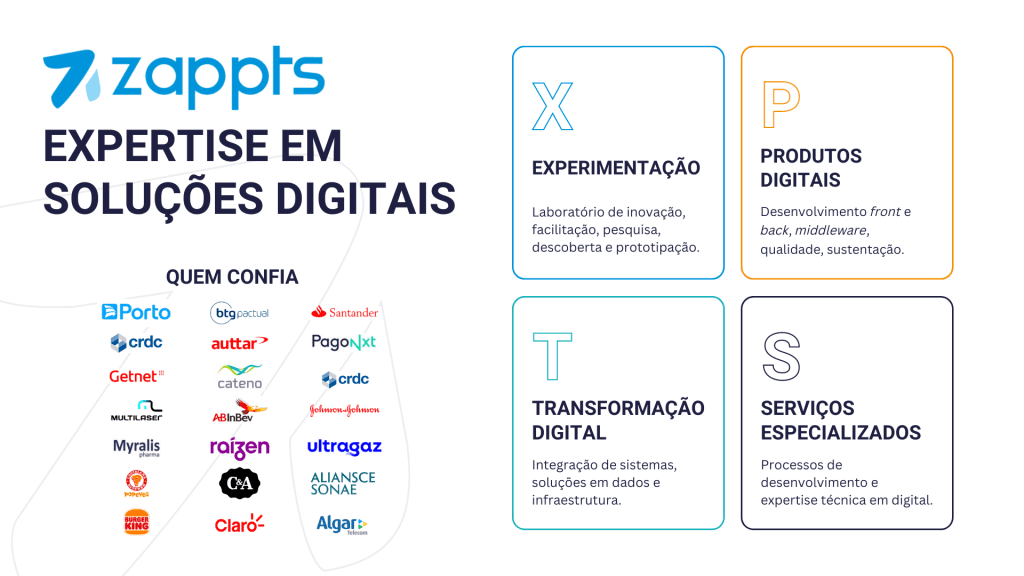
To learn more about how Zappts can help your company, click here, and get a free assessment with our tech consultants.
Share this article
Related articles

16 set 2026
The End of Passive SaaS: Why You’ll Pay for Outcomes, Not Seats
The traditional software pricing model based on per-user licenses (seat-based SaaS) faces an inevitable decline in 2026.

09 set 2026
The Timid Autonomy Dilemma: Why Keeping AI in a Suggestion-Only Role Is Killing Your Margins
This article analyzes the financial impact of this "timid autonomy" and advocates for an urgent shift to the "Human-on-the-loop" (HOTL) model.

02 set 2026
The "SaaSocalypse" is actually an architecture and identity crisis.
This article reverse-engineers a real-world success story (anonymized) from the financial sector, dissecting the layers of...