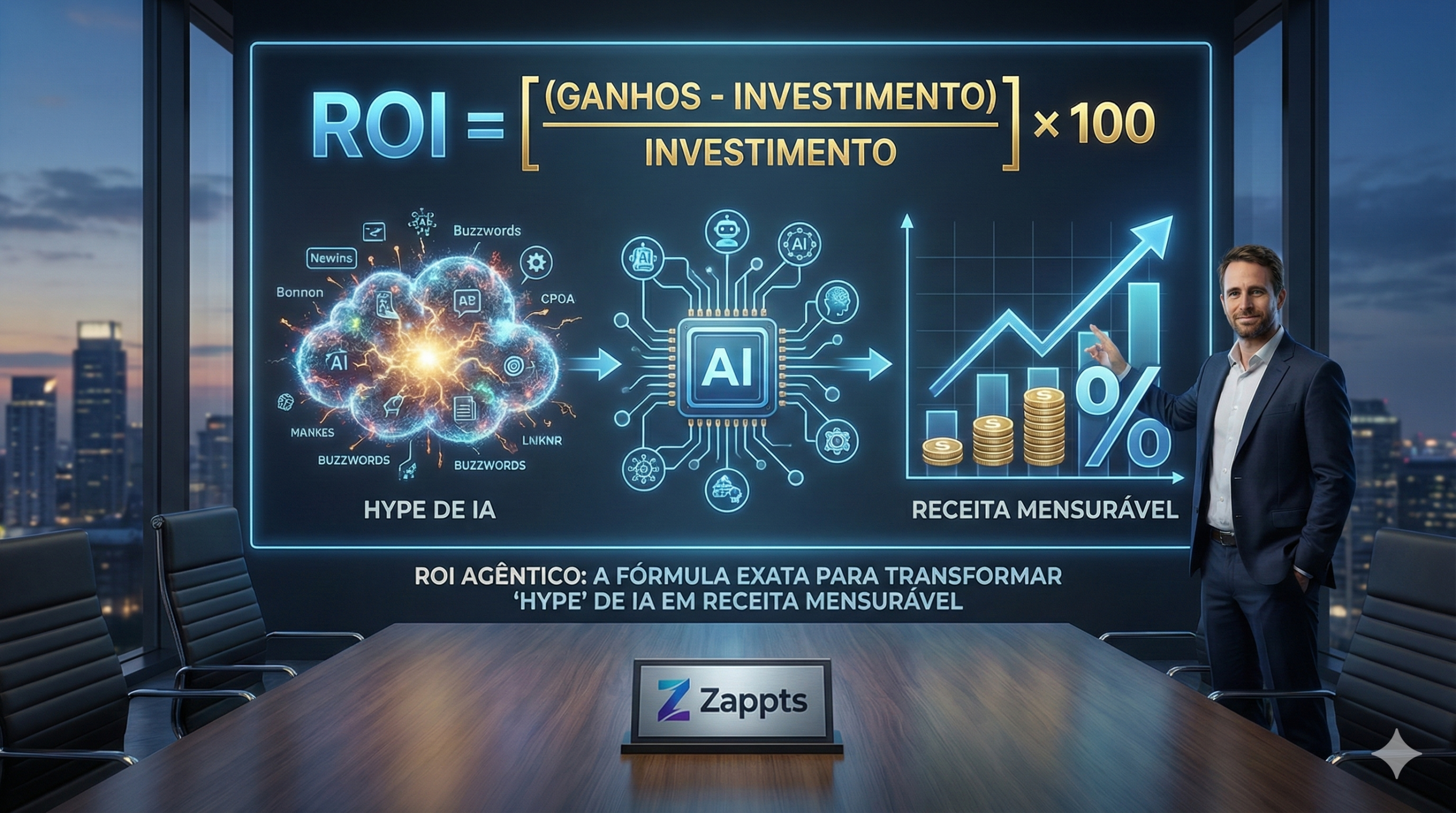
Agentic ROI: The Exact Formula to Turn AI "Hype" into Predictable Revenue
Summary: Core Thesis, Key Insights and Strategic Recommendations Core Thesis: Calculating the ROI of Agentic Transformation is decisive for validating the impact of AI agents in companies, offering clear metrics to measure financial and intangible gains, scale initiatives, and ensure digital leadership with operational autonomy. Key Insights: Strategic Recommendations: Understand What to Measure: Results [...]
28 de janeiro de 2026
Summary: Core Thesis, Key Insights and Strategic Recommendations
Core Thesis:
Calculating the ROI of Agentic Transformation is decisive for validating the impact of AI agents in companies, offering clear metrics to measure financial and intangible gains, scale initiatives, and ensure digital leadership with operational autonomy.
Key Insights:
- AI agent ROI integrates cost reduction, increased productivity, additional revenue, innovation, customer experience, and operational precision.
- The classic ROI formula applies, but must consider all gains generated and the lifecycle costs of agents, including intangible and recurring benefits.
- Practical measurement involves mapping target processes, quantifying before/after improvements, summing gains and costs, and applying the formula, enabling fast and strategic decisions.
- By maximizing ROI with clear goals, frequent monitoring, and focus on holistic benefits, companies amplify results and sustain the scale of artificial intelligence.
Strategic Recommendations:
- Define measurable success indicators (cost reduction, revenue, NPS, experience) already in the AI agents architecture.
- Monitor and review ROI periodically, taking into account agent evolution, recurring impact, and indirect benefits.
- Consider the combination of financial gains and qualitative factors (agility, innovation, satisfaction, and reputation).
- Invest in data collection processes, systemic integration, and training to ensure accuracy in measurement and maximize efficiency.
- Use ROI as a driver to prioritize areas and scale agentic automation projects progressively.
Understand What to Measure: Tangible and Intangible Results
The ROI of agentic transformation goes far beyond immediate financial gains. It involves clear metrics and impact across multiple dimensions:
- Reduced operational costs: Fewer manual tasks, less rework.
- Increased productivity: More strategic focus for teams, agents take over repetitive routines.
- Revenue growth: AI generates opportunities, accelerates sales, and enhances retention.
- Improved experience: More satisfied and loyal customers and employees.
- Error reduction: Data-driven decisions, with excellence and consistency.
- Enabled innovation: New products/services and competitive differentials.
ROI Formula in Agentic Transformation
The calculation basis remains:
ROI=[(Generated Gains−Investment Costs) / Investment Costs]×100
- Generated Gains: Sum of cost savings + additional revenue + efficiency gains.
- Investment Costs: Implementation, licensing, integration, training, maintenance, upgrades, capacity building, etc.
How to Measure in Practice
- Map target processes:
Example: average time spent by the team (before/after agents). - Sum gains over time:
Annual savings, revenue, conversion rates, reduced tickets. - Calculate all costs:
Consider the entire agent lifecycle (implementation, maintenance, evolution). - Apply the formula:
Practical example:
- Total initial investment in AI agents: R$ 1,020,000
- Annual operational savings: R$ 800,000
- Annual revenue increase: R$ 700,000
- Total gain in 1 year: R$ 1,500,000
ROI=[(1,050,000−1,200,000)/1,200,000]×100=25%
Tips to Maximize AI Agent ROI
- Set goals and KPIs from the start (cost reduction, NPS, growth).
- Evaluate recurring gains and agent progress.
- Consider intangible benefits (innovation, reputation, satisfaction).
- Monitor ROI periodically, reinforcing areas of greatest impact.
The Importance of Holistic Measurement
The ROI of agentic transformation transcends immediate financial returns, driving competitiveness, resilience, and digital leadership. Measuring holistically, combining efficiency, growth, and experience, is essential to become a reference in artificial intelligence, automate operations, and accelerate results.
About the Author
Rodrigo Bornholdt is Co-founder and Chief Technology Officer at Zappts, specialized in Software Architecture and Artificial Intelligence, with solid experience in technology team leadership, complex systems development, and innovation applied to business strategies.
About Zappts
Zappts is a Brazilian technology and innovation company that for over 10 years has been creating, modernizing, and evolving secure and scalable digital solutions for large organizations. Combining practical experience in software engineering, data, and artificial intelligence, it integrates technology, methodology, and processes, accelerating value delivery with efficiency, quality, and governance. Its operations span from strategy to software application and AI development, being a reference in Brazil on intelligent agents and agentic transformation. Click here to learn more.
Share this article
Related articles

16 set 2026
The End of Passive SaaS: Why You’ll Pay for Outcomes, Not Seats
The traditional software pricing model based on per-user licenses (seat-based SaaS) faces an inevitable decline in 2026.

09 set 2026
The Timid Autonomy Dilemma: Why Keeping AI in a Suggestion-Only Role Is Killing Your Margins
This article analyzes the financial impact of this "timid autonomy" and advocates for an urgent shift to the "Human-on-the-loop" (HOTL) model.

02 set 2026
The "SaaSocalypse" is actually an architecture and identity crisis.
This article reverse-engineers a real-world success story (anonymized) from the financial sector, dissecting the layers of...