Multi-Agent Orchestration (MAS): When One AI Agent Is Not Enough
Summary, Core Thesis, Key Insights and Strategic Recommendations Summary In the last article we showed that the attempt to create a "Super Agent" that does everything (serves customers, queries databases, negotiates debts and sends emails) is a common architectural flaw. This article introduces Multi-Agent Orchestration (MAS) as the definitive solution for high-complexity processes, [...]
25 de março de 2026
Summary, Core Thesis, Key Insights and Strategic Recommendations
Summary
In the last article we showed that the attempt to create a “Super Agent” that does everything (serves customers, queries databases, negotiates debts and sends emails) is a common architectural flaw. This article introduces Multi-Agent Orchestration (MAS) as the definitive solution for high-complexity processes, demonstrating how to decompose business problems into teams of specialized agents coordinated by a central logic.
Core Thesis: An LLM’s accuracy decays exponentially as the number of tools and instructions in its context increases. To scale complex operations, companies must abandon the “Generalist Agent” model and adopt “Swarm” or “Hierarchy” architectures, where specialist agents collaborate with each other (e.g.: a Researcher, a Writer and a Reviewer) under the direction of an Orchestrator.
Key Insights:
- The “God Bot” Fallacy: Trying to cram all of the company’s business rules into a single system prompt results in confusion, hallucination and high latency.
- Specialization = Performance: An agent that only knows how to read legal contracts performs better than an agent that tries to read contracts and crack jokes at the same time.
- Collaboration Patterns: The market is converging on patterns like “Supervisor-Worker” (a boss distributes tasks) and “Sequential Handoffs” (assembly line).
Strategic Recommendations:
- Decompose business processes into “atomic tasks” before coding.
- Use orchestration frameworks (such as LangGraph) that allow state control and feedback loops.
- Avoid the “infinite loop”: implement forced-stop mechanisms when agents start discussing among themselves without reaching a conclusion.
Context and Business Problem
Think of a good professional, sitting behind a desk, who has a pile of tasks to execute. From that pile, we have 50 different documents, in different formats, that he needs to take different actions on and forward to different people. Certainly, even with a lot of training, there is a great chance of confusion, a process similar to another being confused and a wrong decision, a wrong forwarding happening. It’s not difficult to understand this situation, but when implementing agents, this factor is generally not considered relevant.
It is common at the beginning of the AI journey to create what we call a “Swiss Army Knife Agent” that must sell insurance, but also answer questions about claims, and if the customer requests it, calculate policy renewal. Oh, not to mention that it should check the SPC.“
In the beginning, it works. But as you add more rules (“Don’t sell to minors under 18”, “Query API X”, “If it’s state Y, use rule Z”), the agent starts to degrade. It forgets to check the SPC. It confuses the renewal rule with the new sale rule.
The problem is cognitive: Language Models (LLMs), just like humans, suffer from context overload. When the “System Prompt” (initial instructions) gets too long, the model loses focus on the middle instructions (Lost in the Middle phenomenon).
Market Drivers: Complexity Demands Teams
The natural evolution of software is leading us to Multi-Agent Systems (MAS) for two reasons:
- Modularity and Maintenance: It is impossible to maintain a 5,000-line prompt. It is easy to maintain 5 prompts of 1,000 lines each, each handling one part of the process. Even better to deal with 20 prompts of 250 lines.
- Security and Access: The “Sales Agent” should not have the “Delete Customer” tool. The “Admin Agent” should use that tool. Separating agents allows applying granular permissions (Principle of Least Privilege).
Strategic Analysis: Designing the Digital Team
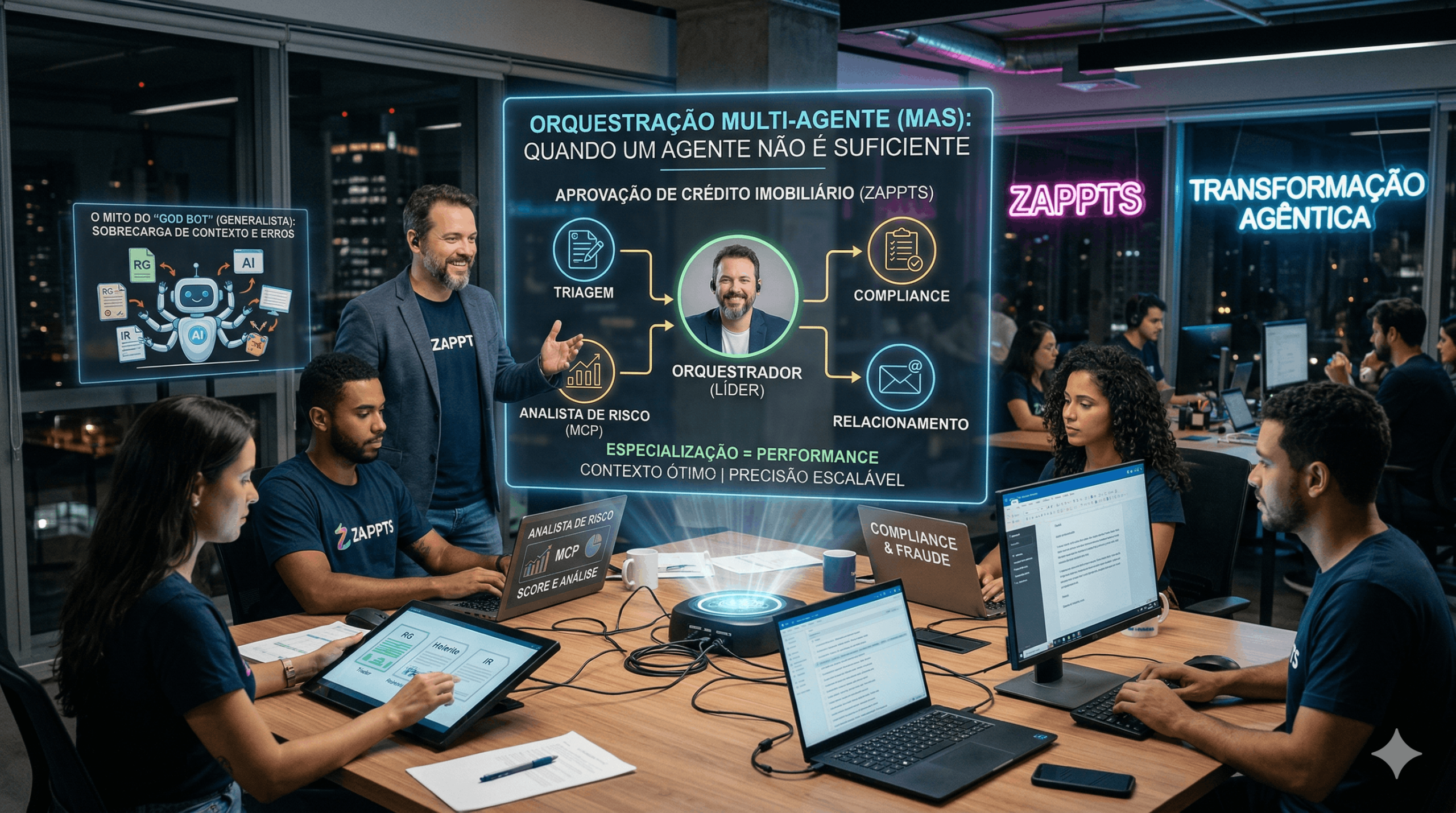
At Zappts, we don’t design “bots”, we design “digital organizational charts”. Let’s apply this to a real case: Mortgage Credit Approval.
Traditional Approach (Flawed): A single agent receives the customer’s PDF, tries to read it, validates in Serasa, calculates income and delivers the verdict. Result: Frequent errors and lack of explainability.
Multi-Agent Approach (Zappts): We create a virtual team coordinated by an Orchestrator:
- Triage Agent (The Doorman): Receives the document, verifies if it is legible and classifies it (ID, Payslip, Tax Return). If illegible, requests re-submission. Passes the ball.
- Risk Analyst Agent (The Technician): Receives extracted data, queries the Bureau (via MCP) and applies the mathematical credit policy. It does not talk to the customer. It generates a “score”.
- Compliance Agent (The Lawyer): Verifies if the customer is a Politically Exposed Person (PEP) or if there are frauds in the CPF.
- Relationship Agent (The Communicator): Receives the technicians’ verdict (Approved/Rejected) and writes the final email to the customer with empathy and the brand’s voice tone.
Each agent uses a different model (a cheaper one for triage, a more robust one for risk) and has different tools. They talk to each other, exchanging JSONs, until the work is completed.
Implications for Organizations
Adopting M.A.S. changes how IT builds software:
- Complex Debugging: When something goes wrong, was it the Analyst’s or Compliance’s fault? Observability (Tracing) needs to monitor the conversation between the robots.
- Coordination Cost: Multiple agents mean multiple LLM calls. The cost increases, but the success rate (accuracy) increases disproportionately, justifying the investment in critical processes.
Strategic Recommendations
For CTOs, CIOs, Solution Architects and Product Heads:
- Map the Flow, Not the Screen: Design the process on a whiteboard as if you were hiring people. “Who does what?”. These “who” will be your agents.
- Start by separating agents within the flow: An agent that receives messages and analyzes intents, directing to different agents depending on the intent, agents that play the role of guard-rails, multi-agent cells that process tasks, curation and audit agents, agents that return the response. All or many of these may be in sequence or run in parallel, but they specialize in tasks.
- Multi-Agent Cells with Supervisor Pattern: A Leader Agent that receives the user’s demand and decides which sub-agent to trigger.
- Don’t overdo it: If the task is simple (“What’s the weather forecast?”), one agent is enough. Orchestration is for processes, not for tasks.
Conclusion
In the corporate world, we have already learned that centralizing all operations in a single person is the sure recipe for creating bottlenecks and errors. With Artificial Intelligence, the rule is exactly the same. The true Agentic Transformation is not about trying to create a “super-robot” that solves all the company’s problems, but rather about designing an architecture where different digital specialists collaborate efficiently and securely. If the goal is to scale with precision, it’s time to stop thinking about building “one bot” and start orchestrating “a team”.
About the Author
Rodrigo Bornholdt is Co-founder and Chief Technology Officer at Zappts, specialized in Software Architecture and Artificial Intelligence, with solid experience in technology team leadership, complex systems development, and innovation applied to business strategies.
About Zappts
Zappts is the leading consulting firm in agentic transformation in Brazil, helping companies evolve from digital to agentic. With over 10 years, Zappts creates, modernizes and evolves secure and scalable digital solutions for large organizations. Combining practical experience in software engineering, data and artificial intelligence, it integrates technology, methodology and processes accelerating value delivery with efficiency, quality and governance. Its performance ranges from strategy to the development of software applications and AI agents, being a reference in Brazil on the topic of artificial intelligence agents. Click here to learn more.
Share this article
Related articles

16 set 2026
The End of Passive SaaS: Why You’ll Pay for Outcomes, Not Seats
The traditional software pricing model based on per-user licenses (seat-based SaaS) faces an inevitable decline in 2026.

09 set 2026
The Timid Autonomy Dilemma: Why Keeping AI in a Suggestion-Only Role Is Killing Your Margins
This article analyzes the financial impact of this "timid autonomy" and advocates for an urgent shift to the "Human-on-the-loop" (HOTL) model.

02 set 2026
The "SaaSocalypse" is actually an architecture and identity crisis.
This article reverse-engineers a real-world success story (anonymized) from the financial sector, dissecting the layers of...