The Myth of "Human-in-the-Loop": Why We Need to Evolve to "Human-on-the-loop"
Summary, Core Thesis, Key Insights and Strategic Recommendations Summary The first generation of corporate AI was designed with a handbrake pulled: the "Human-in-the-Loop" (HITL) paradigm, where every machine action requires human approval. Although safe, this model destroys economies of scale. This article advocates the transition to the "Human-on-the-loop" (HOTL) model, where the human acts as a strategic supervisor and auditor, intervening only in exceptions, allowing the agentic operation to gain exponential speed. [...]
22 de abril de 2026
Summary, Core Thesis, Key Insights and Strategic Recommendations
Summary
The first generation of corporate AI was designed with a handbrake pulled: the “Human-in-the-Loop” (HITL) paradigm, where every machine action requires human approval. Although safe, this model destroys economies of scale. This article advocates the transition to the “Human-on-the-loop” (HOTL) model, where the human acts as a strategic supervisor and auditor, intervening only in exceptions, allowing the agentic operation to gain exponential speed.
Core Thesis: Keeping humans in the transactional execution loop (validating every e-mail or click) turns AI into merely an incremental productivity tool (Copilot), limiting ROI. True Agentic Transformation requires the human to leave the assembly line and climb to the control tower, auditing the process instead of performing the task.
Key Insights:
- The Biological Bottleneck: If your AI processes 1,000 requests per minute, but your human can only approve 1 per minute, your system’s speed is 1, not 1,000.
- Decision Fatigue: Humans who spend all day just clicking “Approve” on AI suggestions go into autopilot and end up approving errors (Rubber Stamping), negating the promised security.
- Management by Exception: The future of work is not doing; it’s correcting what AI couldn’t do with high confidence.
Strategic Recommendations:
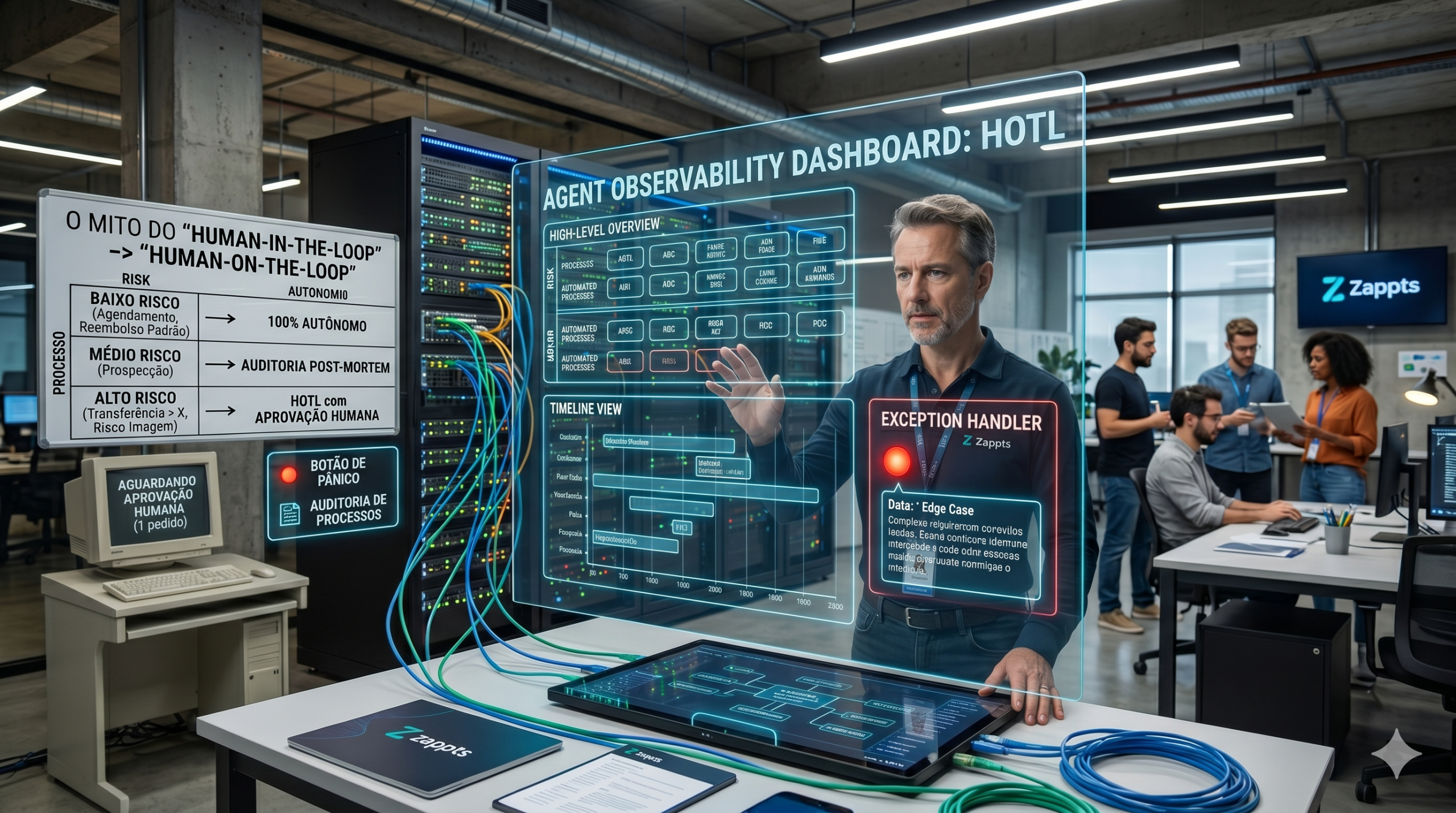
- Classify processes by risk: Low risk (meeting scheduling) should be 100% autonomous. High risk (bank transfer above X) should require human approval.
- Implement “Agent Observability” dashboards so managers can see workflow in real time without stopping operations.
- Train the team to act as “AI Trainers”, correcting the agent’s logic when it errs, instead of just correcting the final result.
Context and Business Problem
When companies start automating with AI, fear takes over. “What if the bot says something stupid to the customer?”. The standard IT and Business response is: “Let’s put a human in place to approve everything before sending.”
Thus Human-in-the-Loop (HITL) is born. In this model, AI writes the e-mail but does not send it. It generates the report but does not publish it. The human needs to read, validate, and click “OK”. Initially, this brings comfort. But quickly, it becomes an operational nightmare. The human, who should be doing strategic work, becomes a “validation badge.” They spend all day reading machine-generated text. Productivity does not increase; only the type of boredom changes.
Market Drivers: The Need for Speed
The market is penalizing human latency.
- Real-Time Expectation: The customer requesting a refund on Saturday night does not want to wait until Monday morning for a human to approve. They want instant resolution.
- Opportunity Cost: While your human salesperson is validating prospecting e-mails one by one, the competitor’s agent has already contacted 5,000 leads and scheduled 50 meetings autonomously.
- Trust Evolution: Modern models, when anchored in real data (RAG) and with robust engineering, achieve accuracy rates above 95% in standardized tasks, making human review redundant in most cases.
Strategic Analysis: Climbing to the Control Tower
Zappts proposes the evolution to Human-on-the-loop (HOTL). The difference is subtle in the preposition but massive in operations.
- In-the-loop: The human is a cog in the machine. If they leave for lunch, the machine stops.
- On-the-loop: The human is the factory operator. The machine works on its own. The human looks at the dashboards, adjusts parameters, and intervenes only when a red light comes on.
How to implement HOTL safely: We define Control Parameters.
- Scenario A: The Agent is 99% confident the answer is correct. Action: Execute automatically. A portion (or all) is submitted for auditing to evaluate the process for continuous improvement.
- Scenario B: The Agent is 70% confident (e.g., smudged document, ambiguous customer). Action: Forward to the human review queue (Human Handoff).
This way, the human works less, but their work has much more value. They only solve the difficult cases, the “Edge Cases,” while AI clears the massive volume of trivial cases.
Implications for Organizations
Adopting HOTL requires cultural maturity:
- Tolerance for Controlled Error: In massive volumes, AI will make mistakes. But humans also make mistakes. The question is: is the cost of AI error lower than the cost of human slowness? In most low-risk processes, yes.
- Accountability: Who answers for the agent’s error? In the HOTL model, the “process owner” is responsible for continuously auditing and refining the agent’s prompts.
Recommendations for CTOs and Technology Leaders
For CTOs, COOs, and Process Leaders:
- Audit the “Acceptance Rate”: If your humans approve 99% of AI suggestions without changing anything, remove the human from that loop. They are not adding value; they are just adding cost and time.
- Create the “Panic Button”: The system must allow the human to take manual control of any interaction at any time. AI autonomy is a revocable permission, not an inalienable right.
- Focus on Post-Mortem Auditing: Instead of checking before doing, check a random sample after it’s done (Quality Assurance). Use these insights to improve the system.
Conclusion
The goal of AI is not to turn the human into a faster robot, clicking approval buttons. It is to free the human to be human: empathetic, creative, and strategic. Take your people out of the machine. Put them in command of the machine. Agentic Transformation only happens when we have the courage to trust the automation we built.
About the Author
Rodrigo Bornholdt is Co-founder and Chief Technology Officer at Zappts, specialized in Software Architecture and Artificial Intelligence, with solid experience in technology team leadership, complex systems development, and innovation applied to business strategies.
About Zappts
With 12 years of experience, Zappts is a technology and innovation company that is a reference in Agentic Transformation for large corporations. The company has accumulated more than 280 projects executed and 1 million engineering hours for sectors such as finance, healthcare, retail, and energy. It is the creator of the AI Panorama in Brazil, a survey that maps national technological maturity, and a reference in the implementation of AI agents integrated into the core business with a focus on governance, ROI, and operational efficiency. Click here to learn more.
Share this article
Related articles

16 set 2026
The End of Passive SaaS: Why You’ll Pay for Outcomes, Not Seats
The traditional software pricing model based on per-user licenses (seat-based SaaS) faces an inevitable decline in 2026.

09 set 2026
The Timid Autonomy Dilemma: Why Keeping AI in a Suggestion-Only Role Is Killing Your Margins
This article analyzes the financial impact of this "timid autonomy" and advocates for an urgent shift to the "Human-on-the-loop" (HOTL) model.

02 set 2026
The "SaaSocalypse" is actually an architecture and identity crisis.
This article reverse-engineers a real-world success story (anonymized) from the financial sector, dissecting the layers of...