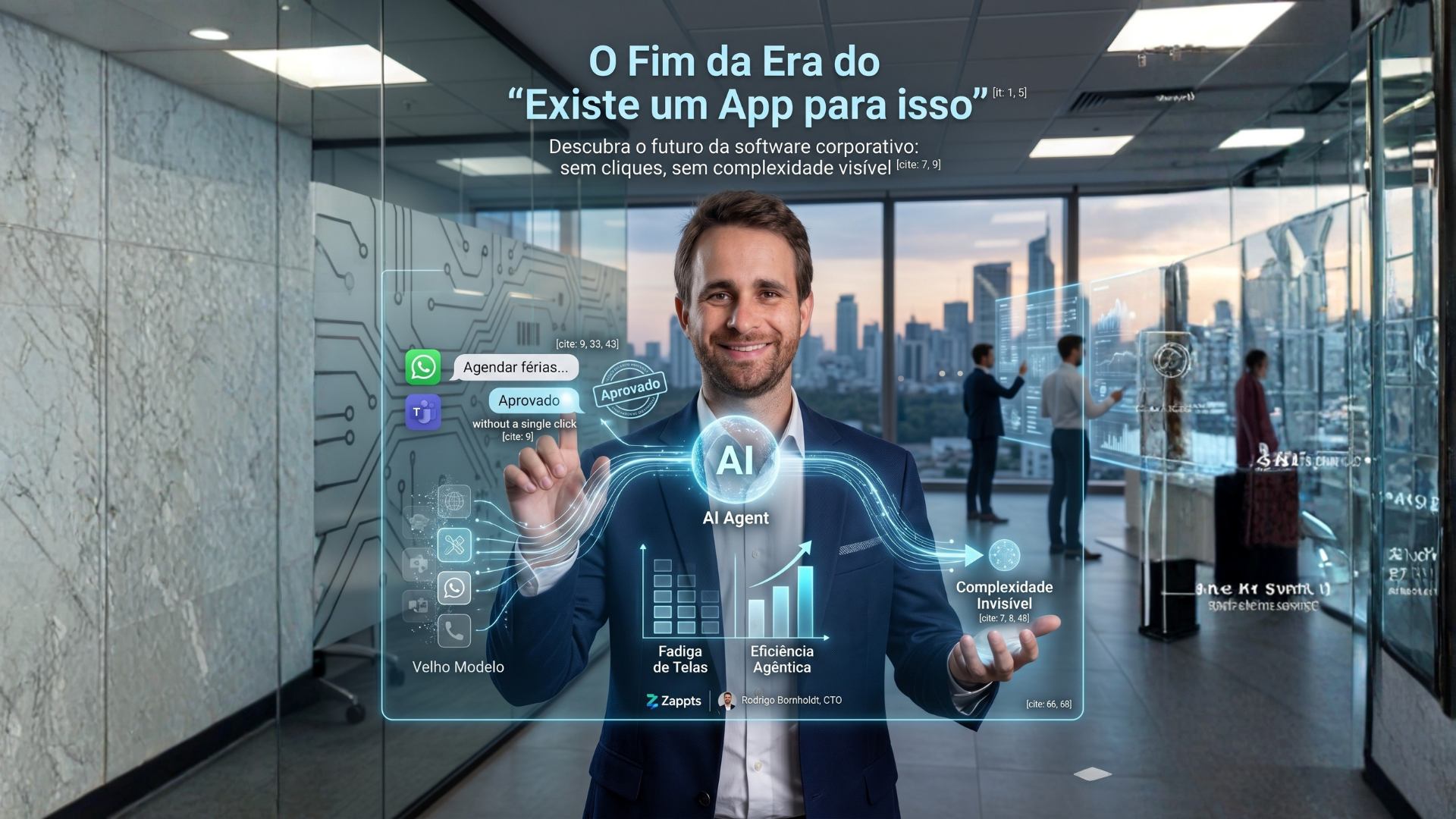
The End of the App: Why Conversational Interfaces Will Dominate Your Market?
Summary, Core Thesis, Key Insights and Strategic Recommendations Summary The era of "There's an App for that" created a fragmented and cognitively exhausting software ecosystem. The modern user doesn't want to learn to navigate new menus; they just want the job done. This article decrees the decline of the complex Graphical Interface (GUI) [...]
15 de maio de 2026
Summary, Core Thesis, Key Insights and Strategic Recommendations
Summary
The era of “There’s an App for that” created a fragmented and cognitively exhausting software ecosystem. The modern user doesn’t want to learn to navigate new menus; they just want the job done. This article decrees the decline of the complex Graphical Interface (GUI) in favor of the Conversational Interface (CUI), where software complexity becomes invisible and interaction occurs via natural language.
Core Thesis: The ultimate interface is not a prettier dashboard, but the absence of interface (“Invisible App”). The future of corporate software lies in AI Agents that live where the user already is (Microsoft Teams, Slack for internal teams, WhatsApp, Alexa for external access), transforming complex intentions (“Book vacation”, “Approve budget”) into transactions executed without clicks.
Key Insights:
- The Cognitive Cost of Navigation: Every click, every dropdown menu, and every login page is a barrier to productivity. Conversation “flattens” information architecture: any feature is one sentence away.
- From “Learn to Use” to “Know How to Ask”: Software training becomes obsolete. If the user can speak English, they can operate the most complex system in the company.
- The Corporate Super-App: Instead of maintaining 50 internal apps that nobody uses, or a small fraction uses a few of them, companies will consolidate everything into a single intelligent chat channel.
Strategic Recommendations:
- Stop investing in aesthetic redesigns of legacy portals and invest in creating “Skills” for the Corporate Chatbot.
- Adopt the concept of Generative UI: When conversation is not enough, the AI draws a temporary micro-form on the screen only for that moment, and then it disappears.
- Integrate Agents with existing collaboration channels (Teams/Slack), avoiding forcing the user to install yet another application.
- Integrate your company with external agents and existing channels, such as WhatsApp, Alexa, among others, positioning your company where the user already is, where they are used to interacting, where they concentrate all their interactions.
Context and Business Problem
For 20 years, IT’s answer to any business problem was: “Let’s build an App”. Or “Let’s create a Portal”. The result is the digital chaos we live in today. The average employee switches between 9 and 13 different applications per day. They have to remember where the “Request Vacation” button is (is it in the ERP? In the HR Portal? In the Intranet?).
This friction generates “Shadow IT”: the user gives up on the complex official system and solves everything by personal email or WhatsApp, losing traceability. The problem is not the lack of features, it’s the Graphical Interface (GUI). Visual interfaces require the user to understand the mental model of the designer who created the system. This is inefficient.
Market Drivers: The Rise of Conversation
The shift to invisible interfaces is driven by:
- Screen Fatigue: Nobody wants to download another app. Corporate app retention rates are abysmal.
- LLM Maturity: Before, chatbots were dumb (“Press 1 for Invoice”). Today, with language models, they understand vague intentions (“I need that invoice from the cleaning supplier from last month”) and execute the complex search on their own.
- Chat Ubiquity: WhatsApp and Teams have become the de facto operating systems of work and personal life. Software must go there.
Strategic Analysis: The Agentic Experience (AX)
Zappts proposes the transition from UX (User Experience) to AX (Agent Experience).
Current Scenario (GUI):
- User wants vacation.
- Opens HR Portal -> Login -> “My Time” Menu -> “Absences” Submenu -> “New Request” Button -> Selects Date on Calendar -> Clicks Submit.
- Time: 3 minutes. Frustration: Medium.
Future Scenario (CUI):
- User opens WhatsApp, Teams, or Company Google Chat.
- Types (or speaks): “I want vacation in the second half of October.”
- Agent: “Understood. From 10/15 to 10/30? You have balance. Can I send it for your manager’s approval?”
- User: “Yes.”
- Time: 15 seconds. Frustration: Zero.
The complexity (checking balance, calculating business days, notifying manager) did not disappear; it became invisible. The Agent absorbed the complexity so the human wouldn’t need to navigate it.
Implications for Organizations
This change eliminates the need for large Frontend teams and screen and interface Designers for internal systems and increases the need for Prompt Engineers and Conversation Designers.
- Accessibility: Conversational systems are natively more accessible for people with visual or motor disabilities.
- Training Reduction: The onboarding of a new employee boils down to: “Here is the Agent’s contact. Ask it for whatever you need.”
Recommendations for CTOs, CIOs and Heads:
For CTOs, CIOs and Heads of Product and Digital:
- Adopt the “Chat-First” strategy: When digitalizing a new process, ask: “Does this really need a screen or can it be a conversation?”.
- Explore “Generative UI”: Use technologies where the AI generates visual components (charts, tables, buttons, forms) within the chat only when necessary. The best of both worlds.
- Watch out for Latency: Chat interfaces need to be fast. If the Agent takes too long to respond, the illusion of a “fluid conversation” breaks. Use the engineering techniques from the Article “Latency, Cost and Hallucination: The Trio That Kills AI Projects in Production”.
- Authentication and authorization: The channels already bring, naturally and securely, who the user is at each interaction. Therefore, they already arrive authenticated. So worry about solving authorization: Manage access tokens so the user can navigate your company using their own authorization, their own accesses, ensuring the user will always access the internal information they are already authorized to access.
Conclusion
The best design is the one you don’t see. The “App” as a final destination tends to be replaced. The future belongs to intelligent services that float in the air, ready to respond to any command, on any channel, at any time. Is your company building software to be clicked or intelligence to be conversed with?
About the Author
Rodrigo Bornholdt is Co-founder and Chief Technology Officer at Zappts, specialized in Software Architecture and Artificial Intelligence, with solid experience in technology team leadership, complex systems development, and innovation applied to business strategies.
About Zappts
With 12 years of experience, Zappts is a technology and innovation company that is a reference in Agentic Transformation for large corporations. The company has accumulated more than 280 projects executed and 1 million hours of engineering for sectors such as finance, healthcare, retail and energy. It is the creator of the AI Panorama in Brazil, a survey that maps national technological maturity, and a reference in the implementation of AI agents integrated with core business focusing on governance, ROI and operational efficiency. Click here to learn more.
Share this article
Related articles

16 set 2026
The End of Passive SaaS: Why You’ll Pay for Outcomes, Not Seats
The traditional software pricing model based on per-user licenses (seat-based SaaS) faces an inevitable decline in 2026.

09 set 2026
The Timid Autonomy Dilemma: Why Keeping AI in a Suggestion-Only Role Is Killing Your Margins
This article analyzes the financial impact of this "timid autonomy" and advocates for an urgent shift to the "Human-on-the-loop" (HOTL) model.

02 set 2026
The "SaaSocalypse" is actually an architecture and identity crisis.
This article reverse-engineers a real-world success story (anonymized) from the financial sector, dissecting the layers of...