Navigating the Gartner Agentic AI Hype Cycle 2026: How to Escape "Agent Washing" and Scale AI Agents with Value Engineering
This article dissects Gartner's projections and shows why technical governance and pragmatic methodologies are vital for companies...
17 de junho de 2026
Summary, Central Thesis, Key Insights and Strategic Recommendations
Summary
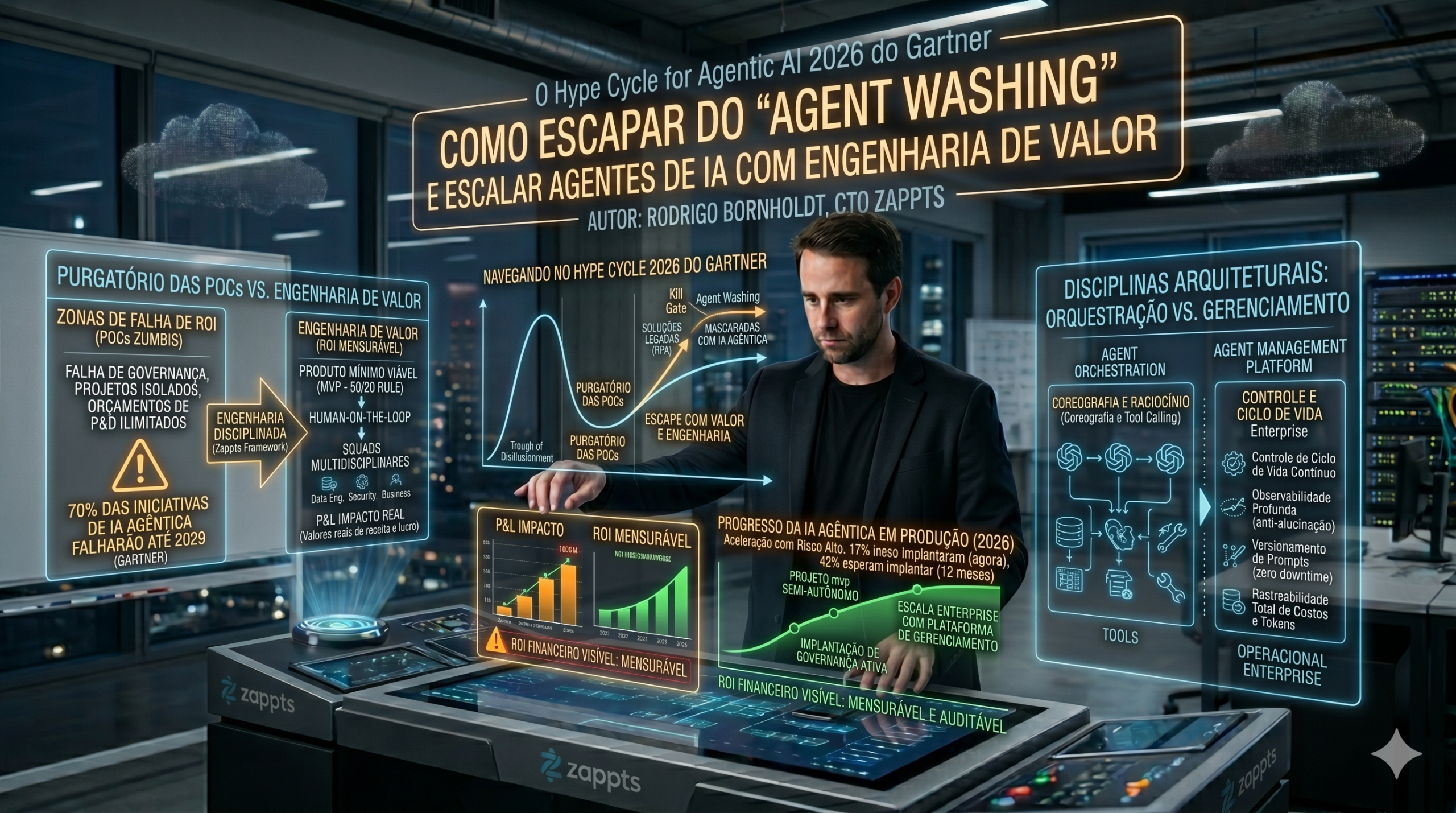
The Gartner Hype Cycle for Agentic AI 2026 confirms extreme interest and substantial investments in automation capabilities, but brings a critical warning: rapid progress in agentic AI is being outpaced by hype and confusion. This article dissects Gartner’s projections and shows why technical governance and pragmatic methodologies are vital for companies looking to take their projects out of “POC Purgatory” and generate real P&L impact.
Central Thesis: The corporate market faces a new and dangerous obstacle classified by Gartner as “Agent Washing”. Vendors are masking legacy automation solutions (RPA) with the label of AI Agent platforms. To avoid being part of the over 70% of agentic AI initiatives that will fail by 2029 due to lack of use case optimization and governance failures, organizations need rigorous methodologies based on the Minimum Viable Product (MVP) model. The difference between an innovation that never leaves the lab and a revenue-generating product is, purely, disciplined engineering.
Key Insights:
- Acceleration with High Risk: Only 17% of organizations have deployed AI agents so far, but 42% expect to do so in the next 12 months. The market focus remains on incremental automation.
- The End of the Total Autonomy Illusion: In practice, 100% autonomous agents are not ready for most corporate use cases. Semi-autonomous deployments, with human supervision of agent work, are the scenario companies should plan for. This validates the rule that the MVP must solve 80% of cases, leaving the remaining 20% for “Human-on-the-loop” control.
- The Danger of “Agent Washing”: The market is being obscured by false promises, making it difficult for buyers to distinguish real agentic AI capabilities from traditional automations dressed in new terminology.
Strategic Recommendations:
- Assume Semi-autonomy from the Start: Since human supervision remains essential, build architectures that guarantee human overflow routes (Human-in-the-loop) at the agent development stage.
- Implement “Kill Gates”: To escape zombie POCs, establish ruthless criteria to cancel projects cheaply and quickly in the first weeks if the ROI equation does not close.
- Replace Isolated Teams with Multidisciplinary Squads: Integrate Data Engineering, Security, and Business from Day 1 to prevent the technical team from building solutions disconnected from operational reality.
2026 Gartner Hype Cycle for Agentic AI
Gartner’s latest report dedicated entirely to Agentic AI marks a moment of critical maturity for the market. By positioning innovations in the adoption cycle, the consultancy highlights two essential architectural disciplines that separate amateur projects from Enterprise-level operations: Agent Orchestration and Agent Management Platform.
While orchestration focuses on the complex choreography of multiple language models, tool calling, and reasoning flows, the Management Platform acts as the central nervous system of corporate operations. Building an isolated agent on a laptop has become trivial; the real engineering challenge lies in provisioning a management platform that ensures continuous lifecycle control, deep observability against hallucinations, prompt versioning without service downtime, and total cost and token traceability. Executives who ignore this management layer are the first to experience performance degradation in production.
In this context, the warning about “Agent Washing” becomes the focal point of Gartner’s document. The market practice of repurposing traditional robotic process automation (RPA) solutions and selling them as cutting-edge AI tools is generating a trail of corporate frustration. Understanding the boundary between robust management frameworks and superficial promises is the primary step to avoid early project failure and justify multi-million dollar investments in the sector.
Implications for Organizations
- Zero Tolerance for Governance Risks: Much of the large-scale AI failure projected by Gartner (70% by 2029) will be caused by neglecting compliance, audit requirements, and end-user risk tolerance. Without security-by-design architectures, C-Level executives will not trust AI to operate sensitive data.
- The “Semi-autonomous” Operational Challenge: Preparing the company for agents means strongly aligning business with IT: the business owner must be available daily to review, validate deliveries, and act as supervisor for anomalies that AI cannot resolve (the famous 20% of vital human effort).
- Quarterly Delivery Cycle: Technology changes so fast that projects taking 6 months are born obsolete. Organizations must focus on rapid MVP for adoption and testing, always maintaining the technical rigor for transition to enterprise scale.
Recommendations for CEOs, CIOs, CTOs and Board Members
For the Board of Directors, CIOs, CTOs and CEOs:
- Audit Your Pipeline: List all current AI projects. If any has been in development for more than 3 months and has no real users, cancel or restructure it. Protect your portfolio against Agent Washing.
- Start Small, but Deep: Do not try to build a “Super App” in 90 days. Choose a vertical process and solve it completely, end to end, assuming that the human will be a continuous part of the supervision and approval cycle.
- Hire Accelerators: Do not try to build your LLM infrastructure from scratch. Partners that bring ready-made code libraries save months of initial setup and drastically reduce technical failure costs.
Conclusion
Corporate success in Artificial Intelligence requires combining cutting-edge research with flawless technical execution. The difference between a lab innovation and a revenue-generating product is disciplined engineering. With market illusions being exposed by Gartner, the safe path is to embrace semi-autonomy, reject masked tools, and focus solely on delivering measurable value.
About the Author
Rodrigo Bornholdt is Co-founder and Chief Technology Officer at Zappts, specialized in Software Architecture and Artificial Intelligence, with solid experience in technology team leadership, complex systems development, and innovation applied to business strategies.
About Zappts
With 12 years of experience, Zappts is a technology and innovation company that is a reference in Agentic Transformation for large corporations. The company has accumulated over 280 projects executed and 1 million hours of engineering for sectors such as finance, healthcare, retail, and energy. It is the creator of the Panorama of AI in Brazil, a survey that maps national technological maturity, and a reference in the implementation of AI agents integrated into core business with a focus on governance, ROI, and operational efficiency. Click here to learn more.
Share this article
Related articles

16 set 2026
The End of Passive SaaS: Why You’ll Pay for Outcomes, Not Seats
The traditional software pricing model based on per-user licenses (seat-based SaaS) faces an inevitable decline in 2026.

09 set 2026
The Timid Autonomy Dilemma: Why Keeping AI in a Suggestion-Only Role Is Killing Your Margins
This article analyzes the financial impact of this "timid autonomy" and advocates for an urgent shift to the "Human-on-the-loop" (HOTL) model.

02 set 2026
The "SaaSocalypse" is actually an architecture and identity crisis.
This article reverse-engineers a real-world success story (anonymized) from the financial sector, dissecting the layers of...