Model Context Protocol (MCP): The New Bridge Between Corporate Systems and AI
Introduction In recent years, Artificial Intelligence (AI) has gone from being just a technology innovation topic to becoming a strategic competitive differentiator. Organizations that manage to integrate AI into their daily operations are already reaping gains in productivity, operational efficiency, and new ways of creating value. But for AI to deliver its full potential, it needs a reliable bridge between AI agents and corporate systems. [...]
22 de agosto de 2025
Introduction
In recent years, Artificial Intelligence (AI) has gone from being just a technology innovation topic to becoming a strategic competitive differentiator. Organizations that manage to integrate AI into their daily operations are already reaping gains in productivity, operational efficiency, and new ways of creating value.
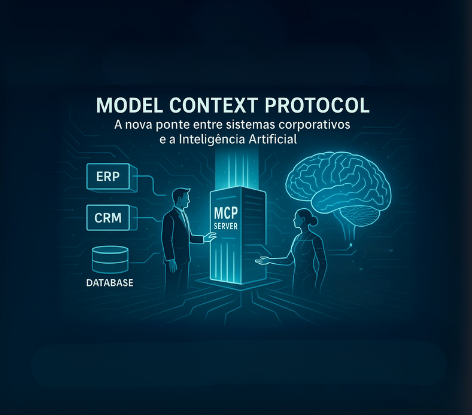
But for AI to deliver its full potential, it needs a reliable bridge between AI agents and corporate systems (ERPs, CRMs, databases, internal applications). This is exactly where the MCP (Model Context Protocol) comes in – a protocol that defines how AI agents can interact with corporate systems. In practice, this communication happens through an MCP Server, which provides tools and integrations following this standard.
More than just a technical term, MCP represents the evolution of how companies connect with AI and how intelligent agents can operate in business processes with security, scalability, and context.
What is MCP (Model Context Protocol)?
Simply put, MCP is a protocol that allows AI agents to communicate with both corporate systems and with each other, in a standardized way.
If traditional APIs function as a technical entry point, the MCP (protocol) defines a communication standard for these interactions to occur. The MCP Server, on the other hand, can be seen as an intelligent server that organizes, translates, and makes information available to AI agents in a structured and contextualized manner.
While an API responds to specific commands, MCP is capable of acting as an orchestrator, understanding different data sources and providing AIs with exactly what they need to execute a business task.
This difference is essential:
- API = technical integration between systems.
- MCP = context layer that connects AI + systems + business.
Why is MCP important for businesses?
Executives know that technology only makes sense when it delivers direct impact on results. In this regard, MCP offers clear strategic advantages:
- Integration agility: enables connecting new AI agents without the need for major customizations in each system.
- Reduced technical complexity: abstracts API details, simplifying communication between AI models and corporate systems.
- Focus on data value: instead of dealing with technical endpoints, the business starts working with contextualized information for decision-making.
- Scalability: as new AI use cases emerge, MCP ensures the company doesn’t need to reinvent integrations each time.
In summary, MCP enables AI to act as a real intelligence layer, interacting seamlessly with the organization’s processes.
MCP and AI Agents
One of the main transformation vectors of MCP is how it empowers corporate AI agents.
Imagine a business assistant that not only answers questions, but also:
- Queries customer history across different systems;
- Creates financial reports in real time;
- Updates records and operational information;
- Executes administrative tasks automatically.
All of this is possible because MCP provides AI with the right tools to act within the corporate environment.
While traditional APIs deliver raw data, MCP delivers data ready for action. This means AI can not only “read” information, but also execute complete workflows.
MCP and personal assistants
Personal assistants, such as Alexa, Siri, and others, are already very common in our daily lives. However, they came to market long before Generative AI, which makes them very limited. But soon, all of these will receive upgrades to become true personal assistants that use Generative AI, along with other personal assistants that will emerge already equipped with this technology. This tends to be the main form of human interaction, concentrating the management of daily activities, shopping, social media, and perhaps even financial transactions, being capable of executing complex tasks involving one or more of these capabilities in a single task.
Imagine, for example, that you are in your car, a few years ahead, and you have a personal assistant at the steering wheel called “Alex.” You then, without needing to divert your attention from traffic, without needing to take your hands off the wheel to press buttons, say: “Alex, could you add the screwdriver that’s on my favorites list from that shopping app, close the cart, pay with my primary credit card, and fill in my home address for delivery?” At this point, Alex will have access to all your apps and will be able to complete this task for you.
But what does this have to do with MCP? Everything! The connections of these personal assistants with services will only be possible using a protocol like MCP. Just as you need an API layer for your store to connect to marketplaces (for example), MCP is the way to make your application available to assistants.
In other words, for your business to be present in the future of human interaction, it will be mandatory to have an MCP Server configured to connect to assistants.
The future of business with MCP
MCP represents a fundamental step for intelligent assistants to become an active part of companies’ daily operations.
Today we can already see scenarios like:
- Executives interacting with corporate assistants that orchestrate scheduling systems, CRM, reports, and e-commerce in a single conversation.
- AI agents acting as copilots for sales, marketing, and operations teams, bringing context and personalized recommendations in real time.
- End-to-end automated processes, where MCP ensures the security and consistency of communication between AI and the company’s legacy systems.
- Personal assistants: Only with MCP will it be possible to connect your business to personal assistants.
We are not talking about the future, but the present. Companies that already explore MCP and AI agents are creating a competitive advantage that is difficult to achieve with traditional integrations alone.
Conclusion
The Model Context Protocol (MCP) is not just another technological advancement. It is the foundation for companies to extract real value from Artificial Intelligence, transforming the way agents communicate, understand, and act in business processes.
Executives who want to keep their organizations competitive need to view MCP as a strategic innovation layer, as important as the adoption of APIs was years ago.
At Zappts, we believe that MCP will be one of the great enablers of the new era of AI in business.
👉 Want to understand how MCP can transform your company?
Talk to Zappts experts and discover how to apply AI agents and MCP to accelerate results and create new value opportunities.
Share this article
Related articles
16 set 2026
The End of Passive SaaS: Why You’ll Pay for Outcomes, Not Seats
The traditional software pricing model based on per-user licenses (seat-based SaaS) faces an inevitable decline in 2026.

09 set 2026
The Timid Autonomy Dilemma: Why Keeping AI in a Suggestion-Only Role Is Killing Your Margins
This article analyzes the financial impact of this "timid autonomy" and advocates for an urgent shift to the "Human-on-the-loop" (HOTL) model.

02 set 2026
The "SaaSocalypse" is actually an architecture and identity crisis.
This article reverse-engineers a real-world success story (anonymized) from the financial sector, dissecting the layers of...