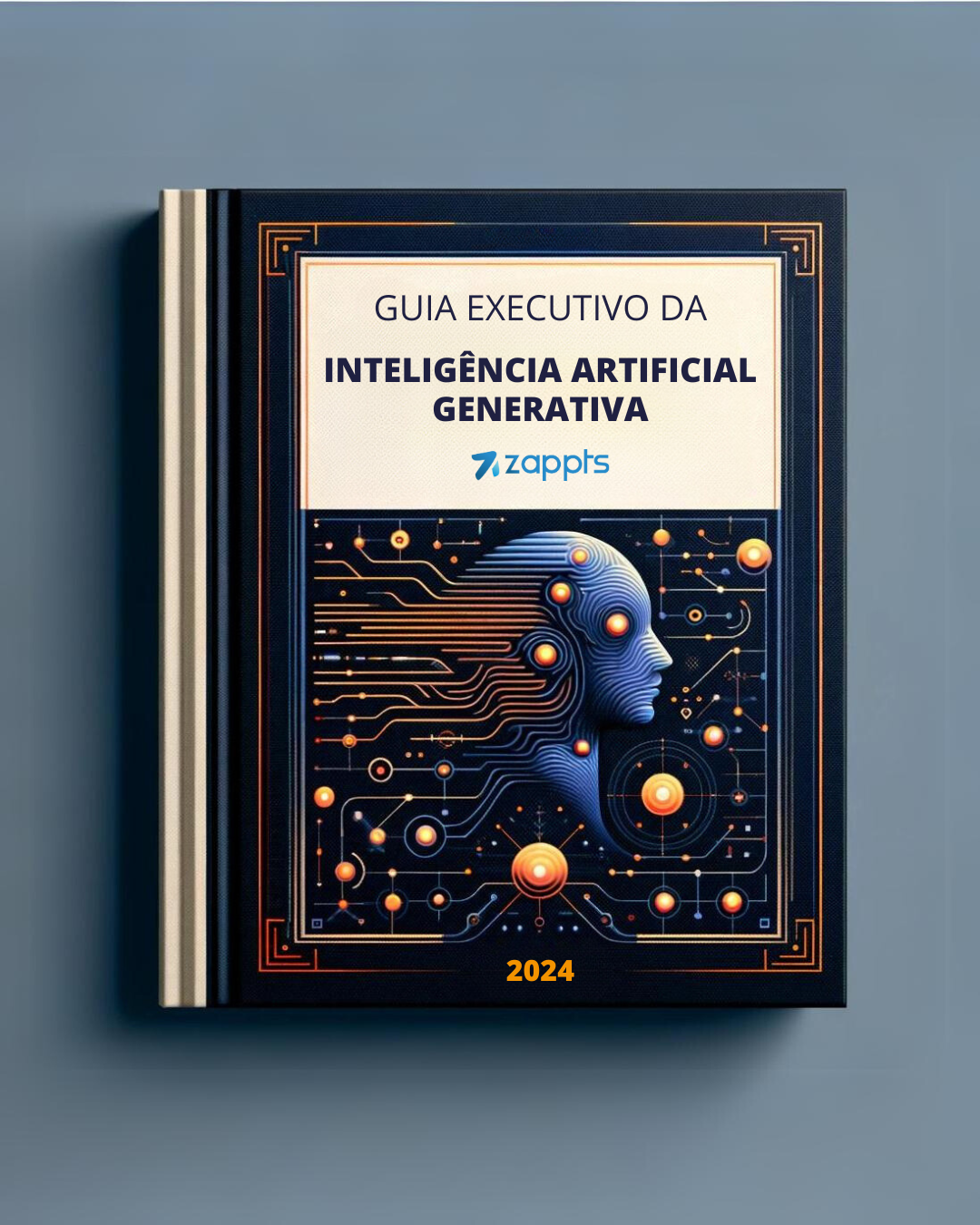
Executive Guide to Generative Artificial Intelligence: Transforming data into innovative strategies
Introduction Generative AI represents a technological revolution with the potential to transform the world as we know it. A Google Cloud survey revealed that 82% of organizations believe in the transformative potential of generative AI. The differentiator of this technology lies in its accessibility and versatility, allowing anyone with basic internet search knowledge to generate[…]
11 de abril de 2024
🟠Introduction
Generative AI represents a technological revolution with the potential to transform the world as we know it. A Google Cloud survey revealed that 82% of organizations believe in the transformative potential of generative AI. The differentiator of this technology lies in its accessibility and versatility, allowing anyone with basic internet search knowledge to generate content, images, summarize texts, and other functions, simply with natural language commands.
McKinsey & Company estimates that generative AI could add between $2.6 trillion and $4.4 trillion annually to the global economy, through increased personal and corporate productivity. This guide aims to equip business leaders, especially in the technology sector, with the knowledge needed to begin implementing and exploring generative AI in their processes, products and services. To this end, the Executive Guide on Generative AI, developed by Google Cloud, was taken into consideration and is available in full here.
🟠Generative AI Concepts
Generative AI stands out for its ability to help solve everyday problems in an intuitive and fast way. Its potential is amplified by the capacity of a single platform to serve multiple use cases, improving with the increase of users and applications. This technology relies on models trained with vast datasets, enabling content generation, enhanced research, process automation and information discovery with unprecedented efficiency.
Generative AI is defining the future of technology by enabling machines to understand, interpret and create content autonomously. This form of artificial intelligence uses advanced algorithms to analyze large volumes of data, learning from them and generating new data based on this learning. Unlike other AIs that are limited to making decisions based on pre-existing data, generative AI is capable of creating text, images, music and even software code that did not exist before. This not only expands the scope of automation to include creative tasks, but also introduces a new paradigm where machines can be partners in the creative process, helping and inspiring humans in their quest for innovation.
One of the pillars of generative AI are foundational models, trained with a vast range of information. They are at the heart of AI’s ability to generate relevant content adapted to diverse contexts. These models, such as GPT (Generative Pre-trained Transformer), have revolutionized the way we interact with technology, making it more intuitive and natural.

🟠Step-by-step Guide for Implementing Generative AI
Google Cloud’s guide proposes a ten-step roadmap for implementing generative AI, from identifying a specific application domain to expanding to other use cases. It highlights the importance of assembling a multidisciplinary team, defining data sources, establishing success metrics (KPIs) and gradually expanding the use of technology based on concrete feedback and performance analysis. Check out the ten steps below.
Identify a specific domain
Choose a company area that could significantly benefit from generative AI, such as customer service or marketing. Evaluate where employees spend time on repetitive tasks or where access to and analysis of large volumes of data could optimize processes or innovations.
Select a profile
Determine the specific work category or function within the chosen domain to make more efficient. Consider factors such as difficulty filling positions, the repetitive nature of tasks, and the importance of work for revenue generation.
Determine data sources
Identify the data necessary for the chosen profile to operate effectively, considering both internal and external information. This includes, for example, customer data, interaction histories, internal knowledge bases, and market information.
Create a specialized team
Form a group with three specialists including a business professional to define requirements, a prompt engineer to convert needs into AI commands, and an ML operations leader to ensure effective system deployment. You can count on specialized partners like Zappts in this case.
Define objectives and desired outcomes
Clearly establish goals and what is expected to be achieved with the implementation of generative AI. This involves defining intentions, such as increasing efficiency, improving customer satisfaction or accelerating the development of new products.
Create prompts with the specialized team
Collaborate with the specialized team to develop effective prompts that direct the generative AI model to produce the desired outputs, considering business needs and available data.
Design user experience (UX) and user interface (UI)
Design a user experience and interface that facilitate interaction with generative AI, ensuring they are intuitive, accessible across multiple devices, and aligned with users’ workflows.
Expand use to more people
After initial testing and adjustments, gradually expand the use of generative AI, inviting more users of the chosen profile to interact with the model, collecting feedback for continuous refinements.
Create a language model (LM) operations plan
Develop a detailed plan to manage, monitor and optimize the performance of the generative AI model, ensuring its effectiveness and operational security over time.
Expand usage to other use cases
Based on initial success and learnings, explore the application of generative AI in other use cases within the same domain, expanding its benefits and impact on the organization.
🟠Key Generative AI Indicators
Before diving into the details of KPIs for Generative AI, it is essential to understand the importance of establishing clear and measurable metrics to evaluate the success and impact of this technology within an organization. The implementation of Generative AI represents a significant advance in how companies innovate, automate processes, and engage with customers and employees. Therefore, defining appropriate KPIs not only helps measure return on investment, but also provides valuable insights for continuous improvement of AI applications. As we explore these metrics, let us remember that KPIs serve as beacons, guiding organizations on their digital transformation journey and enabling them to maximize the benefits of Generative AI in a strategic and responsible manner.
Productivity
Assessment of productivity increase in the profile or department impacted by generative AI, considering the number of tasks completed per unit of time and the reduction in manual effort required.
Customer satisfaction
Use of satisfaction surveys or customer feedback to measure the effectiveness of generative AI in meeting customer needs and expectations.
Accuracy
Determination of the accuracy of generative AI models in generating relevant and correct results, quantified by metrics such as precision, F1 score, recall, or mean squared error.
Business impact
Identification of specific business metrics impacted by generative AI, such as increased sales, reduced customer complaints, or higher employee retention.
Training time and cost
Assessment of the time and resources required to train and fine-tune the generative AI model, including value return time.
Cost savings
Analysis of cost savings obtained through the use of generative AI, comparing the cost of AI systems with expenses associated with manual or outsourced processes.
Scalability
Assessment of the generative AI model’s ability to handle increased usage or demand, essential for long-term success.
Output quality
Assessment of the quality of results generated by generative AI, based on predefined criteria and, depending on the use case, manual reviews or automated quality checks.
Response time
Measurement of the time the generative AI model takes to generate responses or results compared to traditional methods, aiming for increased efficiency and improved customer experience.
Error rate
Monitoring how frequently the generative AI model produces incorrect or undesirable results, seeking to minimize this rate to maintain accuracy and reliability.
Human oversight metric
For generative AI processes that include human oversight, monitoring metrics related to the efficiency and effectiveness of supervision.
Regulatory compliance
For domains dealing with sensitive information, such as health or finance, verification of compliance with regulatory requirements and relevant data privacy standards by the generative AI system.
🟠Sectoral Application of Generative AI
This chapter presents specific use cases for different sectors, including retail, financial services, health, media, manufacturing, and communication services. Practical examples of companies already leveraging generative AI to transform their operations are detailed, demonstrating the vast potential of the technology to innovate, automate processes, and create new business opportunities.
- Retail and Consumer Goods: Content creation assistance, conversational commerce, customer service automation, and new product development.
- Financial Services: Financial document research and synthesis, advanced virtual assistance, capital market research, and compliance and regulatory automation.
- Health and Biological Sciences: Digital concierge for patients, contextual research, expedited prior authorization, and clinical trial report generation.
- Media and Entertainment: Media content discovery, content creation assistance, internal document and media research, and consumer-brand interaction.
- Industry and Manufacturing: Machine-generated event monitoring, customer service automation, and technical and engineering document research and synthesis.
- Service Providers: Customer service automation, network operations and planning, advertising and creative content assistance, and contract analysis and negotiation.

🟠Artificial Intelligence for Business Decisions
Zappts stands out by combining the most advanced Machine Learning techniques with the deployment of Generative Artificial Intelligence for business decisions at scale, offering solutions that analyze large datasets to reveal hidden patterns, anticipate market trends and support strategic decisions, in addition to creating and applying generative AI models that have the potential to transform sectors. This integrated approach allows Zappts to optimize operations, increase efficiency, drive sustainable growth and explore new forms of engagement and innovation for its clients, personalizing experiences and creating unique content, staying ahead in the digital age. Learn about some of the services offered by Zappts below.
- Algorithm analysis and optimization: We evaluate and improve ML algorithms for specific adaptation to different types of data and use scenarios.
- Recommendation system evaluation: We review and improve systems to provide more accurate and relevant personalized recommendations.
- Predictive analytics implementation: We develop models that anticipate future events based on historical data.
- Business process optimization: We apply ML to automate and improve business operations, reducing costs and increasing efficiency.
- Classification and regression model development: We create models to categorize data or predict continuous values, supporting a wide range of business applications.
- Generative AI Consulting: Expert guidance to develop strategies and implement generative AI solutions, helping companies identify innovation opportunities and maximize return on investment.
- Large Language Model (LLM) Development and Fine-tuning: Services that include generating and improving training data for fine-tuning language models, adapting them to specific business needs to generate content, code, or automated solutions.
- Custom LLM Applications: Development of sector-specific applications that use generative AI to transform business processes, from automatic content generation to innovative solutions for business challenges.
- Exclusive (Private) LLM Instance for Confidential Data: Implementation of private and secure language models, ensuring that clients’ confidential data is processed in a controlled and protected environment, respecting all data privacy regulations.
🟠Conclusion: Accelerating Innovation
This article provides a comprehensive overview of the transformative impact of generative AI in the business environment and the global economy. Generative AI is a technology capable of increasing personal and corporate productivity, potentially adding billions to the world economy. Through a detailed exploration of the fundamental concepts of generative AI, the article illustrates how this technology enables autonomous content generation, from text to images and music, expanding the scope of automation to encompass creative tasks and establishing a new paradigm of cooperation between machines and humans in the creative process.
In addition to highlighting the technological revolution promoted by generative AI, the article offers a pragmatic roadmap for its implementation. This roadmap, ranging from identifying application domains to expanding to new use cases, underscores the importance of a multidisciplinary team, clear definition of success metrics, and adaptation based on concrete feedback to maximize the potential of generative AI. By providing sectoral use cases and emphasizing Zappts’ integrated approach, which combines Machine Learning techniques with generative AI to drive business decisions, the article underscores this technology’s unparalleled capacity to innovate, automate processes, and personalize interaction with customers and users, positioning it as a key element at the forefront of digital transformation.
🟠About Zappts
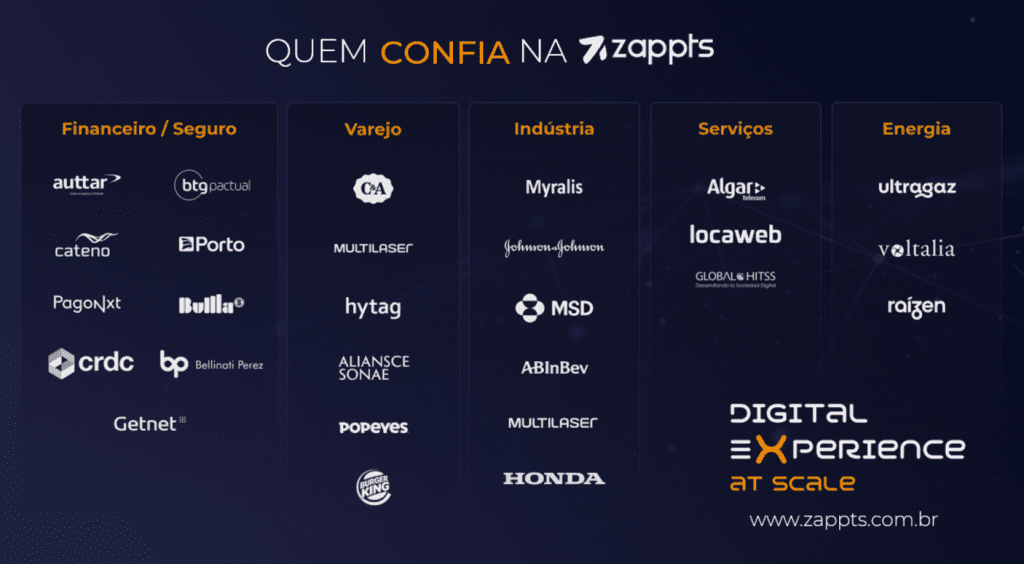
Since 2014 in the market, Zappts supports leading market brands such as Porto, Getnet, BTG Pactual, Cateno, Ambev, Multilaser, Ultragaz, C&A and Burger King, among others, ensuring scalability of digital experiences. Focused on software development, especially in Front-end, UX Design, Quality Assurance and Cloud Environment Management, it acts in the planning, management and operation of corporate digital solution development services, environment management and knowledge transfer through information technology. The company is a reference in creating digital experiences for users, in addition to developing innovative and fast solutions, operating in a 100% remote model, with teams distributed across more than 18 states in Brazil.
Share this article
Related articles

16 set 2026
The End of Passive SaaS: Why You’ll Pay for Outcomes, Not Seats
The traditional software pricing model based on per-user licenses (seat-based SaaS) faces an inevitable decline in 2026.

09 set 2026
The Timid Autonomy Dilemma: Why Keeping AI in a Suggestion-Only Role Is Killing Your Margins
This article analyzes the financial impact of this "timid autonomy" and advocates for an urgent shift to the "Human-on-the-loop" (HOTL) model.

02 set 2026
The "SaaSocalypse" is actually an architecture and identity crisis.
This article reverse-engineers a real-world success story (anonymized) from the financial sector, dissecting the layers of...