
Developing an Agile Business Beyond Technology: Key Trends and Metrics
Learn how agile practices like Design Thinking, Scaled Agile Frameworks, and DevOps can transform beyond technology, bringing operational efficiency and innovation to the entire organization.
18 de setembro de 2023
If you are a technology leader looking for ways to align your company with current trends and drive agility across all departments, this article is for you. Discover how Agile, Design Thinking, Scaled Agile Frameworks, DevOps, and agile metrics can transform your business.
Introduction
As the business world continues to evolve at an accelerated pace, agility has become a critical factor for success. However, agility is no longer restricted to the technology domain. Technology leaders, such as directors, managers, and coordinators from various areas, are increasingly recognizing the importance of applying agile practices throughout the organization, beyond the IT department.

Agile Beyond IT: Expanding Horizons
The Agile concept has evolved far beyond software development, unfolding into a philosophy that permeates all corporate sectors. Technology leaders are eager to explore the applicability of agile principles in departments as diverse as marketing, human resources, sales, and operations. This strategic expansion of Agile not only optimizes internal processes but also establishes a new paradigm of collaboration and adaptation across the entire organization.
Today, organizations adopting Agile Beyond IT are aligning their culture with the fundamental values of this approach: transparency, collaboration, and flexibility. Leading technology analysis authorities highlight that effective implementation of Agile across all sectors can trigger a notable increase in business responsiveness to market changes. As technology leaders drive this transformation, they not only enhance internal innovation but also shape a culture ready to embrace emerging opportunities with agility and confidence.
Design Thinking and Agile: Powering Innovation
The synergy between Design Thinking and Agile has stood out as a transformative approach in the pursuit of relevant innovation. Putting the customer at the epicenter of the creation process is not just an intention, but a strategic imperative. By integrating agile methods with Design Thinking principles, technology leaders are empowering their teams to dive into customer needs in a holistic and empathetic way.
The union of these methodologies allows companies not only to meet customer expectations but also to anticipate their undeclared needs. Market research highlights that this approach significantly increases the chances of developing solutions that truly solve customer problems. As technology leaders adopt this approach, they are not only improving products and services but also building a culture of innovation that transcends the conventional, generating tangible impact on business results.

Scaled Agile Frameworks: Efficient Coordination at Scale
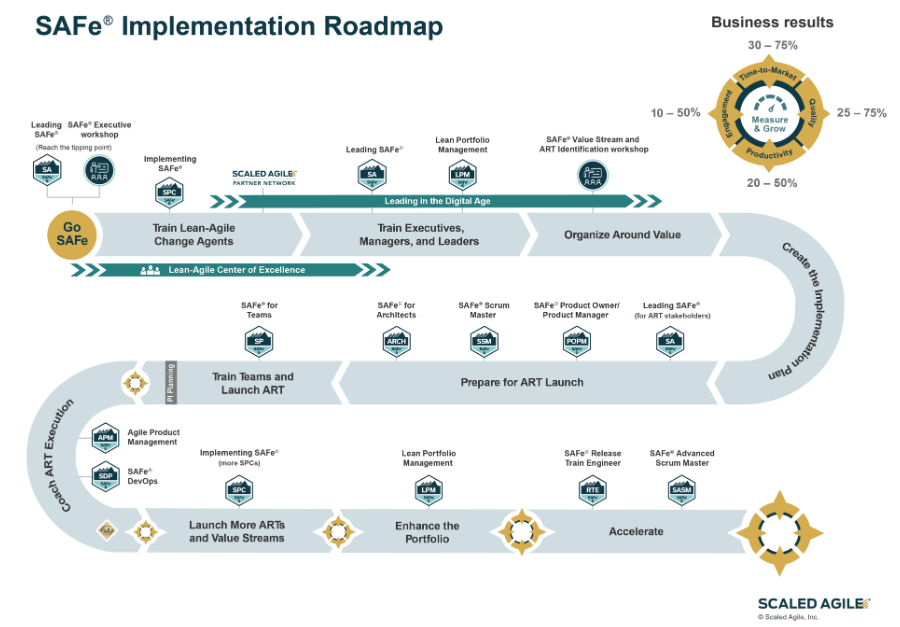
As companies expand their operations and seek to deliver results in an increasingly complex context, efficient coordination between agile teams becomes an imperative. In this scenario, Scaled Agile Frameworks (SAFe, LeSS, Nexus) emerge as reliable guides to face this challenge. SAFe, for example, offers a comprehensive and structured approach to scaling Agile, enabling distributed and interdependent teams to collaborate harmoniously while maintaining focus on value delivery.
Successful implementation of these frameworks is anchored in the creation of integrated workflows, aligning organizational strategies with agile execution and maintaining transparent communication between teams. International studies, many conducted by respected institutions such as Gartner and Forrester, indicate that companies adopting these structures observe significant improvement in operational efficiency, product quality, and the ability to adapt quickly to market changes. As technology leaders seek to direct their organizations toward continuous success, the strategic adoption of Scaled Agile Frameworks emerges as a solid response to face the challenges of agile scalability.
DevOps and Continuous Integration: Aligning Development and Operations
In a scenario where delivery speed and quality are competitive imperatives, collaboration between development and operations, known as DevOps, emerges as a strategic approach to promote faster and more reliable deliveries. By aligning these historically distinct departments, technology leaders create a synergy that is fundamental to accelerating the development cycle. A fundamental component of this process is Continuous Integration, a pillar of DevOps, which allows teams to combine their code changes continuously, reducing conflicts and facilitating the delivery process.
Gartner, a respected authority in technology research, highlights that organizations adopting DevOps can experience a notable increase – up to 50% – in the frequency of successful implementations. This gain is driven by improved collaboration between teams, process automation, and a more results-oriented approach. Beyond improving operational efficiency, adopting DevOps also translates into greater reliability of the final product and greater responsiveness to market changes. As technology leaders seek to optimize the development workflow, DevOps and Continuous Integration emerge as an effective path to achieve tangible results in a constantly evolving competitive environment.

Business Value Metrics and Product Quality: Measuring Agile Success
In the agile context, measuring success goes beyond traditional productivity metrics. Technology leaders are increasingly turning to Business Value Metrics to assess the financial impact of agile projects. Metrics like ROI (Return on Investment) and VAC (Value Added to Customer) offer a holistic and tangible view of the financial benefits generated by these initiatives. This results-oriented approach provides a clear understanding of how agile projects contribute to the organization’s overall results.
Furthermore, the quality of the delivered product is a critical factor in agile success. Product Quality Metrics, such as customer satisfaction and defect rates, act as barometers of agile practices effectiveness. Ensuring that the delivered value is of high quality not only reinforces customer trust but also solidifies the organization’s reputation in the market. Therefore, companies that adopt an agile metrics-oriented approach are more likely to achieve exceptional results, driven by clarity, transparency, and focus on tangible outcomes.
Business Vision in Brazil and Beyond
The agile context transcends borders, being especially relevant in the Brazilian business scenario. Companies in Brazil are adopting agile approaches in various spheres to remain competitive in a constantly changing environment. According to local studies, successful Agile implementation has generated notable results. An average increase of 30% in operational efficiency and customer satisfaction is highlighted as one of the fruits harvested by agile adoption in the country.
This success is not just a coincidence, but rather the reflection of technology leaders who embraced and led this transformation. By directing their teams beyond software development and exploring agile approaches in various areas, these leaders are positioning their organizations to stand out in an increasingly dynamic market.

Conclusion
In a business landscape that is constantly evolving, technology leaders have a crucial role to play in embracing and driving agility across all organizational spheres. As we explore the facets of Agile Beyond IT, Design Thinking, Scaled Agile Frameworks, DevOps, and agile metrics, it becomes evident that these are not just concepts, but the pillars that sustain effective transformation and excellence in modern business.
The wealth of insights from renowned institutions such as Gartner and Forrester supports the conviction that the intelligent application of these trends can catalyze notable growth in corporate results. By strategically implementing these approaches, technology leaders can guide their organizations toward an agile future full of success. The ability to adapt quickly, innovate impactfully, and measure progress with results-oriented metrics solidifies a company’s position in a constantly changing world. By embracing these paradigms, technology leaders not only ensure the resilience of their organizations but also pave the way for sustainable growth and lasting competitive advantage.
About Zappts
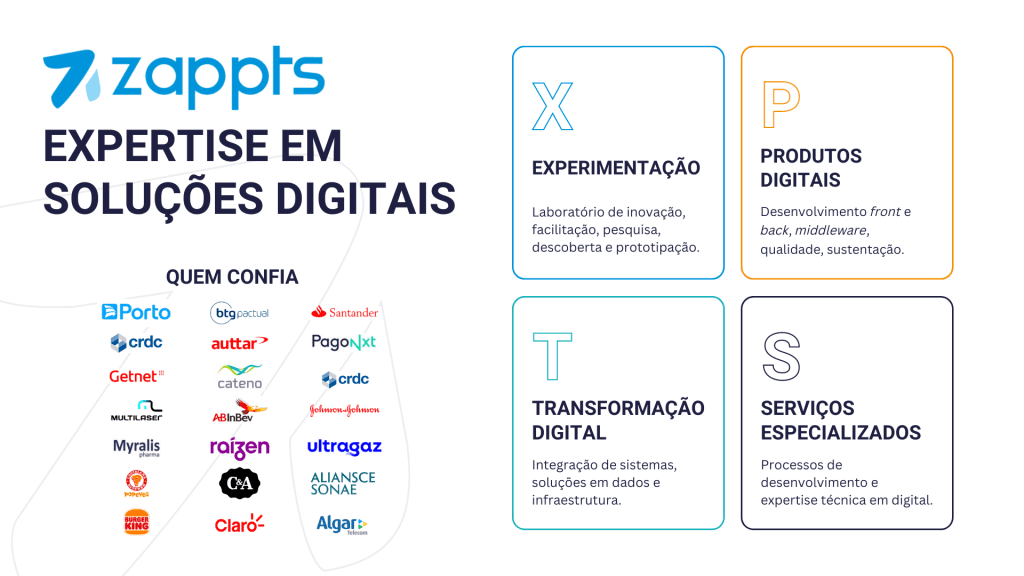
Since 2014 in the market, Zappts supports leading brands in their markets, such as Porto, Getnet, BTG Pactual, Cateno, Ambev, Multilaser, Ultragaz, C&A and Burger King, among others. Focused on software development, especially in Front-end, UX Design, Quality Assurance and Cloud Environment Management, it operates in the planning, management and operation of corporate digital solution development services, environment management and knowledge transfer through information technology.
We are a reference company in creating digital experiences for users, in addition to developing innovative and fast solutions, operating in a 100% remote model, with teams distributed across more than 18 states in Brazil.
To learn more about how Zappts can help your company, click here, and schedule a free assessment with our tech consultants.
Share this article
Related articles

16 set 2026
The End of Passive SaaS: Why You’ll Pay for Outcomes, Not Seats
The traditional software pricing model based on per-user licenses (seat-based SaaS) faces an inevitable decline in 2026.

09 set 2026
The Timid Autonomy Dilemma: Why Keeping AI in a Suggestion-Only Role Is Killing Your Margins
This article analyzes the financial impact of this "timid autonomy" and advocates for an urgent shift to the "Human-on-the-loop" (HOTL) model.

02 set 2026
The "SaaSocalypse" is actually an architecture and identity crisis.
This article reverse-engineers a real-world success story (anonymized) from the financial sector, dissecting the layers of...