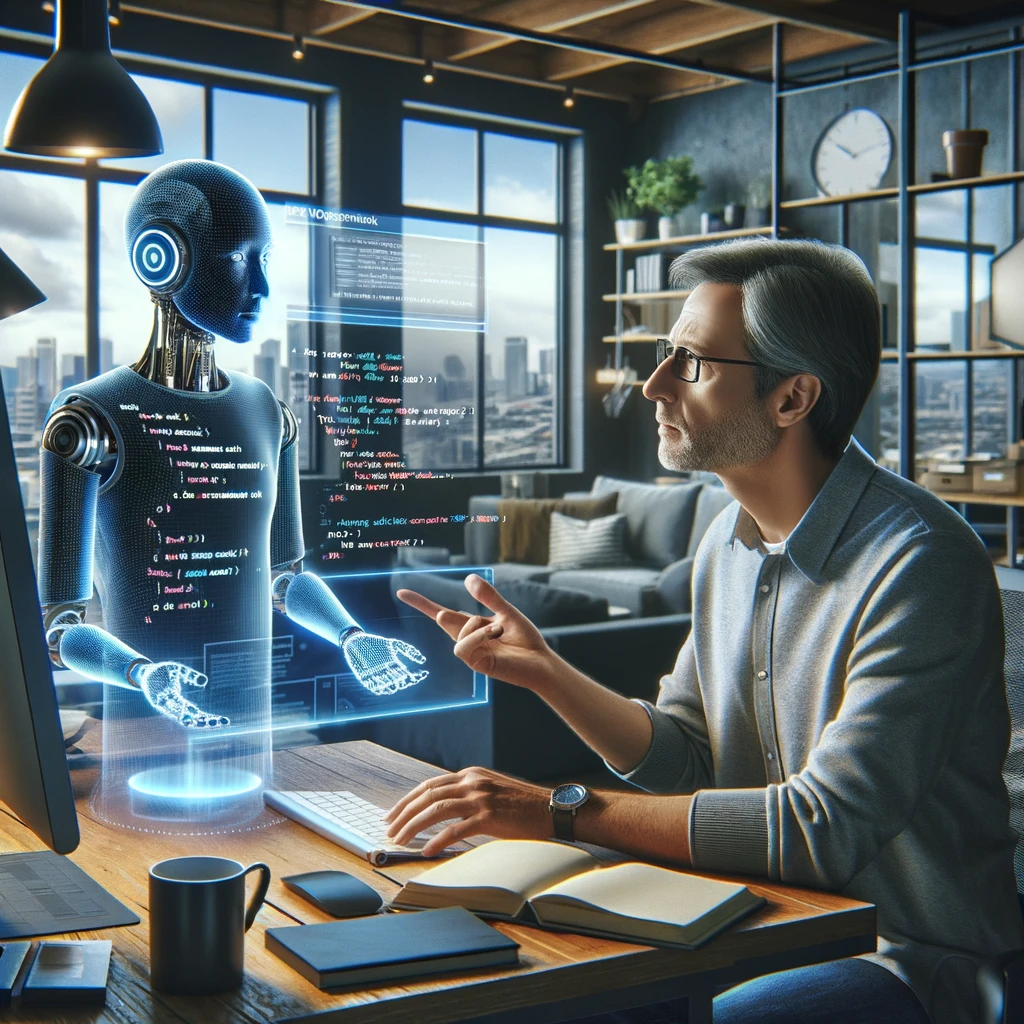
How to Improve Software Development with Artificial Intelligence
🟠Introduction As we enter a new era of technological innovation, Artificial Intelligence (AI) is positioned at the center of significant transformations in the field of software development. With a projection of $3 trillion being invested in AI by companies by 2027, according to Gartner, AI is ready to redefine the […]
29 de maio de 2024
🟠Introduction
As we enter a new era of technological innovation, Artificial Intelligence (AI) is positioned at the center of significant transformations in the field of software development. With a projection of $3 trillion being invested in AI by companies by 2027, according to Gartner, AI is ready to redefine existing paradigms in software engineering.
This article explores how AI is shaping the future of software development, identifying opportunities, mitigating risks, and defining the crucial role of human developers in this new frontier.
🟠The Impact of AI on Software Engineering
Transformation of the Engineer’s Role
Contrary to popular concerns, AI is not here to replace software developers, but to enhance their skills. Forrester research reveals that 71% of companies are experiencing real use cases for generative AI, with expectations of significant growth in their operations and productivity. This reflects a rapid increase in the adoption of this technology, pointing to a substantial positive impact on the corporate environment, and the need for technology teams to make better use of AI algorithms.
Redefinition of Processes
The integration of AI in software development is transforming multiple stages of the development lifecycle:
Design and Documentation
AI assists in user interface design and in writing user stories and requirements, enabling greater strategic alignment.
- Detailing: AI facilitates the automatic generation of technical specifications and detailed documentation, reducing human errors and accelerating the development cycle.
- User Interface (UI): AI can suggest UI layouts based on usage and accessibility patterns, ensuring applications are both functional and aesthetically pleasing.
- User Experience (UX): AI tools analyze user behavior to suggest UX improvements, enhancing user retention.
Development and Debugging
AI tools can accelerate resource development, bug fixing, and support requests while enabling true continuous delivery.
- Automatic Code Completion: Beyond completing lines of code, AI can provide entire templates based on design patterns, significantly accelerating the coding process.
- Code Generation: Beyond accelerating resource development, AI can generate base code for applications from high-level descriptions. Beyond starting projects, AI can provide code blocks for common functionalities such as database connections and APIs.
- Automated Debugging: AI identifies and suggests bug fixes faster than traditional methods, using advanced techniques such as machine learning to recognize problematic patterns.
- Continuous Integration: AI contributes to continuous integration and delivery processes (CI/CD), automating testing and deployment, ensuring software can be developed and released faster and more reliably.
Quality Assurance with AI: Testing and Maintenance
Automation through AI improves testing processes, building a robust architecture to evaluate software functionality end-to-end.
- Test Automation: AI can create and run automated tests, adjusting them as the software evolves, to ensure comprehensive coverage.
- Predictive Maintenance: Using historical data and usage patterns, AI can predict failures or areas of software that require maintenance, enabling proactive interventions.
- Performance Optimization: AI analyzes application performance under different conditions and configurations to suggest improvements.
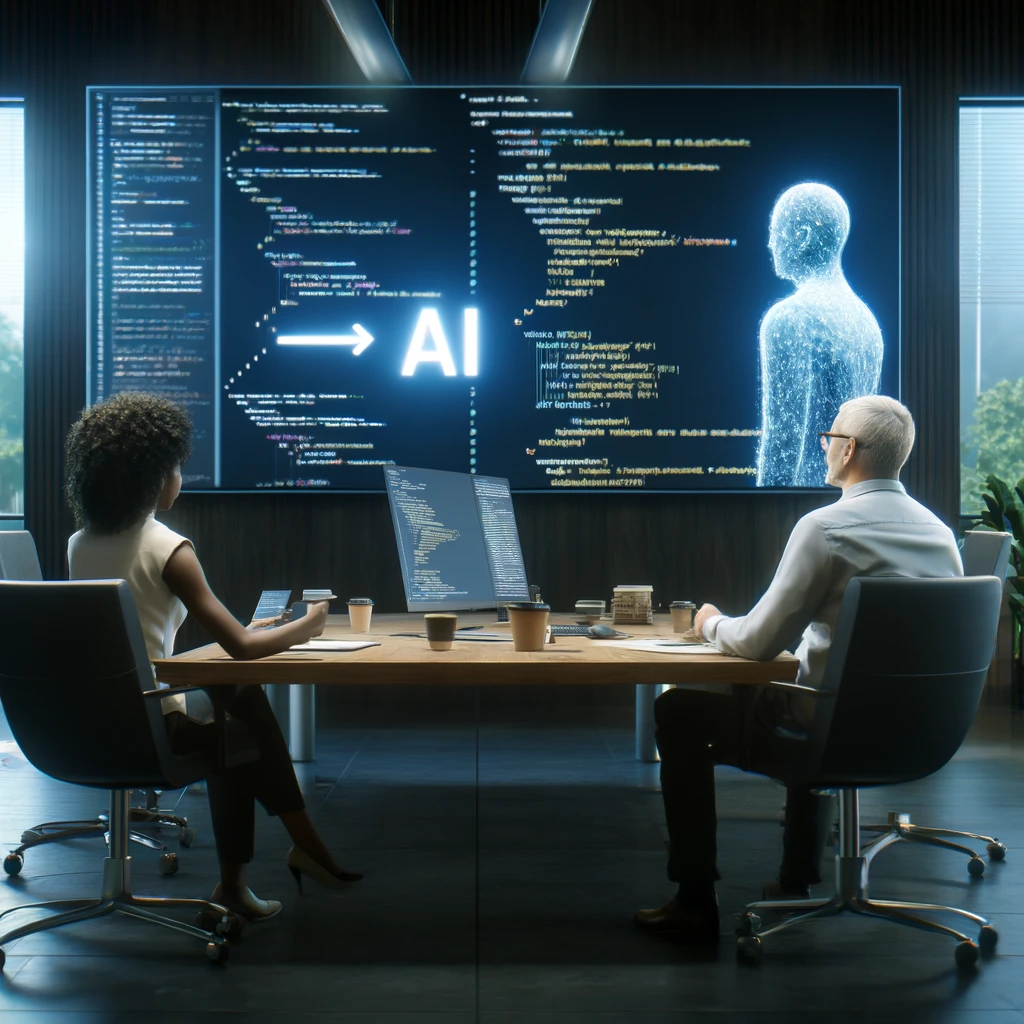
Image generated by the author using Generative AI software
🟠Opportunities and Challenges of AI Code
Expanded Capabilities
AI in software development is not a silver bullet, but offers significant advantages:
Automation of Routine Tasks
Performs repetitive tasks freeing developers to focus on more complex problems.
- Workflow Management: AI can organize and prioritize tasks, adapting the workflow in real time to maximize team efficiency.
Optimization of Existing Code
Ideal for small edits and optimizations, improving efficiency.
- Code Refactoring: AI suggests and performs refactoring to improve code readability and maintainability without changing its external behavior.
- Algorithm Improvement: AI analyzes code to identify and replace algorithms with more efficient versions.
🟠Need for Human Supervision
Despite significant advances in AI for software development, human supervision remains essential for several reasons:
Complexity and Context
- Strategic Decisions: In complex software projects, strategic decisions still require human intuition and understanding. Developers can assess nuances and long-term implications that AI may not fully capture.
- Adaptation to Changes: In dynamic environments, human developers are needed to quickly adapt development strategies in response to market changes or business requirements, something AI may not do autonomously.
Integration and Strategic Application
- System Integration: Effective integration of new AI systems with legacy systems often requires specialized knowledge and deep understanding of the existing technology ecosystem.
- Governance and Compliance: Human developers are crucial to ensure all AI solutions comply with legal and ethical regulations, an area where human sensitivity and discernment are irreplaceable.
Creativity and Innovation
- Human-Driven Innovation: While AI can optimize and improve existing processes, disruptive innovation often comes from human insights that challenge the status quo and introduce new approaches.
- User-Centered Design: Developers and designers use empathy and direct user feedback to create experiences that meet human needs intuitively, something AI is still learning to replicate.
Team Management and Leadership
- Team Dynamics: Leaders and project managers play a crucial role in motivating, guiding, and managing development teams, ensuring collaboration and communication are efficient and effective.
- Professional Development: The guidance and professional development provided by human leaders are essential for the personal and professional growth of team members, helping them adapt to new technologies and grow in their careers.
🟠Risks Associated with AI in Software Development
Inherent Challenges
The adoption of AI brings risks that need to be proactively managed:
Technological Dependency
Restructuring around AI can create dependencies that are problematic if access to technology is interrupted.
- Failures and Interruptions: Dependence on AI systems can be problematic if technical failures or service interruptions occur.
- Software Updates: Changes in AI systems may require frequent software adaptations, increasing maintenance costs.
Security and Privacy
AI tools must be meticulously monitored to ensure they do not compromise data security.
- Rigorous Monitoring: It is essential that all AI tools are subjected to constant monitoring to prevent any compromise of data security. Robust audit and access control implementations must be established to detect and respond to suspicious activities in real time.
- AI Vulnerabilities: AI systems can introduce new security vulnerabilities. For example, machine learning models may be susceptible to data poisoning attacks, where maliciously altered input data can compromise model integrity. Implementing rigorous input validations and continuous monitoring of model behavior are crucial measures to mitigate such risks.
- Data Management: AI data handling and storage must follow the strictest privacy and security standards. This includes encryption of data at rest and in transit, as well as compliance with global regulations such as GDPR (General Data Protection Regulation) and LGPD (Lei Geral de Proteção de Dados).
- Privacy by Design Principles: Incorporating privacy by design principles in AI system development is essential to ensure user privacy is a priority from the design phase. This involves integrating privacy controls directly into system architecture and AI process operations.
- Incident Response: The incident response framework must be robust and agile, with clear plans and procedures for handling data leaks or security breaches. Specialized cybersecurity teams must be trained to respond quickly to emerging threats and to execute recoveries of compromised systems.
🟠Mitigation Strategies
It is crucial to develop strategic approaches to mitigate risks, including:
Research of Specific Use Cases
Adapt AI tools to specific needs.
- Relevance Validation: Ensure each AI implementation meets a specific need, avoiding solutions in search of problems.
- Return on Investment (ROI) Analysis: Evaluate the potential impact of AI relative to implementation cost and effort.
Strengthening Security Safeguards
Establish rigorous reviews and prepare teams to respond to security breaches quickly.
- Security Audits: Conduct regular audits on AI implementations to identify and mitigate potential risks.
- Updates and Patches: Keep AI systems updated with the latest security measures.
Team Training and Development
Expand AI literacy among developers and non-developers to make the most of its capabilities.
- AI Training: Expand AI understanding among all team members, not just developers.
- Cross-Skill Development: Encourage the development of skills in complementary areas such as cybersecurity and data analysis to maximize the effectiveness of AI solutions.
🟠Conclusion
While AI reshapes software development, technology leaders must equip themselves to explore its full potential, remaining faithful to ethical practices. The collaboration between AI and human developers promises to revolutionize not only how software is created, but also how it is conceived, tested, and implemented. By embracing AI, companies can position themselves at the forefront of technological innovation, ensuring a competitive and dynamic future.
To deepen your knowledge of AI, check out the “Executive Guide to Generative Artificial Intelligence: Transforming data into innovative strategies“, a guide developed by Zappts for business leaders, especially in the technology sector, to start implementing and exploring generative AI in their processes, products, and services.
🟠About Zappts
Since 2014 in the market, Zappts supports leading market brands such as Porto, Getnet, BTG Pactual, Cateno, Ambev, Multilaser, Ultragaz, C&A and Burger King, among others, ensuring scalability of digital experiences. Focused on software development, especially in Front-end, UX Design, Quality Assurance and Cloud Environment Management, it acts in the planning, management and operation of corporate digital solution development services, environment management and knowledge transfer through information technology. The company is a reference in creating digital experiences for users, in addition to developing innovative and fast solutions, operating in a 100% remote model, with teams distributed across more than 18 states in Brazil.
Share this article
Related articles
16 set 2026
The End of Passive SaaS: Why You’ll Pay for Outcomes, Not Seats
The traditional software pricing model based on per-user licenses (seat-based SaaS) faces an inevitable decline in 2026.
09 set 2026
The Timid Autonomy Dilemma: Why Keeping AI in a Suggestion-Only Role Is Killing Your Margins
This article analyzes the financial impact of this "timid autonomy" and advocates for an urgent shift to the "Human-on-the-loop" (HOTL) model.

02 set 2026
The "SaaSocalypse" is actually an architecture and identity crisis.
This article reverse-engineers a real-world success story (anonymized) from the financial sector, dissecting the layers of...