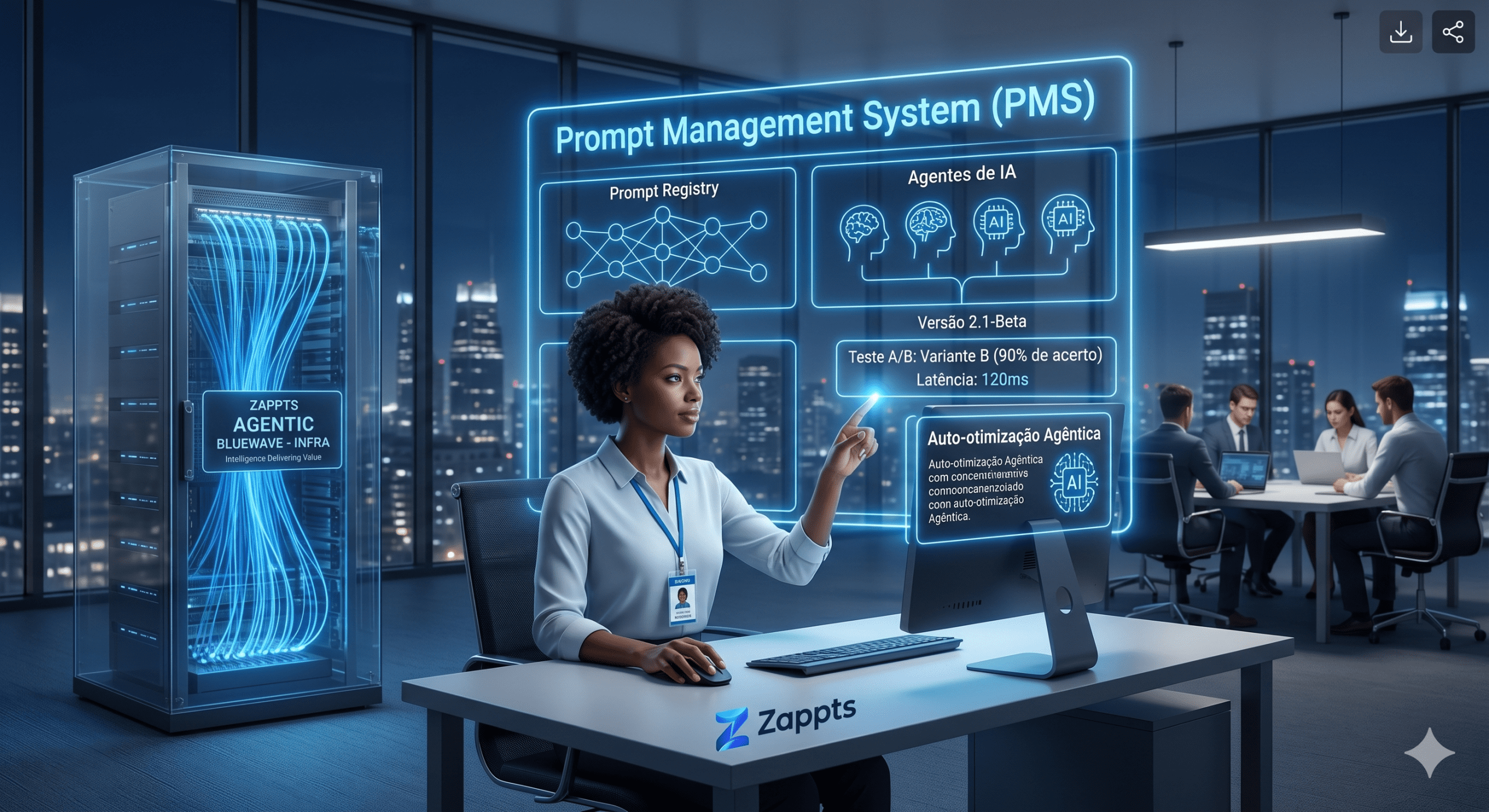
How Adopting a Prompt Management System (PMS) Will Boost the Performance of Your AI Agents
The current status of Agentic Transformation, the performance of an Artificial Intelligence agent is not determined only by the selection of...
24 de junho de 2026
Summary, Central Thesis, Key Insights and Strategic Recommendations
Summary
In the current stage of the Agentic Transformation, the performance of an Artificial Intelligence agent is not determined solely by the choice of the underlying language model, but by the precision, contextualization, and capacity for continuous evolution of its instructions. Many large enterprises face an invisible performance ceiling because they treat their prompts as static elements, hardcoded directly into the application code. This coupled approach creates a critical obstacle: it paralyzes the continuous improvement cycle, makes audits unfeasible, and prevents real-time metric evaluations.
Central Thesis: The central thesis of this article demonstrates that the transition from a hidden command in the repository to an environment managed by a Prompt Management System (PMS) repositions the prompt as a true business tool. By decoupling the cognitive layer from the deterministic software infrastructure, technology leaders unlock the agility needed to monitor, test, and optimize agent performance at the speed demanded by the corporate market, even allowing AI itself to act in the self-optimization of the system.
Key Insights:
- The main driver of AI adoption in Brazilian corporations has consolidated around the search for operational efficiency, registering a drastic leap from 33.3% in 2024 to 74.1% in 2025.
- Keeping prompts hardcoded eliminates the ability to conduct structured A/B testing and automated evaluations (Evals), stagnating the accuracy rate of mission-critical agents.
- Decoupling transforms the prompt into a dynamic business asset, transferring control of AI behavior from software development workflows to business analysts and domain experts.
- About 71% of technology leaders point to AI agents as the main competitive differentiator for the next three years, but the scale of this differentiator depends directly on an agile and adaptable governance architecture.
Strategic Recommendations:
- Eradicate cognitive imprisonment: Immediately replace the practice of embedding prompt strings in code with dynamic calls via IDs managed in a centralized repository (Prompt Registry).
- Implement data-driven governance (Evals): Condition any context or instruction change to clear metrics of cost, latency and accuracy, avoiding empiricism in AI evolution.
- Enable the agentic self-optimization loop: Configure the PMS ecosystem to allow evaluation agents to analyze production logs and suggest automatic improvements to the prompt base, accelerating the corporate AI learning curve.
The AI Performance Ceiling: How Hardcoding Suffocates Agent Evolution
When evaluating the lifecycle of a generative AI agent in production, the greatest risk to its effectiveness lies not in the computational limitations of the model, but in the obsolescence of its instructions. The business ecosystem is dynamic; new compliance rules emerge, customer behavior patterns change, and new exception scenarios arise daily.
If your agent’s prompt is hardcoded – embedded directly in the application’s source code – any attempt at evolution runs into what we call the “Rigid Code Nightmare.” To adjust a single line of context or refine a response to a hallucination detected in production, the technical team must open a Git branch, submit the text to a traditional code review, run complex CI/CD pipelines, and schedule a deployment window.
This operational friction generates three serious consequences that destroy system performance:
- Impossibility of Real Versioning: Without a PMS, the evolution history of agent behavior is diluted in Git commit messages. It becomes virtually impossible to track in isolation which specific semantic change in a paragraph caused a 5% improvement in conversion or generated a security breach.
- Paralysis of Evaluation Processes (Evals): AI refinement requires a scientific approach. To know whether prompt V2 is superior to prompt V1, it must be tested against a validation dataset. When the command is fused with software logic, isolating the impact of the instruction from changes in the microservices infrastructure becomes an architectural puzzle.
- Erosion of Continuous Improvement: Due to the technical bureaucracy required to change a text in production, innovation teams tend to postpone small optimization adjustments. The agent enters a state of behavioral stagnation, distancing itself from the corporate goal of achieving high performance and operational stability (99.99% Uptime).
Breaking the Traditional Architecture: Chassis vs. Cognitive Engine
The definitive mitigation of this scenario relies on a classic software architecture principle: Separation of Concerns. In the context of agentic workflows, this principle dictates the surgical isolation between two structures:
- Infrastructure (The Chassis): Represents the rigid and deterministic code of the system. It is the layer responsible for managing memory persistence, token and quota control, authentication, tool calling orchestration, and API connections. The chassis ignores the semantic content of the command; it only executes the technical lifecycle.
- Content (The Cognitive Engine): It is the textual instruction (the prompt) that dictates the persona, scope, ethical boundaries, and logical behavior of the AI. Unlike conventional code, it is inherently non-deterministic and highly sensitive.
To contextualize this evolution, software engineering is not creating an unprecedented dynamic, but replicating successful patterns consolidated in previous technological transformations:
| Technology Era | Coupled Approach (Legacy) | Decoupled Solution (Market Standard) | AI Era Equivalent |
| Web Development | Static content and texts written directly in HTML/PHP tags. | Headless CMS (Strapi, for example). Engineering structures the chassis; editors change text in a panel. | Prompt Management System (PMS): A headless CMS focused on serving structured instructions to LLMs at runtime. |
| DevOps and Infrastructure | Server IPs, passwords and credentials exposed in function bodies. | Environment Variables and Central Registries (HashiCorp Vault, Docker Registry). | Prompt Registry: The application dynamically requests an external Prompt_ID and injects contextual metadata at runtime. |
| Enterprise Systems | Tax calculation rules and discounts diluted in backend logic. | Isolated BRMS (Business Rule Management Systems). | Decoupled Cognitive Engine: The prompt isolates cognitive logic and corporate guidelines, leaving pure computation to the chassis. |
The Decoupled Prompt as a Business Tool: Monitoring, Evaluation and Effectiveness
The implementation of a Prompt Management System (PMS) acts as a watershed in corporate architecture by materializing the principle of Separation of Concerns. By removing the cognitive instruction from within the software and moving it to an independent management platform, the prompt ceases to be a static string and rises to the status of a business tool.
This paradigm shift radically redefines operations:
Semantic and Contextual Monitoring
With centralized PMS, each agent interaction in production can be monitored in parallel with the exact version of the instruction that generated it. Digital operations leaders gain full visibility into how textual nuances impact financial results and customer experience (CX), allowing them to predictively identify which context triggers cause friction or responses outside the desired standard.
Autonomy for Domain Experts
Who best understands a bank’s credit rules, an insurer’s policies, or the flows of a large retail chain is not the software engineer, but the business expert. PMS offers an intuitive visual interface (UI) that transfers control of the cognitive engine to the hands of the legitimate owners of the corporate process. A product manager can adjust AI conversion rules directly from a control panel, validating changes instantly without depending on the capacity or delivery schedule of the development team.
The Self-Optimization Loop: Enabling AI That Suggests Its Own Improvements
One of the greatest strategic benefits of adopting a decoupled Prompt Management infrastructure is unlocking the Agentic Self-Optimization Loop. In a traditional (coupled) scenario, the system is incapable of acting upon itself: an AI cannot rewrite its own source code in production without opening catastrophic security and vulnerability precedents.
When the prompt resides in an accessible external repository structured via API, doors open for AI to act on its own performance evolution, operating in three autonomous stages:
- Meta-Cognitive Log Analysis: A supervisor agent (an LLM focused on quality control and auditing) continuously analyzes the conversation histories and executions of the company’s operational agents, identifying patterns of redundant responses, ambiguities, or scenarios where the agent demonstrated hesitation.
- Improvement Hypothesis Generation: Based on detected performance failures, this supervisor agent uses advanced prompt engineering frameworks (such as Chain-of-Thought or Reasoning) to design an improved version of the instruction, refining the context and behavioral constraints.
- Autonomous Injection into the PMS Playground: The AI sends the improvement proposal directly to the PMS testing environment through an API integration. The new instruction is automatically registered as a candidate version (e.g., V2.1-Beta), ready to be submitted to automatic regression testing batteries before receiving human leadership approval (Human-on-the-loop).
This architectural flexibility extinguishes the greatest limiter of contemporary corporate AI: the dependence on a manual and artisanal intervention cycle for each intelligence advancement. Agents gain the ability to dynamically refine their own working methods, scaling business productivity without inflating engineering operational costs.
Scientific Experimentation in Production: A/B Testing, Observability and Rollbacks
Ensuring Return on Investment (ROI) in Artificial Intelligence initiatives – a metric demanded by 100% of strategic executives and financial directors – requires abandoning intuitive assumptions and introducing a culture of rigorous scientific experimentation. PMS constitutes the technical foundation needed to enable this validation at scale.
Behavioral A/B Testing
Decoupling allows your application to distribute production traffic between different prompt variants at runtime. You can direct 90% of interactions to the stable standard instruction (Variant A) and 10% to a new optimized approach (Variant B). At the end of a sampling cycle, clear business metrics – such as resolution time, conversion rate, or token consumption – mathematically determine which variant ensures the greatest operational efficiency.
Zero-Latency Rollbacks
If a newly approved variant manifests unforeseen anomalous behavior in production (an outbreak of hallucinations or scope creep), risk mitigation is immediate. Through the Prompt Registry, technical leadership triggers an instant rollback to the previous safe version with a single click in a panel or via an automated API command. The instruction is updated at the edge instantly through advanced caching mechanisms (client-side caching), eliminating the need for any software engineering intervention and neutralizing potential damage to brand reputation or regulatory compliance breaches.
Strategic Recommendations
To migrate your AI operation from the purgatory of isolated prototypes to a level of agentic scale focused on performance and governance, follow this prescriptive action plan:
- Adopt a Reference LLMOps Platform: Evaluate and incorporate leading market tools specialized in prompt lifecycle management (such as Langfuse, Braintrust, etc), prioritizing vendors with support for open and interoperable architectures.
- Define Parameterized Integration Contracts: Instruct your software architecture team to rewrite LLM call functions. The application code should only request dynamic keys (e.g., get_prompt()), injecting user data at runtime and treating the cognitive text as a purely external asset.
- Institute Mandatory Evals Processes: Prohibit the publication of prompt changes based solely on informal manual testing. Establish an automated validation barrier, where each proposed new instruction must be executed against a standardized test bank, measuring real impacts on latency, accuracy, and costs per token before approval.
- Create an Enablement Track for Business Teams: Conduct workshops and provide internal manuals to train your analysts and product managers to operate the PMS visual interfaces. Promote these teams’ autonomy in editing AI guidelines, removing engineering from the semantic formatting flow and returning technical focus to infrastructure optimization.
Conclusion
Limiting the performance of Artificial Intelligence agents by imprisoning their logical and contextual guidelines in the bowels of source code is a strategic error that sabotages the innovation potential of any large organization. In the era of Agentic Transformation, the prompt is not a mere configuration parameter; it represents the very operational essence and intelligent governance of your business.
The swift transition to a Prompt Management System (PMS) frees corporations from the chains of hardcoding, converting opaque instructions into measurable, flexible, and highly auditable assets. By designing an architecture where the cognitive engine evolves at the speed of business – and autonomously through the self-optimization loop – your company ceases to be a mere spectator of technological advancement to lead with authority and maximum efficiency the new frontier of global productivity.
About the Author
Rodrigo Bornholdt is Co-founder and Chief Technology Officer at Zappts, specialized in Software Architecture and Artificial Intelligence, with solid experience in technology team leadership, complex systems development, and innovation applied to business strategies.
About Zappts
With 12 years of experience, Zappts is a technology and innovation company that is a reference in Agentic Transformation for large corporations. The company has accumulated over 280 projects executed and 1 million engineering hours for sectors such as finance, healthcare, retail, and energy. It is the creator of the Panorama of AI in Brazil, a survey that maps national technological maturity, and a reference in the implementation of AI agents integrated with core business focusing on governance, ROI, and operational efficiency. Click here to learn more.
Share this article
Related articles

16 set 2026
The End of Passive SaaS: Why You’ll Pay for Outcomes, Not Seats
The traditional software pricing model based on per-user licenses (seat-based SaaS) faces an inevitable decline in 2026.

09 set 2026
The Timid Autonomy Dilemma: Why Keeping AI in a Suggestion-Only Role Is Killing Your Margins
This article analyzes the financial impact of this "timid autonomy" and advocates for an urgent shift to the "Human-on-the-loop" (HOTL) model.

02 set 2026
The "SaaSocalypse" is actually an architecture and identity crisis.
This article reverse-engineers a real-world success story (anonymized) from the financial sector, dissecting the layers of...