
Accelerating Digital Product Discovery: Try the Zappts Calculator
In the competitive world of technology, technology leaders constantly strive to innovate and optimize processes. Zappts, recognized for its expertise in digital solutions, launches a tool to support this audience: the Digital Product Discovery Maturity Calculator.
21 de fevereiro de 2024
Introduction
In the competitive world of technology, technology leaders constantly strive to innovate and optimize processes. Zappts, recognized for its expertise in digital solutions, launches a tool to support this audience: the Digital Product Discovery Maturity Calculator. This article explores the importance of this calculator, its modules, the concepts addressed and the personalized recommendations it offers.
Try the calculator now, click here!
The importance of the calculator
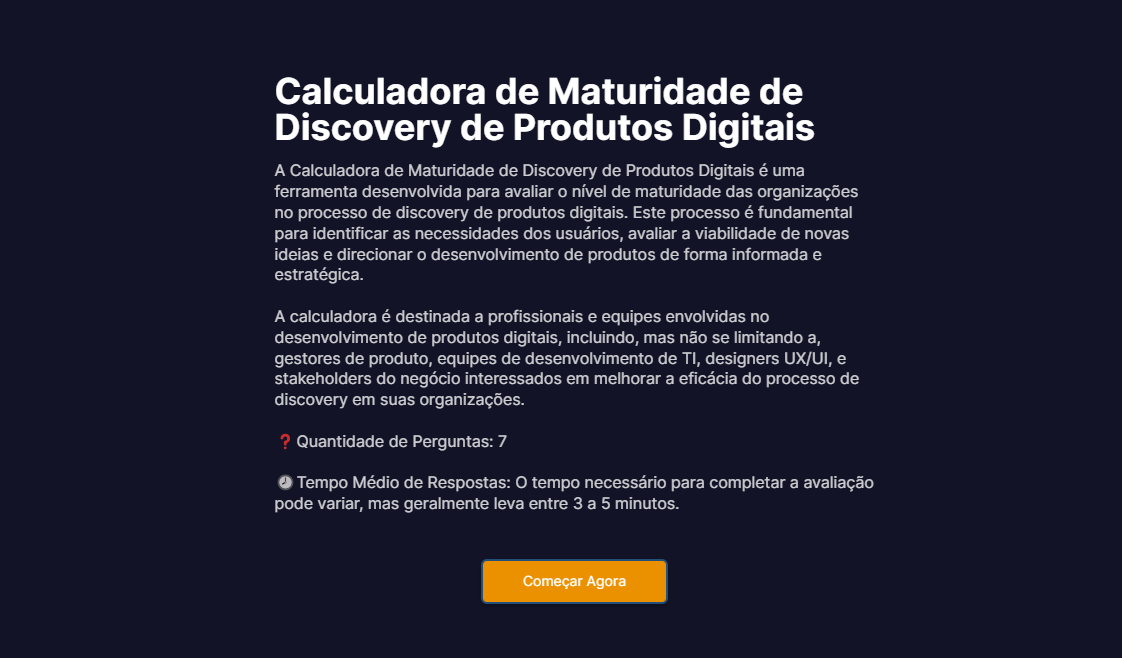
The calculator is a simple yet efficient tool designed for technology leaders across various market segments. It offers a quick analysis of the effectiveness of discovery processes in digital products. This assessment is vital to ensure that teams are aligned with end-user needs and the company’s strategic objectives.
It addresses fundamental concepts such as innovation, strategic management, data analysis, effective communication and risk management. These concepts are crucial to understand the current maturity of a company’s discovery process and identify areas with opportunities for improvement.
How the calculator is divided
The calculator consists of seven key areas and takes about 5 minutes to complete. You can try the calculator, click here!
1) Understanding and applying Discovery
Objective: Assess the level of understanding and application of the discovery process in digital products.
This sector involves a deep understanding of the discovery process, which is fundamental to identifying real user needs and aligning product development with those expectations. Effective discovery application ensures that teams not only generate innovative ideas but also validate and iterate on those ideas based on real feedback.
This reduces the risk of developing features that do not meet market demands, optimizing resources and directing development efforts more strategically.
2) Benefits and risks of Discovery
Objective: Analyze the impact of discovery on business and IT teams, as well as the risks associated with its absence.
Assessing this aspect is vital for business and technology teams to understand the impact of incorporating or neglecting this phase in the product development lifecycle. Recognizing the benefits of discovery helps justify the investment of time and resources in this stage, while understanding the risks associated with its omission can prevent market failures and usability problems.
This area highlights how a well-conducted discovery can significantly improve product relevance and customer satisfaction, while reducing costs and risks of rework and waste.
3) Time and tools used in Discovery
Objective: Examine how time is managed and which tools are used in the discovery process.
Managing “Discovery Time and Tools” is essential to ensure the effectiveness of the process. The time dedicated to discovery and the tools used can significantly influence the quality of insights obtained and the accuracy of product requirements definition.
For business and technology teams, adequately investing in time and appropriate tools means improving the understanding of user needs and increasing the probability of product success in the market. Additionally, choosing the right tools can facilitate data collection and analysis, enabling more informed and agile decision-making.
4) Stakeholder management and communication
Objective: Assess the effectiveness of stakeholder management and communication during the discovery process.
Effective communication ensures that expectations are managed and that there is a clear understanding of product objectives. For business and technology teams, this means decisions are made based on a shared vision, avoiding misalignments and ensuring the final product meets user needs and the company’s strategic objectives.
Efficient stakeholder management also helps ensure the necessary support during product development.
5) Data analysis, feedback and strategic alignment
Objective: Assess the correct use of data analysis, user feedback and alignment of discovery with business strategy.
This area of the research highlights the importance of a data-driven approach in the discovery process. For business and technology teams, this means using quantitative and qualitative data to inform product decisions, ensuring they are aligned with market needs and company objectives.
User feedback is essential to validate hypotheses and guide adjustments, while strategic alignment ensures that product development is in sync with the organization’s long-term vision and goals.
6) Innovation, execution and risk management
Objective: Measure how innovation, discovery execution and risk management are addressed.
These aspects play a critical role in the success of the discovery process and subsequent product development. For business and technology teams, focusing on innovation allows exploring new ideas and approaches, differentiating their products in the market.
Effective execution ensures that innovative ideas are transformed into viable products, while robust risk management minimizes potential setbacks and challenges. Together, these elements contribute to a more dynamic and efficient discovery process, leading to more successful and innovative products.
7) Team formation and impact assessment
Objective: Consider team formation and assessment of discovery impact and ROI.
Finally, this last section emphasizes the importance of having a diverse and skilled team, as well as the need to continuously assess the impact of discovery activities. For business and technology teams, a well-composed team is capable of bringing different perspectives and skills, enriching the discovery process.
Furthermore, continuous assessment of the impact and return on investment (ROI) of discovery helps measure process effectiveness and justify investment in future activities. This aspect is crucial to ensure that resources are allocated efficiently and that the discovery process contributes positively to the overall success of the product.
Results: Personalized recommendations
Upon completing the assessment with the Zappts Digital Product Discovery Maturity Calculator, participants receive highly personalized recommendations within the calculator itself, and subsequently by email. These recommendations are generated with the help of Zeca, a Zappts artificial intelligence agent, ensuring that each suggestion is specifically adapted to the user’s responses and context.
This innovative use of AI technology not only provides fast and relevant feedback, but also highlights the benefits of applying artificial intelligence-based solutions in business processes. The recommendations offer valuable insights on how to improve each aspect of the discovery process, from data analysis and feedback to stakeholder management and innovation. This personalized approach helps organizations identify key areas for the development and implementation of more effective strategies, thus leveraging product success and operational efficiency.

Image generated by the author using AI
Conclusion
The Zappts Digital Product Discovery Maturity Calculator is a valuable tool for technology leaders. It provides critical insights into the discovery process, but also offers personalized recommendations to improve it. Using this tool can lead to greater innovation, operational efficiency and strategic alignment — fundamental elements for success in the dynamic world of digital products.
We invite you to try the Zappts Digital Product Discovery Maturity Calculator and discover how it can transform your discovery process.
Click here and take your assessment today!
About Zappts
Since 2014 in the market, Zappts supports leading market brands such as Porto, Getnet, BTG Pactual, Cateno, Ambev, Multilaser, Ultragaz, C&A and Burger King, among others, ensuring digital experience scalability. Focused on software development, especially in Front-end, UX Design, Quality Assurance and Cloud Environment Management, it operates in the planning, management and operation of corporate digital solution development services, environment management and knowledge transfer through information technology.
We are a reference company in creating digital experiences for users, in addition to developing innovative and fast solutions, we operate in a 100% remote model, with teams distributed across more than 18 states in Brazil.

To learn more about how Zappts can help your company, click here, and talk to our specialists.
Share this article
Related articles

16 set 2026
The End of Passive SaaS: Why You’ll Pay for Outcomes, Not Seats
The traditional software pricing model based on per-user licenses (seat-based SaaS) faces an inevitable decline in 2026.

09 set 2026
The Timid Autonomy Dilemma: Why Keeping AI in a Suggestion-Only Role Is Killing Your Margins
This article analyzes the financial impact of this "timid autonomy" and advocates for an urgent shift to the "Human-on-the-loop" (HOTL) model.

02 set 2026
The "SaaSocalypse" is actually an architecture and identity crisis.
This article reverse-engineers a real-world success story (anonymized) from the financial sector, dissecting the layers of...