
The Evolution of Product Discovery: The Transformative Role of Digital Product Discovery
You are a technology leader at your company and want to explore what is most current about Product Discovery. The article explores the significant evolution in the digital product development process in the IT landscape.
15 de janeiro de 2024
Are you a technology leader at your company looking to explore the latest trends in Product Discovery? The article “The Evolution of Product Discovery: The Transformative Role of Digital Product Discovery” explores the significant evolution in digital product development within the information technology landscape. Highlighting the central role played by Product Discovery, the methodology is presented as a transformative tool for identifying business opportunities and validating ideas, while prioritizing user needs.
Throughout the article, topics such as the history behind Product Discovery, its definition and importance, the relationship between Continuous Discovery and Continuous Delivery, along with practical guidance for conducting an excellent Product Discovery are covered. The article also explores when to apply product discovery, the complementary phases of Product Discovery and Product Delivery, and the importance of Continuous Discovery and Continuous Delivery in the product lifecycle. Additionally, strategies are offered to convince leaders and teams to invest in Product Discovery, highlighting the relevance of Zappts’ specialized consulting and its proprietary methodology, Bluewave, as a valuable resource in the innovation and digital product development process.
🟠Introduction
In the dynamic IT landscape, the digital product development process has evolved considerably over the past 25 years. A crucial piece in this evolution is Product Discovery, a methodology that plays a transformative role in uncovering business opportunities and validating ideas, while prioritizing user needs.
Gathering information, identifying opportunities, and presenting solutions are common practices in product development. Therefore, establishing a Product Discovery process, as we will see, becomes crucial for delivering exactly what customers need.
🟠What is the history behind Product Discovery?
The concept of Product Discovery began gaining prominence in the early years of the 21st century, coinciding with the emergence of the Agile Manifesto. This movement drove user-centered design, promoting the creation of more precise and efficient processes. However, even today, many professionals seek to fully understand the impact of Product Discovery and the practical benefits of its application.

Agile Manifesto meeting, in February 2001 at the Snowbird resort in Utah, United States. Source.
🟠What is Product Discovery?
Product Discovery is a development approach that helps identify and validate business opportunities, taking user needs into consideration. In essence, it consists of researching valuable information and solutions for the target audience, while ensuring they are feasible and strategic for the company. The emphasis is on deeply understanding the problem before proposing solutions.
The main goal of Product Discovery is to learn quickly through scientific experimentation, validating or invalidating hypotheses. This process reduces risk, preventing the company from investing in something that holds no value for either the business or the users.
For a digital product specialist like Zappts, Product Discovery involves activities designed to answer unanswered questions, aiming to mitigate risks related to four key aspects:
- Value: Will customers adopt or use this solution?
- Usability: Will customers understand how to use this solution?
- Execution: Do we have the capability to build this solution?
- Feasibility: Is this solution viable for our business?
If you are a technology leader, designer, developer, or even a CTO or CIO, and you don’t have the answer to these questions, don’t worry! We are here to support you.
🟠What is Product Delivery?
Product Discovery and Product Delivery are complementary phases. Discovery is a stage of research and planning, where the team seeks to understand user needs. Delivery, in turn, occurs when the planned solution is built and implemented.
The idea is for teams to work with the concept of Continuous Discovery and Continuous Delivery, so that the product is constantly reviewed and improved to keep up with changes in user behavior and needs.
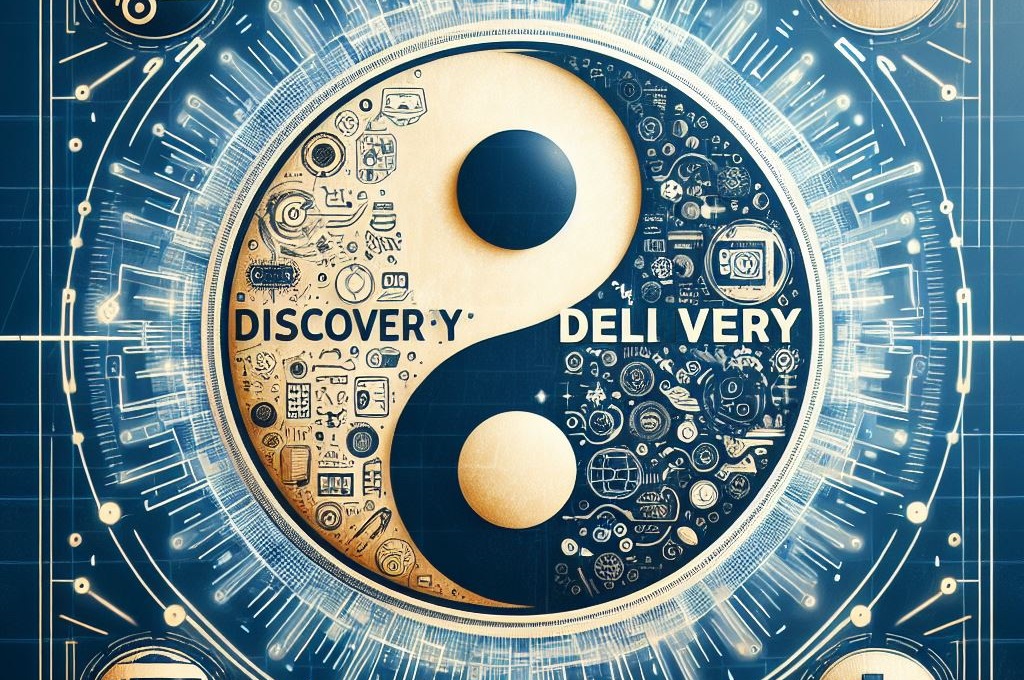
Yin-Yang Discovery X Delivery generated with AI by the author
🟠What is the importance of Continuous Discovery and Continuous Delivery?
Product Discovery and Product Delivery play fundamental roles in the product lifecycle, each contributing uniquely to the success of the company. As we discussed, Product Discovery is crucial because it involves identifying and validating business opportunities, ensuring that proposed solutions meet users’ real needs. By deeply understanding the problem before developing a solution, product teams mitigate risks related to value, usability, execution, and feasibility. This strategic phase provides a solid foundation for product development.
Product Delivery, in turn, comes into play when the execution and implementation of proposed solutions take place. This stage is essential for turning ideas into tangible products, ensuring that the vision conceived during Product Discovery becomes reality. The success of Product Delivery is closely tied to the ability to efficiently translate discoveries and decisions from the discovery phase into tangible and valuable features for users.
The relationship between Continuous Discovery and Continuous Delivery represents an integrated and agile approach to product development. In Continuous Discovery, learning and experimentation occur constantly, keeping the product team in tune with changes in user needs. This aligns with Continuous Delivery, where the continuous delivery of improvements and features happens in an iterative and fast manner. Both “Continuous” approaches ensure that the product is constantly evolving to meet the dynamic expectations of the market, providing a valuable synergy between discovery and delivery over time. This cyclical and continuous approach is essential for sustained success in today’s competitive landscape.
🟠When should you apply product discovery?
Technology leaders who do not have specialized professionals in digital product discovery frequently have this question. Product Discovery is crucial for the evolution of development and can be applied at various stages of the product lifecycle, even after its market launch, especially when introducing new features. However, it is not always necessary or appropriate.
To determine the need for Discovery, it is essential to question aspects such as:
- Is Discovery the best way to validate the idea?
- Is time and money available for execution?
- Is the perceived value of the opportunity high?
- What is the level of risk involved?
- Are the product’s objectives and benefits clear?
🟠How to conduct an excellent Product Discovery?
First, rely on professionals who have already applied Product Discovery, with the technical knowledge and practical experience needed for it. Discovering a product requires dedication and time. In practice, product teams usually follow a Continuous Discovery workflow to increase confidence in the solution before final development. This method involves continuous learning and experimentation, maintaining two parallel tracks, which we call Dual Track Agile.
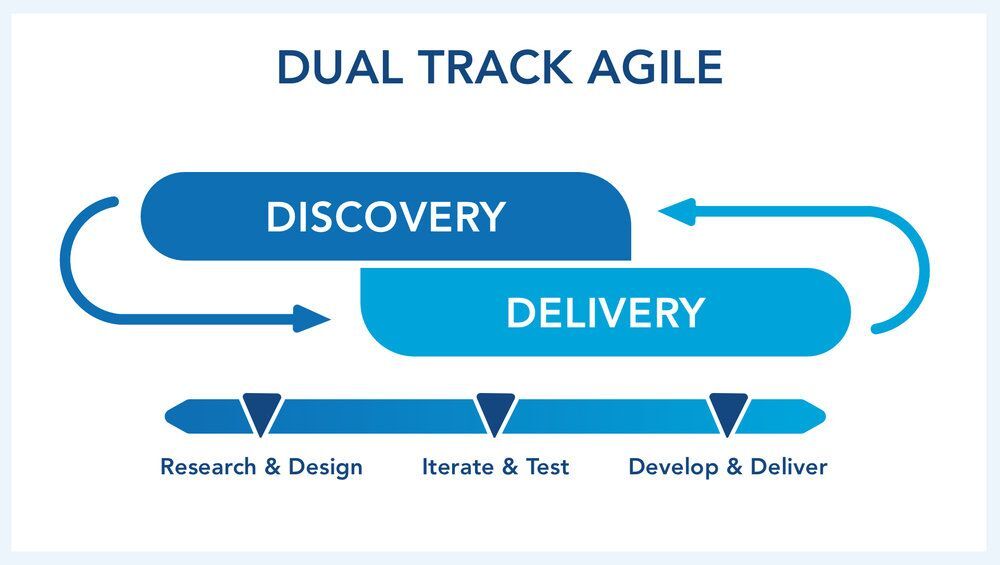
Dual Track Agile Scrum Kanban Academy
🟠1: Understanding (Research and Opportunities)
In this phase, we gather inputs from all stakeholders, evaluate the current product’s outputs (such as analytics data), and understand the expected results (Desired Outcomes). We build an opportunity map, understanding each opportunity and selecting the key bets.
It is important to highlight that developing a product involves making choices. Prioritizing one initiative may mean setting aside another due to capacity constraints, making this phase strategic and decisive for success.
🟠2: Ideation
Ideation is a process of divergence and convergence in search of solutions. This includes analyzing the competition, examining the market, establishing assumptions, creating hypotheses, and debating powerful solutions. Working with Personas, User Journey, Service Blueprint, Jobs to Be Done, and tools like Brainstorming, Value Proposition Canvas, and Product Canvas are fundamental at this stage.
🟠3: Prototyping
Ideas only become good after they are tested. Therefore, prototyping is essential for validating ideas before moving on to final development. Various tools, such as InVision, Marvel, and Zeplin, can be used to create clickable and realistic prototypes.
🟠4: Validation
This is the moment of truth. Observing and listening to real users interacting with prototypes provides valuable learning. It is the best way to understand how the product will behave even before it exists.
🟠5: Refinement
If the feedback is positive, the team can proceed with refinement. However, new investigations and adjustments may be necessary, ensuring that the discovery is aligned with the target audience’s needs.
This refinement phase includes transitioning to the final product delivery, establishing the MVP (Minimum Viable Product) and creating the roadmap. Since the process is continuous, it requires iterations to build confidence in the solution.
It is important to note that Discovery is not an exclusive Design process. The goal is to find a solution that is Usable, Valuable, Feasible, and Viable, requiring the involvement of Business, Product, and Engineering professionals.
Product Discovery is not just about usability or features — it is about risk reduction.
🟠How to convince your leaders and teams to invest in Product Discovery?
Now that you know the basic steps of Product Discovery and have an initial guide to applying the methodology, the question arises: How do I convince my peers to invest in Product Discovery? In practice, the reality varies between companies, each facing its own context, requiring adaptation and collaboration for alignment at every stage.

Some best practices and frameworks that can be incorporated into your argument, adapting them as needed, include:
🟠Train your team continuously
Beyond developing interpersonal skills, your team members need technical training. Not everyone in the company may be familiar with the concept of Product Discovery. It is essential to explain what Discovery is, using accessible language and highlighting the benefits of the process in a clear and objective way.
🟠Use established market frameworks
Various tools can contribute at different stages of Product Discovery. The choice of frameworks should consider the hypotheses raised, risks, and value proposition, adapting them according to the desired objectives. Some examples include Bluewave (Zappts’ proprietary methodology), Double Diamond Design, Personas, Benchmarking, Market Analysis, Jobs to Be Done, Design Thinking, Service Blueprint, User Research, CSD Matrix, Design Sprint, and Opportunity Solution Tree.
🟠Conduct a thorough data analysis
Data leaves no room for argument. After gathering data and insights through frameworks, it is essential to dedicate time to analyzing relevant information. A qualitative analysis of usability tests and market research is crucial for understanding the answers the team can obtain from this data.
🟠Strengthen agile culture
To successfully implement Product Discovery, it is vital to understand that the user’s perspective on the product is more significant than individual or leadership opinions. Building and strengthening agile culture eliminates personal interpretations and interests, focusing on a clear vision of the business purpose and the value to be delivered to the user.
Although implementing and strengthening this culture requires time and effort, it is possible to start gradually, reinforcing values, demonstrating results, building habits, and inspiring people to follow the same path.
🟠Ask for help and learn from the experts
Given the complexity of convincing your peers to invest in Product Discovery, an effective strategy is to seek help and learning from experts in the field. In this regard, Zappts stands out as a technology consulting firm that, since 2014, has delivered significant business results through its technical excellence and commitment to innovation.
When considering implementing Product Discovery, it is crucial to leverage Zappts’ expertise, whose proprietary methodology, Bluewave, stands out as one of the established frameworks in the market. By seeking guidance and insights from the Zappts team, it is possible to enhance the effectiveness of the process, aligning it more precisely with the desired objectives.
The consultancy, specialized in developing scalable digital experiences, has a track record of high-relevance cases across the financial, industrial, retail, services, insurance, energy, and healthcare sectors. Furthermore, Zappts demonstrates a genuine commitment to making things happen, providing not only technical solutions but also valuable support to face the specific challenges of each industry.
Therefore, when seeking help and learning, considering a partnership with Zappts not only enriches the Product Discovery process but also offers the opportunity to have a reliable partner recognized for its technical excellence and commitment to client success.
🟠About Zappts
Since 2014 in the market, Zappts supports leading brands such as Porto, Getnet, BTG Pactual, Cateno, Ambev, Multilaser, Ultragaz, C&A, and Burger King, among others, ensuring the scalability of digital experiences. With a focus on software development, especially in Front-end, UX Design, Quality Assurance, and Cloud Environment Management, the company operates in the planning, management, and operation of enterprise digital solution development services, environment management, and knowledge transfer through information technology.
We are a reference company in creating digital experiences for users. Beyond developing innovative and fast solutions, we operate in a 100% remote model, with distributed teams across more than 18 states in Brazil.
To learn more about how Zappts can help your company, click here, and talk to our specialists.
Share this article
Related articles

16 set 2026
The End of Passive SaaS: Why You’ll Pay for Outcomes, Not Seats
The traditional software pricing model based on per-user licenses (seat-based SaaS) faces an inevitable decline in 2026.

09 set 2026
The Timid Autonomy Dilemma: Why Keeping AI in a Suggestion-Only Role Is Killing Your Margins
This article analyzes the financial impact of this "timid autonomy" and advocates for an urgent shift to the "Human-on-the-loop" (HOTL) model.

02 set 2026
The "SaaSocalypse" is actually an architecture and identity crisis.
This article reverse-engineers a real-world success story (anonymized) from the financial sector, dissecting the layers of...