
The 10 Main Technology Trends for 2025
The 10 technology trends that will have the greatest impact on operations, business models, and customer experience in 2025. Autonomous agents, multimodal AI, efficient computing, AI-driven cybersecurity and much more.
21 de fevereiro de 2025
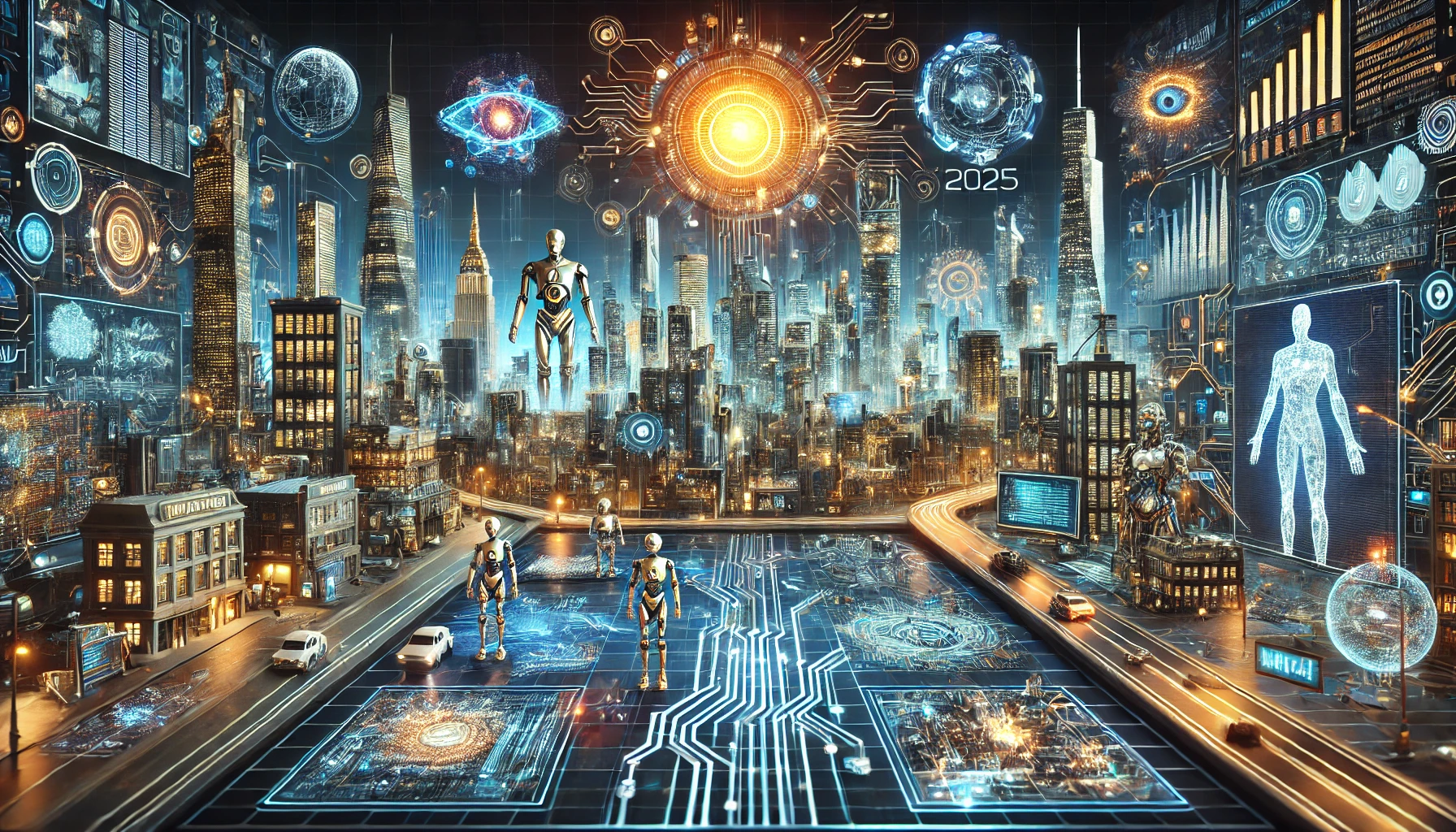
Every year, Gartner presents an overview of the main technology trends that will shape the future of business and society. In 2025, innovations will continue to evolve, driving significant transformations across multiple sectors. From the adoption of advanced AI resources to neurological expansion, each trend has the potential to revolutionize business models, create growth opportunities, and at the same time, bring regulatory and ethical challenges. In this article, you will find a complete guide on these 10 trends, including benefits, practical application examples, and how they can impact your company.
🟠1. AI Agents
Overview
AI agents are autonomous systems capable of making decisions and performing actions without the need for constant human supervision. They use advanced artificial intelligence techniques, such as machine learning and generative AI, to analyze large amounts of data, identify patterns, and execute tasks continuously. This means agents can learn from their own interactions and adapt to constantly changing scenarios.
Beyond optimizing internal processes, AI agents improve the customer experience by offering more agile and personalized services. For example, in call centers or e-commerce platforms, these agents can understand preferences, anticipate demands, and resolve issues immediately. This elevates customer satisfaction and loyalty levels.
In a corporate context, these agents can also assist in strategic decision-making, generating insights from complex data and detecting opportunities or threats before they become critical. As they continue to improve, they become an essential tool for companies seeking to increase efficiency and competitiveness.
Benefits of AI Agents
- Greater operational efficiency by automating repetitive tasks.
- Better decision-making based on predictive analyses.
- Faster and more personalized customer service.
- Continuous learning and adaptation to each user’s context or scenario.
AI Agent Use Cases
- Advanced chatbots: systems that understand natural language and can resolve service issues.
- Fraud analysis: detection of anomalous behavior in financial transactions.
- Virtual assistants: help employees with internal queries, update systems, and execute simple commands.
- Various automations: integration with CRM, ERP, and other corporate systems to streamline workflows.
🟠2. AI Governance Platforms
Overview
As artificial intelligence is adopted on a large scale, concerns arise about how to ensure transparency, ethics, and security. AI Governance Platforms were created to address these issues, allowing companies to monitor, evaluate, and adjust how their algorithms make decisions. These platforms include processes and tools to document, test, and explain how AI models work.
Another important point is the need for regulatory compliance. Various governments and regulatory bodies are developing guidelines to protect data and ensure that algorithmic decisions do not perpetuate biases and discrimination. AI governance platforms help organizations stay in line with these regulations, avoiding fines and reputational damage.
Furthermore, AI governance contributes to strengthening an organizational culture focused on responsibility and trust. By investing in governance, companies demonstrate commitment to ethical values and transparency, which can translate into a competitive advantage by赢得 the trust of consumers, partners, and investors.
Benefits of AI Governance Platforms
- Transparency in AI decision-making processes.
- Reduced regulatory risks and less exposure to legal proceedings.
- Greater trust from customers and business partners.
- Ability to quickly correct and update models with some type of bias.
AI Governance Platform Use Cases
- AI model auditing: continuous verification of performance and equity in results.
- Bias verification in recruitment: ensures that resume selection algorithms do not discriminate against candidates.
- Compliance platforms: monitoring and documentation of the entire AI lifecycle.
- Explainability tools: clearly show how each variable influences the decision.
🟠3. Disinformation Security
Overview
In today’s world, the volume of information shared on networks is growing exponentially, creating space for false or manipulated content. Disinformation Security consists of strategies and technologies that identify, analyze, and neutralize the spread of fake news, deepfakes, and other forms of malicious content.
Companies and governments have suffered significant losses due to rumors, scams, and fake news that can impact financial markets, elections, and reputations. Social platforms are also criticized for allowing the proliferation of disinformation. In this scenario, digital forensics methods and behavioral network analysis emerge as crucial allies.
Furthermore, digital education becomes fundamental. It is not enough to develop advanced systems for detecting informational fraud; it is necessary to empower users and citizens to recognize signs of manipulation and verify sources. Thus, disinformation security operates in both the technological and educational fields.
Benefits of Disinformation Security
- Real-time monitoring of informational threats.
- Protection of institutional and corporate reputation.
- Reduction of fraud, such as deepfake-based scams.
- Increased trust in verified data and news sources.
Disinformation Security Use Cases
- Social media analysis tools: detect orchestrated fake news campaigns.
- Video verification systems: identify image or audio manipulation.
- Media education strategies: empower employees and customers to recognize and report suspicious content.
- Threat monitoring: companies specializing in tracking counterfeits for brand protection.
🟠4. Post-Quantum Cryptography
Overview
Quantum computing promises to drastically accelerate processing speed, but it also poses a threat to classical cryptography methods. Post-Quantum Cryptography involves developing algorithms and protocols capable of resisting attacks conducted by quantum computers in the future.
Currently, hackers can intercept encrypted data and store it, waiting until quantum computing advances enough to break traditional keys. Thus, adopting post-quantum algorithms becomes an essential preventive measure, especially in sectors where data privacy must be maintained for decades.
Companies and governments are investing in research and testing to ensure their communications, transactions, and records are secure in the long term. The transition is not simple, but those who anticipate can avoid serious vulnerabilities in the future, preserving the integrity of critical information.
Benefits of Post-Quantum Cryptography
- Protection against potential quantum computer attacks.
- Maintenance of confidentiality in long-term critical communications.
- Early compliance with future regulatory standards.
Post-Quantum Cryptography Use Cases
- Financial institutions: ensure long-term security of transactions and client data.
- Government and defense: confidential communication between official agencies.
- Blockchain security: adoption of quantum-resistant digital signatures.
🟠5. Invisible Ambient Intelligence
Overview
Invisible Ambient Intelligence brings the idea of making environments more responsive and autonomous through sensors and algorithms that work in the background. It’s like having an “intelligent ecosystem” capable of perceiving what is happening and acting proactively, without requiring direct human intervention.
In smart buildings and cities, for example, sensors can automatically adjust lighting, temperature, and security. The goal is to increase comfort and efficiency while reducing energy and resource waste. All of this occurs invisibly for the end user, who simply enjoys a more functional environment.
Beyond comfort, ambient intelligence can also be applied in industry for machine and process monitoring, contributing to predictive maintenance and fault reduction. In healthcare, hospitals can use sensors to track equipment and patients, optimizing care routes and reducing incident risks.
Benefits of Invisible Ambient Intelligence
- Reduced operating costs through automation.
- Better user experience in environments adapted to their needs.
- Constant monitoring that prevents failures and ensures greater security.
Invisible Ambient Intelligence Use Cases
- Home automation: systems that adjust temperature and lighting based on people’s presence.
- Smart cities: traffic lights that adapt to vehicle and pedestrian flow.
- Industry 4.0: sensors that notify maintenance teams before machines break down.
🟠6. Sustainable Computing
Overview
With growing environmental concern, Sustainable Computing has gained prominence. This concept encompasses practices and technologies aimed at reducing the ecological impact of data centers and devices, from hardware design to software efficiency. The focus is on minimizing energy consumption, optimizing resources, and adopting clean sources.
Companies that adopt sustainable computing not only contribute to environmental preservation but also save in the long run. Data centers that use advanced cooling, for example, reduce energy costs. Additionally, recycling and component reuse initiatives help decrease electronic waste production.
There is also a reputational component: consumers are increasingly attentive to the environmental practices of the brands they consume. Investing in sustainability not only reduces carbon footprint but also strengthens corporate image in the eyes of partners, clients, and investors.
Benefits of Sustainable Computing
- Lower carbon footprint and conservation of natural resources.
- Reduced energy and equipment cooling costs.
- Alignment with environmental standards and certifications, improving corporate reputation.
Sustainable Computing Use Cases
- Eco-friendly data centers: advanced cooling and server optimization to reduce electricity consumption.
- Green coding: efficiency-focused software development, minimizing CPU and memory usage.
- Sustainable disposal: recycling programs for electronic equipment and batteries.
🟠7. Hybrid Computing
Overview
Hybrid Computing emerges from the need to combine different computational environments and resources — such as public cloud, private cloud, local servers, and even edge resources — to maximize performance, reduce costs, and meet specific demands. This flexible approach relies on orchestration tools that make managing multiple systems simpler.
In many cases, it is not viable or safe to put all workloads in the cloud. At the same time, keeping everything within local infrastructure can be expensive and inefficient. Hybrid computing offers the best of both worlds, allowing companies to choose the right strategy for each application.
With the evolution of virtualization and container technologies, it is possible to migrate workloads between different environments in a nearly transparent way. This ensures greater resilience and scalability, while facilitating the adoption of innovations such as AI, machine learning, and large-scale data analysis.
Benefits of Hybrid Computing
- Reduced operational costs by leveraging on-demand cloud resources.
- Greater security by keeping sensitive data on on-premise servers.
- Scalability to handle access peaks or intensive processing.
Hybrid Computing Use Cases
- Large-scale AI processing: part in the cloud to train heavy models, part locally for real-time decisions.
- Testing and development environments: quickly created in the cloud, integrated with internal systems.
- Edge computing: data collection from sensors and devices at the network “edge,” with centralized or distributed processing.
🟠8. Spatial Computing
Overview
Spatial Computing integrates augmented reality (AR), virtual reality (VR), and mixed reality (MR) to create immersive experiences that merge the digital and physical worlds. This technology goes far beyond games and entertainment: training environments, enterprise collaboration, and even engineering projects benefit from it.
With the popularization of more accessible AR and VR devices and the adoption of high-speed networks (5G, 6G), spatial computing promises to transform the way people work, learn, and communicate. It is possible, for example, to gather teams in a collaborative virtual environment where they manipulate 3D objects and simulate real scenarios.
Another area where spatial computing has gained strength is digital twins — virtual replicas of machines, buildings, or entire systems — enabling tests and optimizations without interrupting real operations. Thus, the boundary between physical and digital becomes increasingly subtle, opening doors for innovation opportunities.
Benefits of Spatial Computing
- Greater customer and employee engagement in virtual environments.
- More efficient and safe training, simulating realistic scenarios.
- Rapid 3D prototyping capability, reducing development costs.
Spatial Computing Use Cases
- Digital twins: virtual replicas of factories, buildings, or products for simulations and optimizations.
- Education and training: practical classes in virtual science labs or engineering workshops.
- Immersive retail experiences: customers “try” furniture at home via AR or visit virtual stores in VR.
🟠9. Polyfunctional Robots
Overview
Polyfunctional Robots are designed to perform multiple tasks, adapting to different contexts and needs. Unlike robots specialized in a single function, these systems feature interchangeable modules or sophisticated algorithms that allow them to learn new activities.
The shortage of specialized labor and increasing labor costs are driving the adoption of these robots in sectors such as logistics, manufacturing, and healthcare. They can operate in complex environments, from warehouses to hospitals, assisting with cargo movement, performing inspections, and even in sterilization processes.
The transformation potential is enormous: polyfunctional robots can collaborate with humans on tasks that require precision or repetitive effort, freeing teams for more strategic and creative functions. Adopting these machines also reduces accident risks and raises safety standards.
Benefits of Polyfunctional Robots
- Optimization of industrial and logistical processes.
- Reduced errors and accidents in repetitive or dangerous tasks.
- Easy adaptation to new functions and market demands.
Polyfunctional Robot Use Cases
- Warehouse robots: picking, packaging, and transportation of goods.
- Healthcare sector: surgical assistance, medication delivery, and room sterilization.
- Field services: inspection and repair in hard-to-reach locations or hostile environments.
🟠10. Neurological Expansion
Overview
Neurological Expansion represents the pinnacle of the interface between technology and biology. It involves research and devices that enable direct brain control of machines, as well as the potential enhancement of cognitive abilities. Combining neuroscience, engineering, and computing, this field aims to overcome physical barriers and take human-machine interaction to another level.
One of its most promising applications is in medical rehabilitation. Patients with motor limitations can control prosthetics and assistive devices through thought alone, regaining a degree of autonomy. Additionally, technology companies have been studying ways to improve memory or accelerate learning through brain stimulation.
The ethical and social impact is significant. Issues such as neural data privacy, manipulation risks, and unequal access to technology are widely debated. However, if developed responsibly, neurological expansion could revolutionize sectors such as healthcare, education, communications, and security.
Benefits of Neurological Expansion
- Improved quality of life for people with disabilities.
- Expansion of human cognitive abilities, reducing physical limitations.
- New forms of human-machine interaction, replacing traditional interfaces.
Neurological Expansion Use Cases
- Brain-controlled prosthetics: greater autonomy for amputated or paralyzed patients.
- Accelerated learning: neuronal stimulation that can reinforce certain skills.
- Speechless communication: technologies that capture and translate brain signals into text or commands.
🟠Conclusion
These ten technology trends identified by Gartner show how the future will be shaped by innovation, requiring companies and professionals to stay attentive to the opportunities and challenges each one brings. From strengthening sustainability practices to adopting polyfunctional robots or implementing post-quantum cryptography, all of them require strategic planning, investment in research and development, and an organizational culture open to change.
In a scenario of constant transformations, anticipating these trends can mean the difference between leading markets or falling behind. Evaluate which of these innovations align with your business objectives and needs, and plan their adoption consciously. This way, you will be better prepared to face the demands of 2025 and beyond.
🟠About Zappts
Since 2014 in the market, Zappts supports leading market brands such as Porto, Getnet, BTG Pactual, Cateno, Ambev, Multilaser, Ultragaz, C&A, and Burger King, among others, ensuring scalability of digital experiences. Focused on software development, especially in Front-end, UX Design, Quality Assurance, and Cloud Environment Management, it operates in the planning, management, and operation of corporate digital solution development services, environment management, and knowledge transfer through information technology. The company is a reference in creating digital experiences for users, in addition to developing innovative and fast solutions, operating in a 100% remote model, with teams distributed across more than 18 states in Brazil.
Contact us by clicking here and talk to our consultants.
Source: Gartner
Share this article
Related articles
16 set 2026
The End of Passive SaaS: Why You’ll Pay for Outcomes, Not Seats
The traditional software pricing model based on per-user licenses (seat-based SaaS) faces an inevitable decline in 2026.

09 set 2026
The Timid Autonomy Dilemma: Why Keeping AI in a Suggestion-Only Role Is Killing Your Margins
This article analyzes the financial impact of this "timid autonomy" and advocates for an urgent shift to the "Human-on-the-loop" (HOTL) model.

02 set 2026
The "SaaSocalypse" is actually an architecture and identity crisis.
This article reverse-engineers a real-world success story (anonymized) from the financial sector, dissecting the layers of...