Open Insurance and User Experience
Open Insurance and User Experience: how to ensure competitiveness in the market.
16 de agosto de 2022
See how Open Insurance is revolutionizing the insurance sector, and how User Experience (UX) is essential to ensure competitiveness in the Brazilian market
Context of User Experience in Open Insurance
Responsible for the interaction between an individual and a digital product, service or brand, User Experience is an essential concept in any journey, whether in physical or digital businesses.
The idea of UX encompasses the entire customer journey with a product or service, from the first contact with the brand, through consumption, and reaching post-purchase.
Therefore, the user experience, as the name itself suggests, focuses entirely on the user’s perception and usability. Intuitive digital platforms, easy to use, that make certain user behaviors simple (such as purchasing a certain product, or clicking on a certain button), are those that will have better performance and conversion.
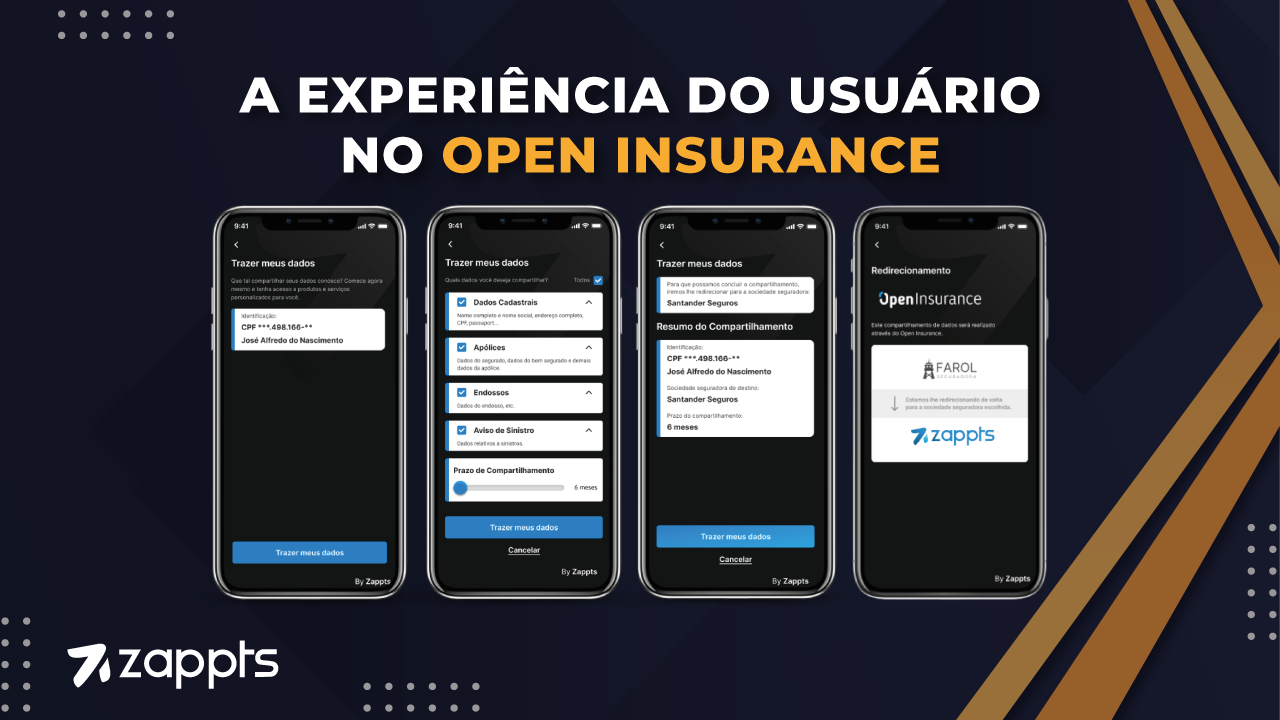
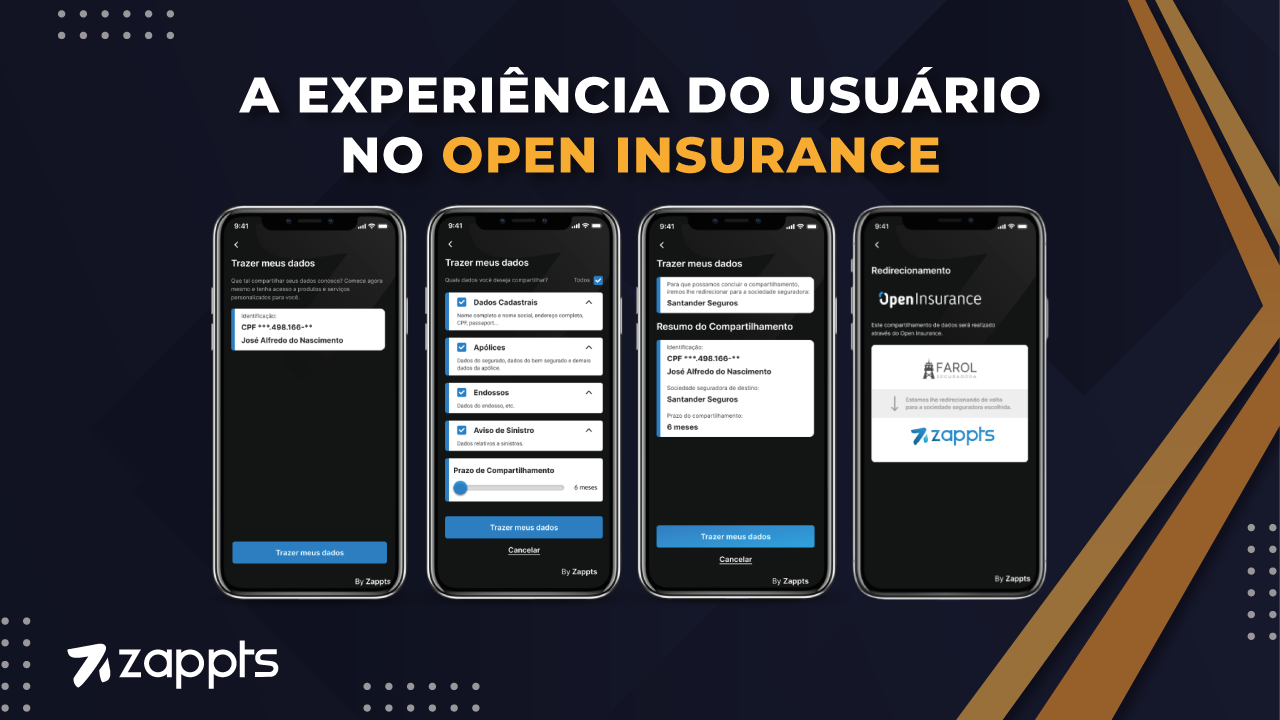
In the insurance market, and in all sectors impacted by digital transformation, concern about user experience will be increasingly relevant for achieving companies’ strategic objectives. As an example in the sector, we have the concern with the digital consent journey for data sharing in Open Insurance, the step that begins the journey of an insured person into the world of open insurance.
In the market scenario when Open Insurance innovations are implemented, the consumer will be at the center and will have greater autonomy and decision-making power, and with data sharing, insurance companies and brokers will be able to bring more advantageous offers to customers, and the more friendly and simple journey ends up inducing the client to finalize the contracting of insurance, portability, etc.
The SUSEP User Experience (UX) Guide
In May 2022, SUSEP publicly made available the User Experience Guide Open Insurance, a guide that defines the specifications regarding the customer experience within the scope of Open Insurance, for carrying out the data sharing journey in the environment. Compliance with the provisions of the guide is mandatory for participating societies.
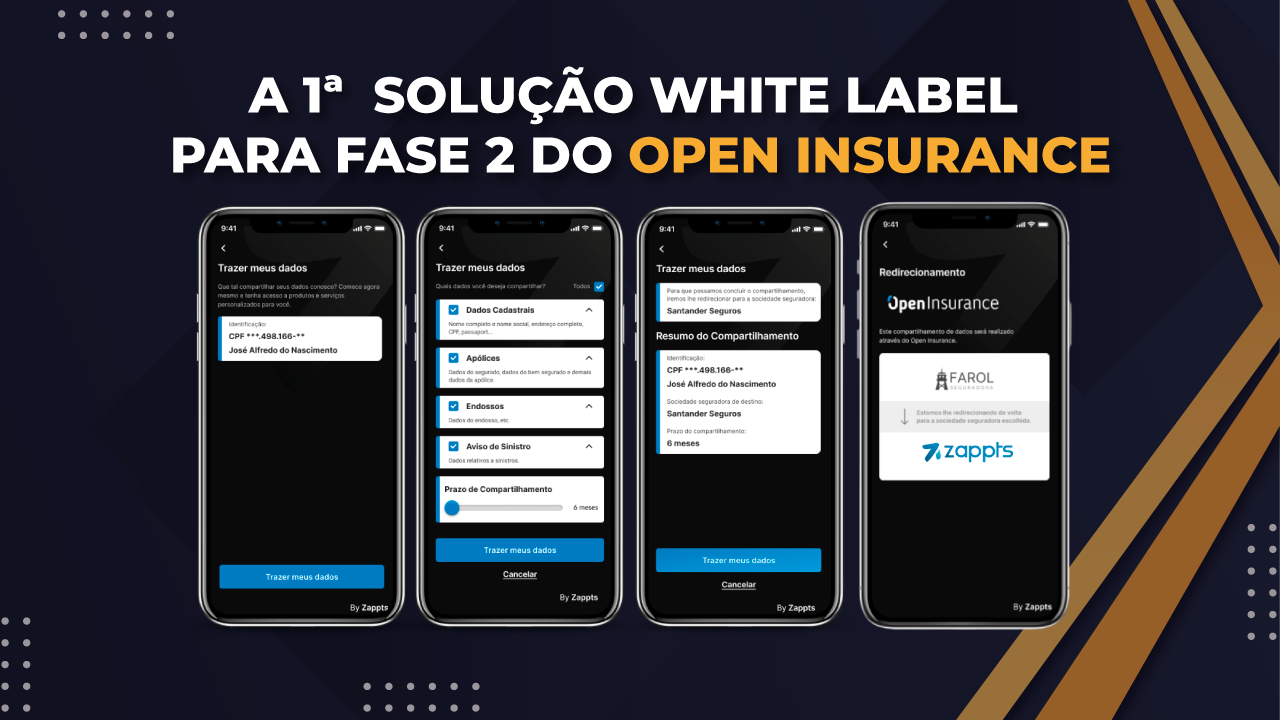
Zappts has developed a whitelabel front-end Open Insurance solution that takes into consideration all the guidelines of the SUSEP User Experience Guide, in order to support insurance companies in carrying out the adaptation and shortening of the adaptation journey to phase 2 of Open Insurance. More information about this solution can be found here and also throughout this text.

Now check out part of the content of the SUSEP Open Insurance User Experience Guide, available here.
Considering the objective of compatibility between Open Finance and Open Insurance, the SUSEP guide was built in a way to maintain a homogeneous data sharing journey, based on interoperability between the environments.
The Guide was prepared with the objective of establishing minimum criteria to ensure that the experience of customers when sharing data and services between participating societies of Open Insurance is standardized, secure, agile, precise and convenient.
The provisions of the Guide are classified as:
- Requirements: binding provisions, derived from regulatory standards, that must be followed by participating societies; and
- Recommendations: non-mandatory provisions for participating societies, but whose implementation is recommended, considering best practices for the customer experience.
The set of requirements and recommendations contained in the Guide must be followed by participating societies, however functionalities not provided for in the document will be accepted, provided they comply with the principles and guidelines of the regulations in force.
10 steps with Requirements and Recommendations were defined that make the Sharing Journey easy to understand. There are two types of journey:
- Single authority data and services sharing journey: sequence of steps of data and services sharing carried out by a single client;
- Multiple authority data and services sharing journey: sequence of steps of data and services sharing carried out by more than one client, for example, corporate policies where sharing depends on the consent of more than one representative or attorney of the company or policies with more than one insured.
Participating societies must also make available to the client, regarding the data and services sharing in which they are involved:
- Consent management environment: environment made available by participating societies in their electronic channels for clients to consult and manage consents already completed or pending, including for the purpose of revocation under the terms of the legislation.
User Journey Principles:
To ensure a good User Journey, we defined clear and objective principles that must be followed by participating societies of Open Insurance.
These Principles are based on the needs and rights of citizens as customers experiencing the different journeys presented in the SUSEP Experience Guide.
- Consumer Centered: The Open Insurance User Journey must be centered on customers’ needs, behaviors and expectations, considering that they may change over time. Interfaces only make sense if they are developed from the perspective of who will use them. If they don’t make sense for the person who is using them, the experience is compromised.
- Simple and Empowering: Interactions must be simple and intuitive, without compromising consent, control, transparency, privacy or understanding. Avoid unnecessary elements, excess text, confusing words, repetitions, too many steps or delays that may cause frustration or even abandonment.
- Accessible and Inclusive: A diverse range of people must be able to access, use and understand the Open Insurance ecosystem. The Open Insurance experience must be democratic and generate new engagement opportunities. In this way, care must be taken not to create barriers to use in its implementation, ensuring that interfaces are in accordance with Nielsen’s Heuristics, which are general rules that guide the interface construction process, aiming to ensure that different clients can use the interface without difficulties and with a positive user experience.
- Understandable: Customers must be able to understand: What information is being shared; With whom the data is being shared; What the purpose of the sharing is; When the sharing begins and ends; How they can manage the use of their data.
- Fast: The speed of interactions is one of the elements related to a good user experience and must be adequate for the customer and the journey they are carrying out. When we talk about loading speed, it is already known that just 1 second is enough to influence the customer’s perception. Waiting generates a stress and distrust response in the system’s functioning that can negatively affect the experience.
- Secure: Throughout the journey, customers must be guided regarding concerns about fraud and data privacy. Questions about use, security and data protection must be clear, both personal and transactional. It is important to build an environment of trust (in the system, in the process and in the societies) to ensure understanding, acceptance and adherence to this new service.
- Based on Current Consent: Customer consent must be current, assuming that their attitudes may change over time. It is important that they are aware that they have the right to change their decision at any time.

Usability guidelines
There are 10 Usability Guidelines that make the experience more intuitive and increase the degree of success of the regulatory objectives. These guidelines were adapted from the 10 Heuristics — processes used in day-to-day decisions with the aim of making the choice easier, faster and more intuitive — of Jakob Nielsen’s Usability.
- Step-by-step visibility: The system should always keep users informed about what is happening and what the next steps are in a clear manner.
- Accessible language: The system should speak the user’s language through words, phrases, symbols and concepts that are familiar to users beyond the interfaces.
- Freedom and autonomy: The system should speak the user’s language through words, phrases, symbols and concepts that are familiar to users beyond the interfaces.
- Consistency and standards: The experience should be clear and without difficulties for the user. Using nomenclatures, symbols and navigation flows consistently helps in understanding navigation and in executing objectives.
- Error prevention: Interfaces with clear instructions, whether through phrases, symbols and layout, enable the user to understand what may happen if they take some action erroneously. Additionally, eliminate situations that may lead to errors.
- Information clarity: The user should not have to remember information from one page to another. Instructions should be clear, as well as the option to go back to the previous page.
- Breadth and inclusion: The system should meet the needs of beginner and advanced users, allowing the more experienced to speed up the process if they wish.
- Prioritization of the necessary: Each extra piece of information on the screen competes with other relevant elements, reducing its visibility. Therefore, it is indicated not to present irrelevant or unnecessary information.
- Error visibility: Users should be able to recognize and solve problems. Error messages should be clear, indicating the problem and suggesting a solution.
- Help and guidance: Even though the ideal is for the system to be used without the need for documentation, the user may need this information. Searching for it should be an easy task, with few and clear steps.
General requirements for Sharing Journeys
The Data Sharing Journey in Open Insurance was structured based on CNSP Resolution 415, SUSEP Circular No. 635 and the Open Insurance Client Experience Manual published by Susep. Meeting the regulatory requirements defined for the guide and respecting legal aspects, a series of requirements were defined that need to be observed by all participating societies, which apply to the data sharing journey, whether carried out by multiple or a single approver.
The journey was detailed in 10 steps necessary for data sharing to take place, always initiated and consented to by the client. The steps involve the “receiving” and “transmitting” societies in data sharing. The receiving society will be the one that receives the client’s data that will be brought from the “transmitter”. The journey always begins at the receiving society.
As a prerequisite for the client to carry out the Journey, it is necessary to have login in both the transmitter and receiver. The 10 steps must be carried out through the dedicated data sharing interface in Open Insurance, exclusively through electronic channels, and must occur successively and uninterruptedly. The digital implementation, whether App or web browser (Browser), and the elaboration of the interface is the responsibility of each participating society.
The experience requirements for the applicable steps were discussed by members of the Client Experience Technical Group, and for each step in the sharing, the minimum and recommended requirements were defined, in order to guarantee a homogeneous journey among the participants of the Open Insurance environment. However, in addition to the guide’s requirements and recommendations, participating societies must observe the regulations in force for the implementation of Open Insurance.
In this way, the list of steps that make up the Sharing Journey is:
At the receiver:
- Step 1: Client identification
- Step 2: Presentation of Purpose (or Purposes)
- Step 3: Choice of Data Transmitter
- Step 4: Choice of Data and Consent Deadlines
- Step 5: Acceptance of Terms and Conditions
- Step 6: Direction to the Transmitter
At the transmitter:
- Step 7: Client Authentication
- Step 8: Confirmation [Single/Multiple Journey]
- Step 9: Client Redirection to the Receiver
At the receiver:
- Step 10: Completion (Consent Confirmation) and Presentation of Operation Receipt [Single or Multiple Authority Journey].
It is important to remember that when carrying out a multiple journey, it is necessary for other approvers with decision-making powers to consent for the sharing to be completed. The deadline for other approvers to act in the case of a multiple authority journey is 60 minutes, and the deadline for carrying out a simple authority journey is also 60 minutes, as defined by the Technology Technical Group.
These definitions may be reviewed by members of the User Experience and Technology Technical Group, through the Open Insurance Structure.

But after all, what is Open Insurance?
So, have you understood exactly what Open Insurance is? Well, through data analysis it is possible to create predictive models of almost everything imaginable, anticipating consumption behaviors, environmental crises or even elections, for example.
In this context, “open everything” was born, or “open any market segment”. According to SUSEP — Superintendência de Seguros Privados, Open Insurance, or the Open Insurance System, “is the possibility for consumers of insurance, open supplementary pension and capitalization products and services to allow the sharing of their information between different companies authorized/accredited by Susep, in a secure, agile, precise and convenient manner. To deliver these benefits to the consumer, Open Insurance operationalizes and standardizes the sharing of data and services through the opening and integration of systems, with privacy and security.”
So, based on the concept of SUSEP — an autarchy of the Brazilian Federal Public Administration, responsible for the authorization, control and supervision of insurance, open supplementary pension, capitalization and reinsurance markets in Brazil, and responsible for implementing Open Insurance in the country — we can glimpse, even if superficially, the quantity and depth of challenges for implementing such a project.
With the basic concept of Open Insurance already clear, we seek, in this article, to point out the main characteristics of this system, going through the User Experience Guide, developed by SUSEP, and the first Open Insurance Solution in Brazil, developed by Zappts, which is a whitelabel front-end that supports insurance companies in carrying out the adaptation and shortening of the adaptation journey to phase 2 of Open Insurance.
Brazil’s 1st Open Insurance Solution is from Zappts
Zappts, a technology company that develops digital solutions for major brands, announced the first Open Insurance solution in Brazil. The launch is considered the first step for insurance companies to adapt to the transition process required by the new regulation, quickly and securely, and be ready to serve their customers within the established deadline.
Zappts’ Open Insurance product is focused on the user’s digital experience journey, so that insurance companies can collect customer consent regarding data sharing. In other words, it is a product that, through the digital experience and journey, done through a responsive and customizable web application, allows shortening the adaptation journey of insurance companies in Open Insurance.
Rafael Tiba, CEO of Zappts, explains that the product was developed especially to comply with Susep CNSP Regulatory Standard No. 415/2021, which deals exclusively with Open Insurance: “We studied the regulatory standard and Open Banking experiences to bring a solution that allows the entire data sharing consent journey to be done legally, providing the end user with a simple and easy-to-use experience,” he comments.
From the launch, the end user can, at any time, simply edit which data is shared with insurance companies, thus bringing practicality and transparency to the insurer-insured relationship.
Furthermore, the Zappts solution is also 100% aligned with the new demands proposed in the General Data Protection Law (LGPD) and in the Open Insurance User Experience Guide developed by SUSEP.
So far, Zappts is the only company in the country to announce a ready-made product on this topic. Any insurance company can already verify it, including requesting its immediate use.
Rafael Tiba acknowledges that, probably, other companies may develop similar products in the coming months, but believes that Zappts has a qualified team to handle the subject: “We should see other players presenting solutions very close to ours, since we are the first to launch this in the market, it is natural, but they will hardly have all the sector know-how that we have and the Open Insurance challenges that we learned to overcome,” he highlights.
The product follows, from the beginning, the usability guidelines that ensure that insurance company customers have a good experience on the platform, as well as insurance companies can quickly adapt to the legislation.
Zappts’ motivation in creating its own Open Insurance product was to provide customers with a practical and quick implementation solution for the legislation, so that they could meet the regulation deadlines, ensuring that their users had the best digital experience with data sharing.
Rafael Tiba comments that, because the company has insurance sector clients in its portfolio and they constantly need to study about “opens” (banking, insurance, health, etc.), it was possible to develop the Open Insurance product in a short time.
To learn more about the Zappts Open Insurance solution, click here.
Phases and deadlines:

- Open Data: Insurance companies share their data
The first phase — which began in December 2021 and ended in June 2022 — was called by SUSEP as “Open Data”, a moment when insurance companies need to share data from their service channels, products and services offered to consumers.
According to information from the “Open Insurance Brasil” website, with this phase it is already possible to compare products and services from each of the companies in the insurance sector.
- Sharing of personal data: Insured share customer data
In the 2nd stage of Open Insurance — which is expected to start in September 2022 until June 2023, but everything suggests that these deadlines may possibly be extended — insurance company customers will have the possibility to share their data with other insurance companies, if it is of interest to them. Similar to banking apps, where it is possible to share data with other institutions, in Open Insurance this process will be quite similar. This will be the moment for insurance companies to watch the digital consent journey of customer data, and it is fundamental that the insurance companies’ touchpoints (websites, apps, etc.) are prepared to carry out the consent process.
With this, insurance companies will be able to offer new insurance solutions that are much more personalized than before, as they will have access to customer data, thus generating hyper-customized proposals for the public.
- Sharing of services
Once the data of insurance companies and their customers has been shared, phase 3 of Open Insurance begins — with a forecast start in December 2022 and end in June 2023.
At this moment, consumers who have given consent for data sharing will have access to insurance services and products personalized for their consumer profile. In other words, this is when Open Insurance will actually work in practice, after all, it will be when it is 100% implemented in national territory. Furthermore, with consent for data sharing, customers will be able to port their account between insurance companies.
Challenges of Open Insurance:
- Data security and protection.
The LGPD (General Data Protection Law) — law that regulates personal data processing activities (and amended articles 7 and 16 of the Civil Internet Framework) — is still in the implementation phase by companies and public institutions. Ensuring the security and protection of insurance users’ personal data will certainly be a challenge for implementing the project in the national territory. This includes, for example, ensuring that customer data is secure and only shared with consent;
- Data mapping and system integration.
If you are in the technology world, you know very well the importance of a good API and middleware services. Roughly speaking, and respecting the poetic license, systems speak different languages, store different information in different ways and in different locations. Therefore, standardizing such information and integrating systems so that all insurance companies operating in Brazil can communicate effectively are huge challenges. Data mapping is one of the great challenges for implementing this ecosystem in the country since, currently, insurance customer data is scattered across various legacy systems in each insurance company;
Remember that solutions such as the whitelabel front-end Open Insurance from Zappts support insurance companies in carrying out the adaptation and shortening of the adaptation journey to phase 2 of Open Insurance. More information about this solution can be found here.
- Meeting deadlines.
Time is indisputably the most valuable asset in the world. You cannot buy time or store it. The implementation of the Open Insurance ecosystem, according to the SUSEP website, is divided into 3 stages, each with their respective deadlines. In the first phase, called “open data”, the deadline ends in June 2022. Then we have phase 2, “sharing of personal data”, with a deadline for June 2023. Finally, we have phase 3, “services”, also with a deadline for June 2023, which would ensure that the open insurance ecosystem is completely implemented. However, there is great concern on the part of insurance companies about meeting these deadlines. The request for a change of deadline has already been made by some companies, however without success, but with the expectation that SUSEP will yield and extend the existing deadline, and it is real.
Advantages of Open Insurance:

Ok, we already understand the concept of Open Insurance, its main challenges, and also some of its benefits, both for clients and insurance companies, with the implementation of this ecosystem.
Now, we list below, in a summarized way, some of the advantages of Open Insurance for insurance consumers:
- Greater clarity about which personal information is being exposed and shared, as well as the manner in which such information is being exposed;
- The consumer will have greater autonomy when choosing (or canceling) insurance. Through a consultation panel with all insurance information, prices and conditions, the customer will have greater ease in making decisions (provided that insurance companies expose such information in the most friendly and intuitive way possible, facilitating the user experience);
- Insurance that is increasingly cheaper and of higher quality. With information transparency being one of the main pillars of Open Insurance, competition between insurance companies will increase, and consequently the fight to improve their services, brand experience and insurance values will be some of the competitive differentiators that may attract or repel customers.
Right! And for companies? What will be the advantages for insurance companies with the implementation of Open Insurance? We answer below:
- Greater competitiveness between insurance companies can also be seen as an advantage for insurance companies. Where there is competition, there is also a greater effort to improve the quality of service provided and ensure competitive differentiators that are perceived as positive by customers. Based on the insights offered by competition analysis, thanks to information transparency, insurance companies will be able to improve their products and services, in addition to reducing their costs;
- Data that become information, which in turn becomes knowledge, and when well applied, generate competitive differentiators. By studying the information released by clients, insurance companies will also be able to create new products, services and business models, expanding revenue that was previously composed only of “shelf products”;
- Less dependence on insurance brokers and physical stores. What for some may be seen as negative, for others may be seen as positive. With digitalization, the need for physical spaces decreases, and consequently the operating costs of insurance companies are also reduced. Furthermore, with a digital system focused on user experience, insurance consumers will have greater autonomy, not necessarily needing the help of insurance brokers.
Criticisms of Open Insurance:
But, like almost everything in life, we can analyze it from a more critical point of view. Below, we list some criticisms of Open Insurance raised by stakeholders impacted by this change:
- Although it shows itself favorable to the Open Insurance model, the National Confederation of Insurance Companies (CNSeg), which encompasses more than 180 companies and service providers in the segment, criticizes the deadlines and rules stipulated by SUSEP. The entity believes that the one-year interval for company adaptation is not sufficient to handle the changes in technology, systems and internal governance necessary to protect user data in the context of Open Insurance.
- As we saw earlier, there is still a gap to be filled regarding the role of insurance brokers once Open Insurance is implemented.
- Greater competitiveness, but with fewer players. Will all insurance companies, even small and medium-sized ones, have the financial and procedural capacity to implement the details of Open Insurance? Maybe not, maybe yes.
- Dependence on digital space. Unfortunately, not all people have access to information technologies, and many are not familiar with digital systems. Will Open Insurance be more inclusive or will it become increasingly exclusive?
Why is Open Insurance important?

The digitalization process in general shortens consumption journeys, optimizes the cost-benefit ratio and generates business intelligence thanks to the correct use of data. In the insurance area, it would be no different.
With the implementation of Open Insurance, the insurance area will improve the cost-benefit ratio of operations, bringing greater agility, security and transparency to the insurer-customer relationship. If signing a contract previously took about 15 days on average, in the digital environment this can take just a few hours, or even less.
Therefore, the simpler your offering process is and the better the user’s experience with the insurance company’s system, the higher the probability of conversion, that is, of a new customer.
On the other hand, the technology behind it must offer infrastructure capable of processing a very high volume of data with agility, fluidity and with fewer and fewer friction or errors.
In other words, technology will play a fundamental role in the innovation of the sector and throughout the customer’s purchase (and repurchase) journey.
Share this article
Related articles

16 set 2026
The End of Passive SaaS: Why You’ll Pay for Outcomes, Not Seats
The traditional software pricing model based on per-user licenses (seat-based SaaS) faces an inevitable decline in 2026.

09 set 2026
The Timid Autonomy Dilemma: Why Keeping AI in a Suggestion-Only Role Is Killing Your Margins
This article analyzes the financial impact of this "timid autonomy" and advocates for an urgent shift to the "Human-on-the-loop" (HOTL) model.

02 set 2026
The "SaaSocalypse" is actually an architecture and identity crisis.
This article reverse-engineers a real-world success story (anonymized) from the financial sector, dissecting the layers of...