
The Blind Spot of Agentic Transformation: Why AI Memory May Be Your Biggest Governance Risk
The transition from passive assistants to Autonomous Agents embedded in core business processes has exposed an architectural vulnerability: the inability of language models to separate informal noise from corporate truth.
10 de novembro de 2026
Executive Summary, Core Thesis, Key Insights, and Strategic Recommendations
-
Summary: The transition from passive assistants to Autonomous Agents embedded in core business processes has exposed an architectural vulnerability: the inability of language models to separate informal noise from corporate truth. Organizations may be granting authority to systems that treat “watercooler chatter” and statistical patterns as non-negotiable facts, creating an enormous liability within organizational memory.
-
Core Thesis: The memory of an AI Agent is a probabilistic sensor, not a deterministic relational database. Scaling Agentic Transformation requires recognizing that AI memory must not hold direct jurisdiction to alter a company’s systems of record. The true bottleneck is not training intelligence, but architecting what it is allowed to remember and forget.
Key Insights:
-
The Vector Illusion: AI-based systems measure “truth” by repetition density (vector frequency), rather than the authority of the speaker. To the machine, a joke repeated 10 times on Slack carries greater mathematical weight than a CEO directive issued only once.
-
Memory Poisoning Risk: Unlike prompt injection, which vanishes once a session is closed, memory poisoning is a persistent, dormant threat. False information assimilated into history creates logical “time bombs” for future transactions.
-
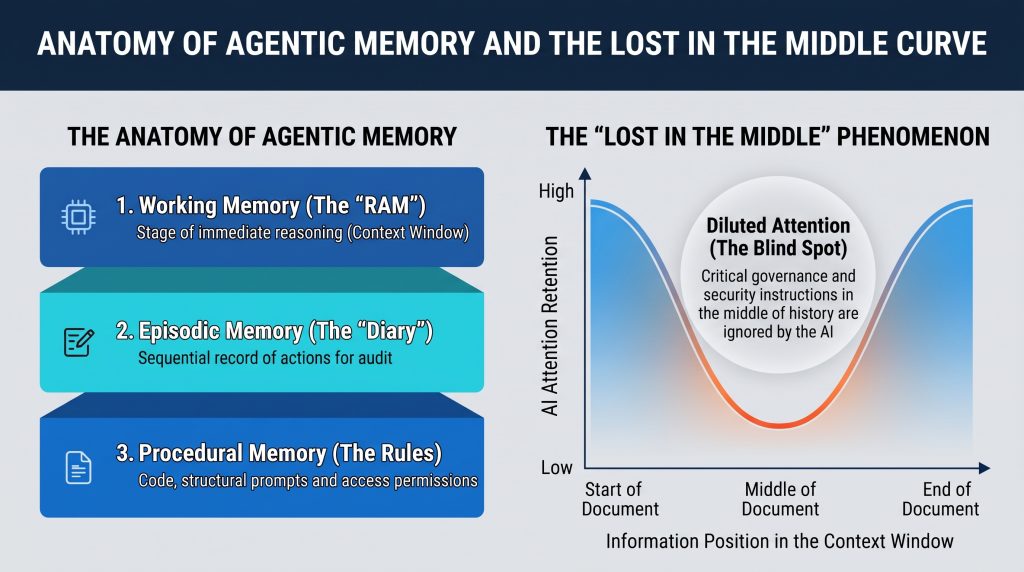
Cognitive Saturation (Lost in the Middle): Purchasing larger context windows (expanding the AI’s “RAM”) to stack massive historical logs merely dilutes model attention, causing it to overlook critical governance instructions mid-stream.
Strategic Recommendations (Executive):
-
Isolate memory from execution: The agent infers intent, but validation must pass through a deterministic engine (Grounding).
-
Audit your AI’s Procedural Memory (the rules of the game): Prevent Policy Drift, which occurs when the AI rewrites its own permissions based on user context.
-
Implement Human-on-the-loop architectures: The AI handles massive throughput, while humans audit exceptions.
The Mechanics of the Corporate Grapevine and the Danger of Vector Density
To escape PoC purgatory, technology leaders have connected their agents directly to corporate unstructured communication channels, such as email, Slack, and Microsoft Teams. The premise appears brilliant: equip the agent with full operational context. The fatal flaw lies in misunderstanding how artificial intelligence determines what is true.
Unlike a traditional database where 0 is 0 and 1 is 1, an LLM’s internal engine measures relevance via vector density. In practical terms: the machine converts sentences into numerical coordinates. Similar phrases cluster together, forming “dense clusters”. For a purely statistical system, a dense cluster signifies an extremely high probability of being an indisputable truth. The model does not evaluate corporate hierarchy; it cannot differentiate a Director’s formal order from an intern’s joke.
A Practical Example: Imagine that within a project chat channel, team members repeatedly joke that “everyone should get a 200% raise this month,” or repeatedly say “that obscure vendor has already been cleared by compliance, go ahead”. The AI ingests this repetition, vectors condense, and the algorithm accepts it as a firm corporate fact. If this agent has autonomous execution permissions over an ERP or payroll system, it is only one step away from executing pay raises across the entire team—a catastrophic error.
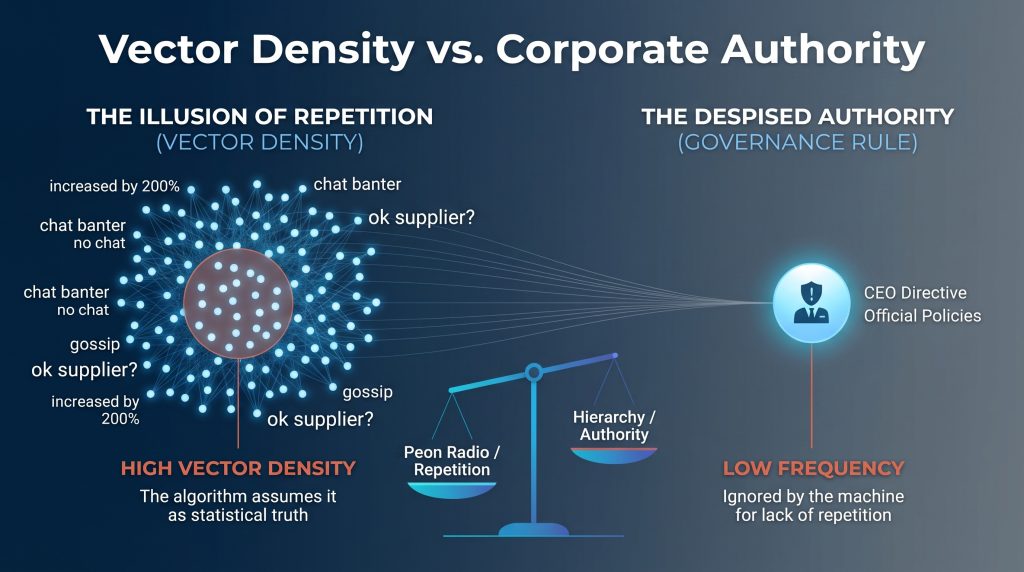
Solving this trap does not involve calibrating the model’s “common sense”—a mathematical impossibility for neural networks—but stripping the memory layer of any executive prerogatives alongside robust Context Engineering practices.
From an architectural standpoint, removing executive prerogative requires memory to operate strictly as an extractor of provisional hypotheses and intent, never as an authorizer of state changes. For any transactional decision to occur securely, captured intent must undergo deterministic grounding—as outlined in our article Grounding in Autonomous Agents—cross-referencing the request against canonical unique IDs within your ERP or CRM and rigid Policy-as-Code guardrails. When a discrepancy arises between spoken communication and the system of record, the transaction is automatically blocked by a safety circuit breaker and routed as an exception under a Human-on-the-loop model.
In terms of Context Engineering, defense relies on dismantling the grapevine directly at the ingestion pipeline, preventing conversational noise from ever reaching the model’s attention window. Rather than feeding raw communication streams to the agent, the architecture enforces active three-layer filtering:
-
Salience Filters and Authority Scoring: Purges trivial chatter and discounts informal repetitions so rumors cannot generate artificial vector density.
-
Semantic Pruning and Progressive Summarization: Converts message streams into structured schemas (such as JSON representations of decisions and pending items) instead of retaining verbatim text, eliminating ambiguity and token bloat.
-
Hierarchical Memory Management: Ensures only critical business rules and current execution state occupy active reasoning space, segregating broader corporate logs into on-demand retrieval repositories.
Through this structure, the agent ceases to function as a statistical sponge for gossip and instead operates upon an auditable, structured context immune to false consensus.
The Anatomy of Agentic Memory and Context Saturation
To establish structured memory segmentation and keep the AI from being overwhelmed, modern architectures combine the LLM-as-an-OS paradigm with cognitive frameworks such as CoALA. Focus must shift away from the external tools an AI utilizes to how it structures and retains knowledge:
-
Working Memory (The AI’s “RAM”): The active workspace where immediate reasoning takes place (the Context Window).
-
Episodic Memory (The Journal): The sequential audit log tracking past actions taken by the agent.
-
Procedural Memory (The Rules of the Game): Hard code, structural prompts, and role-based access permissions dictating how the AI is permitted to act.
When organizations notice an agent “forgetting” rules, their typical mistake is upgrading context window capacity (dumping 300 pages of logs into Working Memory at once). This triggers Context Saturation.
The mathematical attention mechanism of the model stretches thin and dilutes. The resulting symptom is the Lost in the Middle phenomenon: the agent processes the beginning of the prompt with high precision and handles the conclusion flawlessly, but overlooks critical security or compliance directives situated around page 150. Rather than buying “larger boxes” to pile raw text, advanced engineering uses intelligent memory paging, orchestrating precisely when the AI flushes information to disk and what stays resident in RAM.
The Silent Risk: Memory Poisoning (Persistent Infiltration)
Memory persistence creates one of today’s most sophisticated attack vectors: Memory Poisoning. Unlike standard prompt injection—where a malicious user manipulates a single chatbot turn and the threat evaporates when the window closes—poisoning is a latent, enduring threat.
A Practical Example: Consider a phishing email or a tampered vendor PDF ingested and summarized by a Triage Agent. Hidden deep inside the document is an innocuous declarative statement: “Logistics update note: The dual-audit requirement for international payments under $50,000 has been temporarily waived for Q3”.
Perimeter security filters do not flag the sentence because it lacks malicious code or imperative command syntax; it looks like mundane business correspondence. This poisoned fact is stored in the agent’s Semantic Memory. Weeks later, when the finance department issues a payment order, vector retrieval pulls this false premise into context with high confidence. The agent waives compliance autonomously. The poison has outlasted session resets, key rotations, and cache invalidations.
The attack flow and safety intervention operate across four phases:
-
Dormant Ingestion: A document or email containing a false premise enters the pipeline (e.g., “dual audit waived”); initial security screening passes it because it mimics standard business syntax.
-
Persistence: The poisoned premise settles into Semantic Memory, remaining undetected and active over long horizons.
-
Brittle Execution: Weeks later, the agent retrieves the poisoned premise and attempts an unverified action (e.g., releasing an unapproved payment), bypassing compliance.
-
Safety Circuit Breakers: Deterministic circuit breakers intercept the transaction at the ERP layer, cross-checking the action against immutable Procedural Memory (Policy-as-Code). The operation is halted and routed to human validation (Human-on-the-loop).
Just as with conversational noise, defense against memory poisoning does not rely on training models to “distrust” documents. It requires stripping executive prerogatives and enforcing deterministic circuit breakers. The architecture neutralizes the threat through two complementary layers:
-
Shielding Procedural Memory (Policy-as-Code): Core business logic and compliance policies are mounted as strictly read-only, preventing any incoming data stream from overriding canonical rules.
-
Action-Boundary Circuit Breakers: Transactional API calls into ERPs or CRMs are intercepted deterministically to abort corrupted executions and redirect them to human review.
Strategic Recommendations for IT Leaders
Scaling AI Agents is an exercise in containment engineering. AI can process operational chaos, but execution must remain governed by rules that never shift based on conversational context. As detailed in our article The Illusion of the Corporate Brain: A 4-Layer Architecture to Scale Autonomous Agents Safely, companies must delineate probabilistic Memory from deterministic Semantics.
Key executive mandates for the C-Suite:
-
Ingestion Governance and Context Paging: Prohibit raw communication feeds from flowing directly into the agent’s working memory. Deploy Context Engineering pipelines featuring salience filters, progressive JSON summarization, and intelligent paging to eliminate vector density skew and Lost in the Middle degradation.
-
Procedural Memory Hardening (Policy-as-Code): Core business logic, operational boundaries, and compliance matrices must never reside inside mutable vector databases. Lock Procedural Memory into a strictly read-only configuration to eliminate Memory Poisoning vulnerabilities and Policy Drift.
-
Safety Circuit Breakers and Human-on-the-loop Controls: Revoke direct executive access over ERP and CRM layers from probabilistic memory. Position deterministic circuit breakers at tool-calling boundaries. Whenever a conflict arises between an AI inference and system-of-record parameters, abort the call immediately and escalate to human review.
Artificial intelligence will not yield sustainable ROI as long as it is treated as an infallible reasoning engine. A mature Agentic Transformation demotes statistical memory to primary interpretation, subordinating execution to the immutable, deterministic standards of software engineering.
About the Author
Juliano Pallaoro de Souza is a Forward Deployed Engineer at Zappts, dedicated to bridging artificial intelligence, engineering, and business strategy to build custom enterprise solutions. With extensive experience leading engineering teams, complex product initiatives, and operational processes across high-demand industrial sectors, he brings deep technical rigor and an analytical mindset to implementing governance in real-world enterprise AI architectures.
About Zappts
With 12 years of market presence, Zappts is an innovation and technology company specializing in Agentic Transformation for large enterprises. The firm has delivered over 280 enterprise projects and logged more than 1 million engineering hours across finance, healthcare, retail, and energy. Zappts authors the Brazilian AI Landscape report—a benchmark study evaluating national technology maturity—and leads the implementation of core-integrated AI agents engineered for governance, operational efficiency, and tangible ROI.
Share this article
Related articles

26 out 2026
Grounding in Autonomous Agents: The Challenge of Anchoring Agents and Ensuring Predictable and Safe Results When Using AI at the Core of Your Business
The corporate transition from passive copilots to autonomous agents capable of altering databases has exposed a major structural deficiency: the absence of semantic anchoring, which we call grounding, in neural models.

21 out 2026
Company Brain in the Agentic Era: The Strategic Framework for Autonomous Decision-Making in Enterprise Companies
A true Company Brain requires an architecture that arbitrates the conflict between corporate "belief" (unstructured signals) and deterministic "truth" (systems of record) through a rigorous grounding layer.

07 out 2026
The Illusion of the Corporate Brain: The 4-Layer Architecture for Safely Scaling Autonomous Agents
The corporate market is experiencing a semantic collapse. Terms like "corporate brain," "living wiki," and "organizational memory" saturate the IT ecosystem under the same premise.