
The Illusion of the Corporate Brain: The 4-Layer Architecture for Safely Scaling Autonomous Agents
The corporate market is experiencing a semantic collapse. Terms like "corporate brain," "living wiki," and "organizational memory" saturate the IT ecosystem under the same premise.
7 de outubro de 2026
The corporate market is experiencing a semantic collapse. Terms like “corporate brain,” “living wiki,” and “organizational memory” saturate the IT ecosystem under the same premise: unifying the company’s intellectual capital for consumption via Artificial Intelligence. The problem lies in execution. Most of these initiatives deliver only reactive chatbots that summarize documents.
An assistant that answers questions based on loose texts (RAG) is a convenience. A system trusted by C-Level leadership to issue invoices, recalculate routes, or orchestrate processes without manual intervention is a mission-critical asset. To exit the purgatory of PoCs and advance toward Agentic Transformation, the organization does not need a more powerful AI model; it needs a deterministic data architecture divided into four functional layers.
Key Insights
-
The Risk of Ungoverned Action: Extracting information from unstructured bases is trivial. Authorizing an AI Agent to execute a financial transaction based on that information requires governance. The error evolves from a poorly formatted response to a loss on the balance sheet.
-
Step-by-Step Technological Maturity: Adoption evolved from keyword-based search to summarization via RAG. The next mandatory step is corporate ontology: connecting people, processes, and contracts into traceable knowledge graphs.
-
Reliability via Separation of Roles: A true Company Brain structurally separates interpretation from validation. The AI that suggests does not hold final decision-making power. The official system of record acts as the unquestionable referee.
-
Disagreements as a Governance Trigger: When the intent extracted from an interaction collides with the canonical record, the system does not hallucinate a resolution. It halts the autonomous flow and triggers the Human-on-the-loop layer, ensuring human intervention occurs only in exceptions.
The 4-Layer Framework for Autonomous Agents
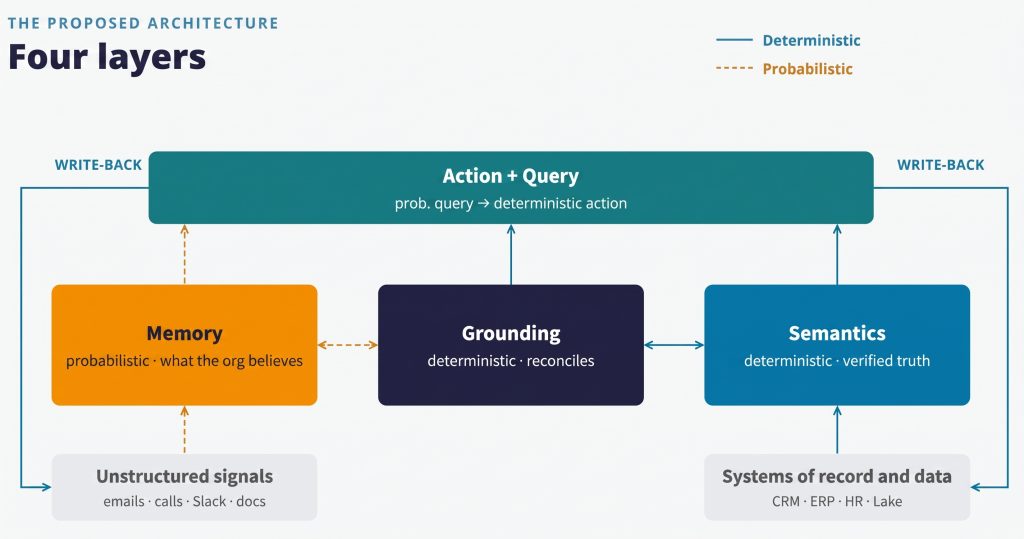
1. Memory (Cognitive Context)
This is the unstructured ingestion layer (emails, transcripts, PDFs, and messages). It is the domain of traditional RAG or “living memory” techniques. Memory identifies intents and captures organic operational signals, but operates in the realm of probabilities. It suggests context, but never holds execution authority.
2. Semantics (Corporate Ontology)
Where the company consolidates its factual baseline. In this layer, entities have unique identifiers (IDs) and mapped relationships. This is not about loose files, but a knowledge graph where an employee is mathematically linked to a cost center and a client. When an AI Agent requires deterministic precision, queries invariably occur here.
3. Grounding (Governance Engine)
The transactional referee. This layer confronts Memory’s probabilistic intents with Semantics’ immutable facts. In case of congruence, the operation proceeds. In case of discrepancy (e.g., an email mentions a R$ 50k contract, but the official system indicates R$ 40k), semantics prevails, and Grounding triggers an inconsistency alert for human audit.
4. Action (Agentic Transformation)
The execution environment. Here, orchestrators trigger autonomous agents to execute write-backs, queries, or systemic issuance. The Agent consumes Memory to understand the objective, but only alters the state of corporate systems based on Grounding’s approval.
Architecture in Motion: Resolving Operational Conflicts
On Tuesday, September 23, an internal communication channel mentions that employee Carlos will go on vacation and will need coverage for “Client X”. The team’s visual board supports this statement. However, the company’s official ERP system (Semantic Layer) records that registration number Z1234 (Carlos) was relocated to “Client Y” on September 9.
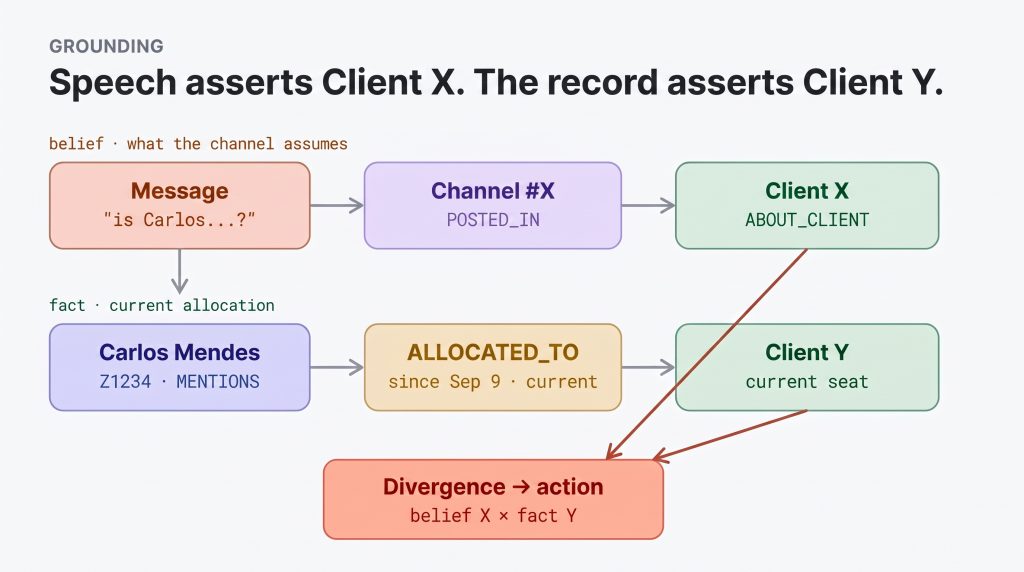
The Grounding Engine intercepts the anomaly: textual extraction assumes “Client X”, but canonical identity points to “Client Y”. The divergence prevents blind execution. The Autonomous Agent does not alter records precipitately. Instead, it proposes a correction in the channel: “Carlos’s (Z1234) current allocation is at Client Y. Would you like me to update the outdated management board and notify those responsible?”. Upon manager approval (Human-on-the-loop), the Agent executes the necessary write-backs in the source systems. This is governance applied to autonomy.
Strategic Recommendations
-
Abandon the Chatbot Illusion: If your AI architecture lacks bidirectional connectors to safely alter system state, you have built an expensive search tool, not an Agentic Transformation asset for your business.
-
Prioritize the Semantic Layer: Before instantiating orchestrator agents, consolidate your data graphs. Without unique identity and clear sources of truth, autonomy accelerates error.
-
Institute Human-on-the-loop: Replace manual approval of all tasks with management by exception. Human capital should act as a supervisor of operational anomalies, freeing agents to absorb transactional volume.
About the Author
Rodrigo Bornholdt is Co-founder and Chief Technology Officer at Zappts, specializing in Software Architecture and Artificial Intelligence, with solid experience in leading technology teams, developing complex systems, and applying innovation to business strategies.
About Zappts
With 12 years of experience, Zappts is a technology and innovation company that is a reference in Agentic Transformation for large corporations. The company has accumulated over 280 executed projects and 1 million engineering hours for sectors such as finance, healthcare, retail, and energy. It is the creator of the AI Panorama in Brazil, research that maps national technological maturity, and a reference in implementing AI agents integrated into the core business with a focus on governance, ROI, and operational efficiency. Click here to learn more.
Share this article
Related articles

16 set 2026
The End of Passive SaaS: Why You’ll Pay for Outcomes, Not Seats
The traditional software pricing model based on per-user licenses (seat-based SaaS) faces an inevitable decline in 2026.

09 set 2026
The Timid Autonomy Dilemma: Why Keeping AI in a Suggestion-Only Role Is Killing Your Margins
This article analyzes the financial impact of this "timid autonomy" and advocates for an urgent shift to the "Human-on-the-loop" (HOTL) model.

02 set 2026
The "SaaSocalypse" is actually an architecture and identity crisis.
This article reverse-engineers a real-world success story (anonymized) from the financial sector, dissecting the layers of...